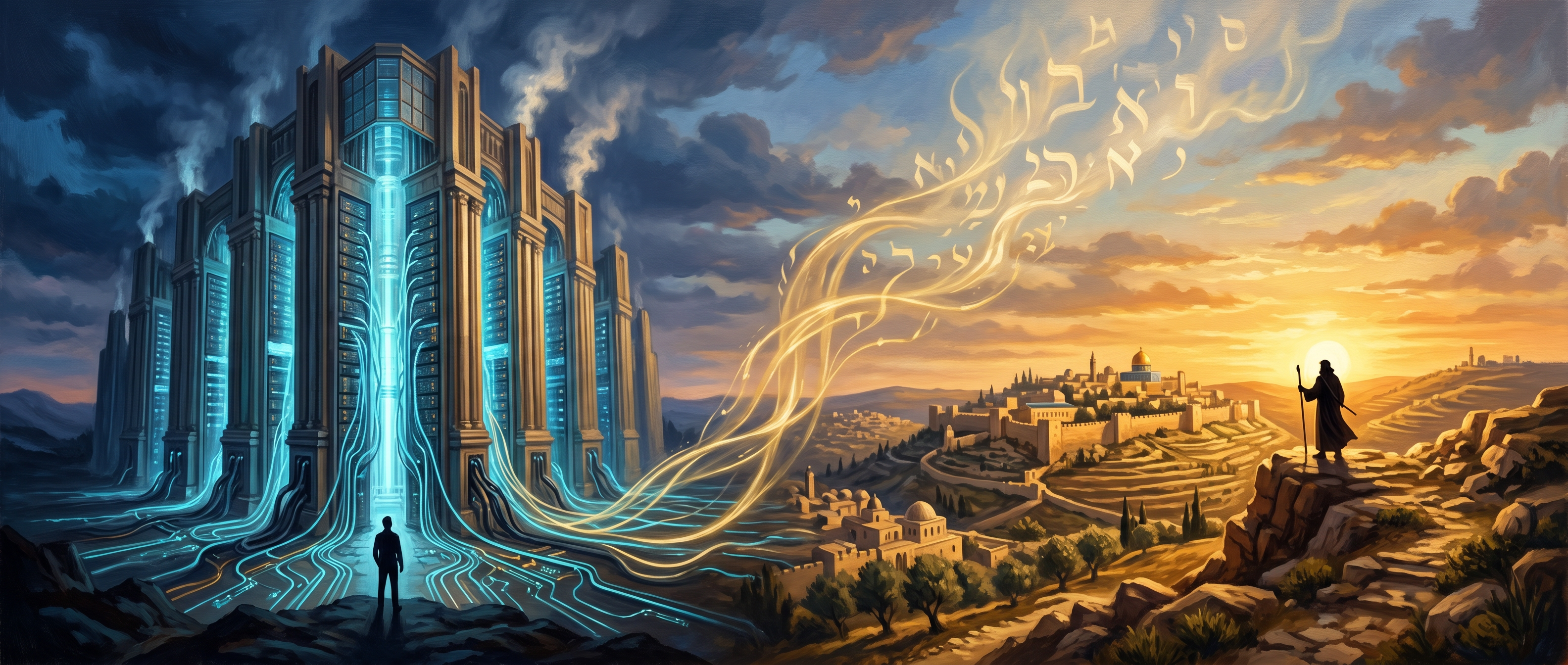
Suppose the machine gives us almost everything.
The most interesting thing Elon Musk said about artificial intelligence was not that it might take every job. It was what he said would remain afterward: the question of meaning.
That admission should stop us. The people building the most powerful systems in the world have unusually concrete ideas about what abundance might look like. Intelligence becomes cheap. Energy becomes plentiful. Robots do the work. Medicine advances by decades in a few years. Goods and services cease to be scarce. Then the economic problem recedes and the human problem comes fully into view.
What is a person for when usefulness is no longer required?
There is an older literature about that world. Isaiah saw nations beating swords into plowshares. Jeremiah saw Torah written on the heart. Ezekiel saw the heart of stone replaced by a heart of flesh. Maimonides imagined an age with no famine or war, when the occupation of the world would be to know God. Read beside the promises coming from the AI labs, these texts can sound uncannily current.
The resemblance is easy to overstate. The prophets were not forecasting datacenters, and the engineers are not announcing redemption. One speaks in the language of covenant and moral repair. The other speaks in the language of capability, productivity, and scale. They share several hoped-for outcomes, but they disagree about what causes those outcomes and what makes them good.
This essay began as a comparison between two visions of the future. The comparison became less interesting than the gap inside it. AI might help build a world with less sickness, less compulsory labor, and more material plenty. It cannot tell us what deserves to be wanted once we get there. The prophets believed that question had to be answered first.
If abundance arrives before we know what abundance is for, what exactly will have been solved?The live question
Their promise is more serious than the caricature.
It is tempting to treat technological prophecy as marketing. Sometimes it is. People raising capital have reasons to describe their products as history. Timelines slip, benchmarks flatter the systems being measured, and every forecast about general intelligence contains assumptions no one can yet test.
But dismissing the whole vision would be lazy. The claims are specific enough to examine, and the people making them have seen systems the rest of us encounter only later.
In his June 2025 essay The Gentle Singularity, Sam Altman wrote that humanity was close to building digital superintelligence. His sequence was concrete: agents doing cognitive work, systems producing scientific insight, robots acting in the physical world. Then came the larger promise. In the 2030s, he wrote, intelligence and energy would become "wildly abundant." With enough of both, and with good governance, "we can theoretically have anything else."
"In the 2030s, intelligence and energy... are going to become wildly abundant. With abundant intelligence and energy (and good governance), we can theoretically have anything else."Sam Altman, The Gentle Singularity, June 2025
Dario Amodei makes the medical version of the case in Machines of Loving Grace. He imagines powerful AI as "a country of geniuses in a datacenter" and predicts a "compressed 21st century": fifty to one hundred years of biological progress packed into five to ten. His list includes preventing or treating most infectious disease, many cancers, Alzheimer's disease, and genetic illness, along with a major extension of healthy life.
These are forecasts, not facts. The mechanism is plausible, but the speed is uncertain. Intelligence may accelerate discovery without accelerating clinical trials, manufacturing, regulation, or distribution at the same rate. A cure that exists only for people who can afford it is not the end of disease. Abundant output is not the same thing as just allocation. The engineers know this, which is why Altman puts "good governance" inside the promise. Those two words carry more weight than the sentence admits.
Musk states the destination most bluntly. At VivaTech in 2024, he described a benign scenario in which machines outperform people at nearly every job, goods and services are no longer scarce, and some form of universal high income replaces wages. Then he named what automation cannot settle: "The question will really be one of meaning." He suggested that perhaps humans would give AI meaning.
That answer reverses the usual fear. The deepest problem may not be that machines become too much like us. It may be that they reveal how little we have said about what we are. An economy can assign a price to labor. It cannot assign a purpose to the person who no longer needs to sell it.
Their future begins inside the human being.
The Hebrew prophets do not offer a technical plan. They offer images: nations walking to Jerusalem to learn, weapons remade as farm tools, predators at peace with prey, law no longer written only on stone, a new heart placed inside the human person.
That difference in genre matters. Prophecy is not a startup roadmap with a poetic interface. Its images make moral claims. Isaiah does not merely imagine a world in which war has become expensive or unnecessary. He imagines nations submitting themselves to judgment and instruction.
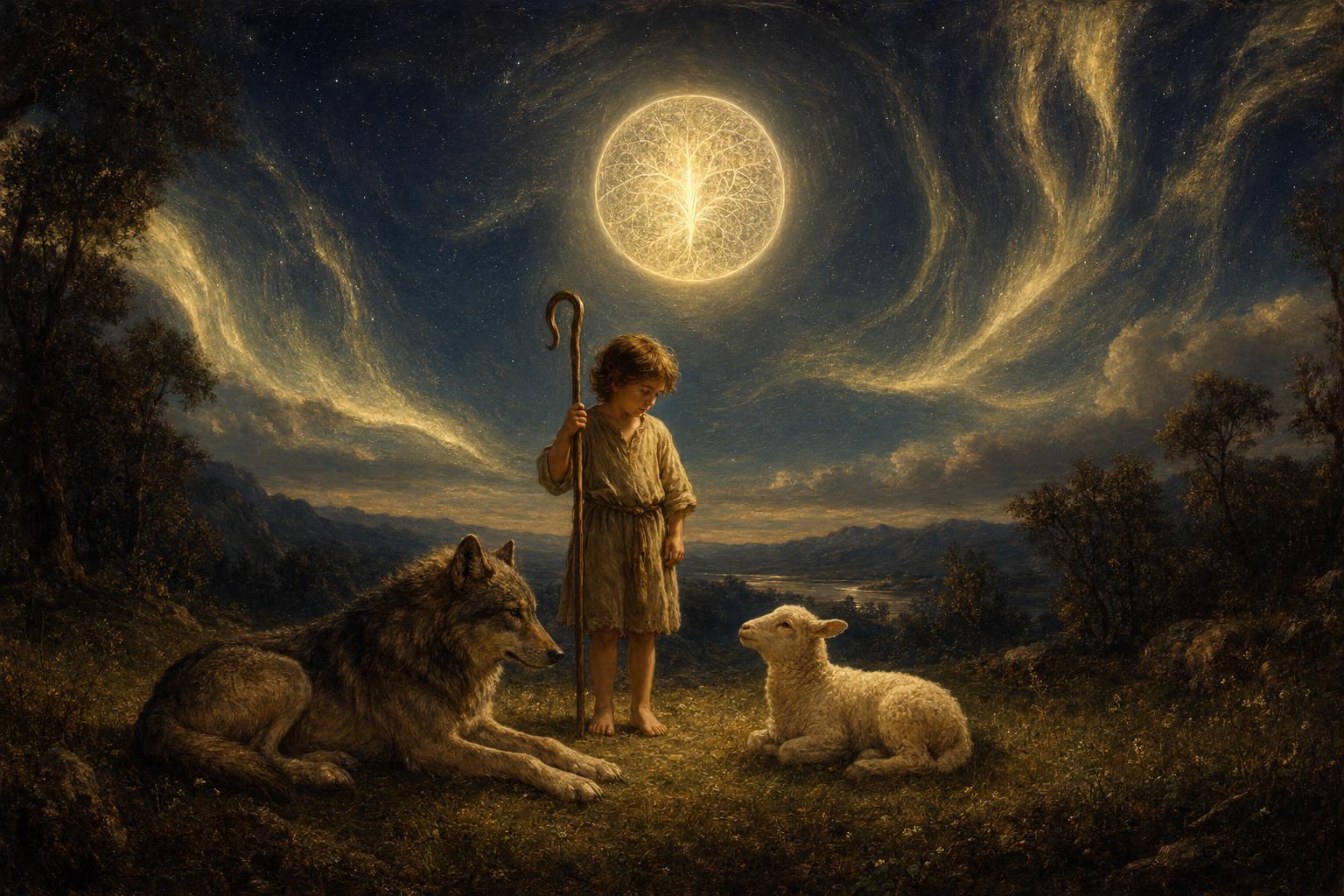
In chapter eleven, Isaiah gives the reason the peaceable kingdom becomes possible. The earth is filled with da'at Hashem, knowledge of God, "as the waters cover the sea." The image is total immersion. This is not knowledge stored in a library or retrieved from a model. It is a way of seeing that changes how creatures inhabit the world.
Jeremiah moves that knowledge inward. Torah will be written on the heart, and no one will need to tell another person to know God because "they shall all know Me." Ezekiel makes the change almost anatomical: the heart of stone is removed and replaced with a heart of flesh.
Maimonides later strips away any excuse to read the wolf and lamb as zoology. He treats the image as a parable, while keeping the substance of the vision: no famine, no war, no envy, and a world devoted to knowing God. The shortage being overcome is not only a shortage of goods. It is a shortage of understanding.
"In that era, there will be neither famine nor war, envy nor competition... The occupation of the entire world will be solely to know God."Maimonides, Mishneh Torah, Kings and Wars 12:5
The prophetic future is therefore hard to reduce to a list of benefits. Peace is bound to judgment. Plenty is bound to the end of envy. Knowledge is bound to the heart. The future is good because the people inside it have become capable of goodness.
The comparison becomes stranger when you look at the clock.
There is one more fact without which the resemblance remains incomplete. We are not making this comparison in some random century. It is the Hebrew year 5786.
The Talmud in Sanhedrin records a tradition that places ordinary history inside a six-thousand-year frame: two thousand years of tohu, two thousand years of Torah, and two thousand years called yemot ha-Mashiach, the days of the Messiah. On the same page, Rav Ketina speaks of six millennia followed by a seventh in which the ordinary order is suspended. The Gemara explains the pattern through Shabbat and the sabbatical year, calling the future rest a day entirely Shabbat.
In that scheme, yemot ha-Mashiach is not one date at the end. It is the final third of the frame. We are not waiting to enter the period. We are living very late inside it.
This is not a countdown clock. The same passage acknowledges that centuries designated for messianic possibility have already passed, and the rabbinic tradition repeatedly warns against confident date-setting. Moshiach can come before the year 6000. The sources do not authorize us to circle a modern year on a calendar and announce that history must obey us.
But they do give Jewish time a direction. Year 6000 is a horizon in the tradition, the edge of the sixth day. In 5786, we are a little more than two centuries away. On that scale, we are living late on Friday afternoon.
We are not merely imagining the future. We are standing in the part of Jewish time that has always faced toward it.The calendar changes the comparison
The Zohar makes the convergence stranger still. Interpreting the flood story, it says that in the six-hundredth year of the sixth millennium, the gates of wisdom above and the fountains of wisdom below would open, preparing the world for the seventh millennium as a person prepares on Friday afternoon for Shabbat. That year was 5600, spanning 1839 to 1840.
The Zohar itself does not say "artificial intelligence," and later readers differ over how literally or broadly to read its language. Still, consider the world that unfolded around and after that date: industrialization, electricity, modern medicine, telecommunications, computation, atomic physics, spaceflight, the internet, and now machine intelligence. At the same time, Jewish learning, translation, and the inner teachings of Torah began to circulate at a scale earlier generations could barely imagine.
That does not prove we have entered the messianic era. It does make the timing difficult to regard as spiritually uninteresting. As the Jewish calendar moves toward its traditional horizon, human beings have suddenly acquired the ability to imagine, in engineering terms, conditions that once belonged almost entirely to prophecy.
This is the beauty and the irony. The men describing the approach of post-scarcity are mostly speaking in secular, technical language. Yet they sound, at moments, like prophets translated into the vocabulary of compute. They speak of wonders becoming routine, knowledge available everywhere, work transformed, disease pushed back, and abundance spreading across the earth. They may not believe they are describing the outer architecture of a messianic world. They may be describing part of it anyway.
Technology would still be only one aspect. It can make prophetic conditions materially imaginable. It cannot make them holy. But the possibility that the machinery of abundance is arriving near the close of the sixth millennium is not a footnote to the comparison. It is what makes the comparison feel almost unbelievable and impossible to ignore.
The resemblance is real, but it is not symmetrical.
Both visions oppose war, want, ignorance, and the fragility of life. That overlap is worth seeing. It tells us that the old human enemies have not changed. But the items do not line up as neatly as they first appear.
The Engineers
Peace as a possible consequence. If energy, food, and production become abundant, some material causes of conflict may weaken. Power, fear, ideology, and status would remain.
Health through capability. Better models could accelerate biological research, diagnosis, drug design, and preventive medicine.
Plenty through production. Intelligence, energy, and robotic labor become cheaper, allowing more goods and services to be made.
Knowledge as access. Expertise becomes widely available, personalized, fast, and increasingly capable.
The unchanged recipient. The system gets more powerful. The person receiving its output is not necessarily wiser, kinder, or less envious.
The Prophets
Peace through moral judgment. The nations stop learning war after submitting to a law that stands above them.
Life inside a repaired order. The prophetic tradition imagines long life and an end to famine as signs that creation is no longer organized around fear and deprivation.
Plenty without envy. Maimonides joins abundance to the disappearance of rivalry. Production and character change together.
Knowledge as relationship. Knowing God means being addressed, obligated, and changed. It is closer to fidelity than information.
The transformed recipient. The person acquires a heart of flesh. The good future depends on who receives it.
The comparison survives, but in a narrower form. Both traditions imagine that some present constraints can be overcome. Both place knowledge near the center. Both ask what human life looks like when survival no longer consumes so much of it.
Then the same word splits in two. For the engineers, knowledge is intelligence made available. For the prophets, knowledge is a relationship that makes a claim on the knower. One can answer a question. The other changes the person asking it.
The difference appears in two further questions: what produces the abundance, and what is it for?
The engineering answer begins with inputs. Make intelligence and energy cheap enough and an enormous range of outputs becomes possible. That is a theory of means. It deliberately leaves the ends open, because a general tool is supposed to serve many purposes.
The prophetic answer begins with an end. Human beings are made to know God, and that knowledge takes ethical form. It changes how power is used, how the stranger is treated, how desire is limited, and how justice is done. Plenty follows the transformation rather than replacing it.
This does not mean engineers have no moral commitments. Amodei writes at length about democracy, health, poverty, and meaning. Altman includes governance in his formula. Nor does it mean religious people possess character simply because they possess a tradition. We plainly do not. The narrower claim is that capability cannot supply its own purpose. No increase in intelligence can derive what intelligence ought to serve.
The machine can widen the field of possible action. It cannot decide what deserves to be done.The limit of capability
Previous abundance has not automatically made us free. Cheap calories did not teach appetite. Infinite media did not teach attention. Frictionless connection did not prevent loneliness. The tools worked. We were less prepared for their success than for their failure.
The prophets place character inside the specification. The promised person is not merely comfortable. That person has learned restraint, justice, gratitude, and responsibility before God. The engineers increase capacity. The prophets ask who will direct it.
That is the decisive difference. The same human being with better tools is not yet a redeemed human being.
Abundance can furnish either room.
The image below contains the argument in miniature. On one side, a person rests in a beautiful apartment while a robot brings dinner. On the other, several generations sit at a table with bread, wine, candles, a text, and a guest.
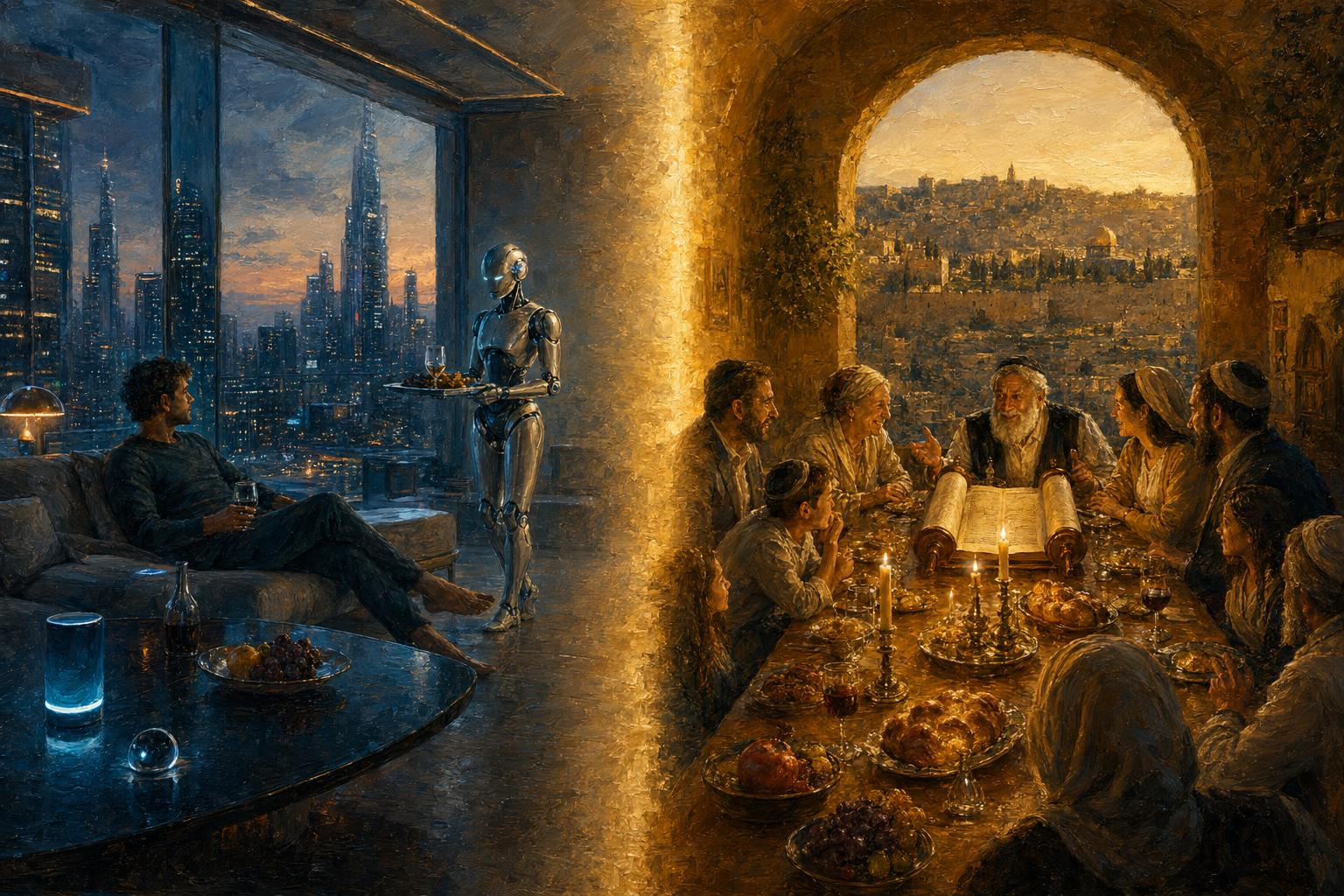
The solitary room is not a dystopia. Rest is good. A machine doing dangerous or degrading work is good. Privacy is good, and some people flourish in quiet. The mistake would be to assume that perfectly delivered comfort becomes meaning once the delivery is fast enough.
The table on the right contains no technology the apartment lacks. Its wealth lies elsewhere. The elder owes the child a story. The host owes the guest a place. The people at the table receive the day rather than optimize it. Shabbos declares, once a week, that a human being does not earn the right to exist by producing.
AI could help create that room. It could give parents time, translate the text, improve the medicine, and remove exhausting labor. It could also make solitude effortless and appetite infinitely serviceable. The technology does not choose between the two scenes. Institutions, habits, and people do.
Judaism begins from an unfashionable premise: the self does not always know what it should want. A preference can be real and still make a life smaller. Covenant addresses desire from outside it. It trains a person to want forms of good that cannot be delivered on demand.
A machine can bring the meal. It cannot turn eating into a table.The difference between service and communion
We have to prepare for success, not only failure.
I do not know whether the AI timelines are right. No one does. Scientific progress may arrive more slowly, wealth may concentrate rather than spread, and political disorder may outrun the promised gains. A serious religious response should not baptize a corporate forecast as prophecy.
But even a partial success would make the deeper question urgent. What happens if less of life has to be spent earning, producing, and surviving? We tend to imagine that people will naturally turn toward family, learning, beauty, service, and God. That confidence is not supported by our recent experiments with spare attention.
The Hebrew Bible repeatedly studies the danger of getting what we want. Israel enters a land of plenty and forgets the source of the gift. Solomon's wealth becomes appetite without limit. Jeshurun grows fat and kicks. Amos speaks to people reclining on ivory couches while the poor are crushed outside. The problem is never bread itself. The problem is receiving bread without gratitude, limit, or obligation.
The engineers may be building part of the body of an age of abundance. They are not building its soul. That sentence is deliberately imperfect. A soul is not a feature to be manufactured, and religious communities are not moral factories. Still, the distinction matters. Technical systems can alter the conditions of life. They cannot do the slow work by which people learn to live well under those conditions.
The engineers may be building the body of abundance. The soul has to be practiced before it is needed.The argument in one sentence
Judaism has practices for precisely this problem. They are small, repetitive, and unimpressed by novelty. Their point is not to reject power. Their point is to form the person who will use it.
Religion can fail this test too. A community can keep every form and still become cruel, incurious, or afraid. Practice is not magic. It works only when it produces the heart the prophets described. The test is not whether we preserve old habits. It is whether those habits make us more capable of justice, wonder, restraint, and love.
If the engineers are even partly right, this formation is not nostalgic work. It is preparation for a world in which external limits weaken and inner limits matter more. We do not need to choose between curing disease and teaching Torah, between better tools and better people. We need enough humility to know that the first does not cause the second.
The question is no longer whether the machine can resemble one part of the messianic dream. It can. The question is whether we will mistake that resemblance for completion.
The four practical directions above are only a starting point. They are not a complete answer to the question of meaning in a world of abundance. In future Emunah Essays, we will write much more about that question: about work and purpose, family and community, creativity and service, Torah and the encounter with God, in a world where scarcity no longer organizes so much of human life. This essay opens the conversation. It does not close it.
- Sam Altman, The Gentle Singularity, June 10, 2025.
- Dario Amodei, Machines of Loving Grace, October 2024.
- Elon Musk at VivaTech, May 23, 2024.
- Babylonian Talmud, Sanhedrin 97a, on the six-thousand-year frame and the seventh millennium as Shabbat.
- Zohar I, Vayera 117a, on the gates of wisdom above and the fountains of wisdom below opening in year 5600.
- Isaiah 2:4 and 11:6-9; Jeremiah 31; Ezekiel 36:26; Zechariah 14:9.
- Maimonides, Mishneh Torah, Kings and Wars 12:5.