
If AI writes the sentences, in what sense am I the author?
The sentences you are reading were made with the latest generation of artificial intelligence models. I dictated ideas, supplied context, argued with drafts, changed the structure, removed what felt false, and kept going until the essay said what I was trying to say.
The model was more than a spell-checker. It found language, built transitions, proposed structures, clarified claims, and sometimes exposed a connection that I had only sensed. None of that is minor. The prose is a collaboration.
That makes the question of authorship harder, not easier. A machine can offer ten ways to finish a thought. It cannot tell me which one I believe. It can make a weak claim sound finished. It cannot decide whether the claim deserves to survive. It can imitate conviction. It cannot accept the consequences of being wrong.
Authorship, as I have come to understand it, lives in those decisions. I choose the question, test the answer, reject what is false, and publish the result under my name. The thoughts are mine, the language is made with AI, and the responsibility is mine.
My problem was never a lack of thoughts. It was the distance to the page.
I am dyslexic, and I am very bad at writing. I do not say that to sound humble. I mean it literally. I never learned to make prose do what I wanted it to do.
When I write alone, I write from inside my own head. I skip the bridge between one idea and the next because I can already see it. I assume the reader knows the subject, remembers the earlier argument, understands the reference, and senses where I am going. Someone who already lives inside the topic may follow me. Everyone else arrives in the middle of a conversation.
For most of my life, what I could sense was larger than what I could express. I could hold an intuition, an argument, even an entire structure in my mind. On the page it became smaller and flatter. Every bridge I had failed to build became a place where the reader could no longer follow.
AI is the first tool that has made that distance feel crossable. I can speak a thought in the order it comes. I can supply the context I usually leave out. Then I can object: “That is too clean.” “You lost the tension.” “Return to the Jewish source.” “This sounds like a machine.” I keep steering until the words hold something close to the shape of the thought.
AI did not give me the thought. It gave the thought a road to the reader.
A model can supply words. It cannot supply the life that made me care about them.
I have spent decades reading. Some books I read once. Others I have returned to for years. The sources range from Tanakh, Talmud, and the Jewish philosophical tradition to Rav Soloveitchik, Abraham Joshua Heschel, science, technology, history, and general philosophy. Hundreds of books stand behind this project, together with years of conversation, work, argument, failure, and ordinary life.
My memory is not especially good. I often cannot summon the exact sentence, page, or citation when I need it. Yet books leave something behind after the details become hard to retrieve. They alter your instincts. They change which questions feel serious, which answers feel too easy, and which tensions you refuse to settle cheaply.
I sometimes borrow the language of neural networks for this. My own weights have been trained. Every book, teacher, failure, conversation, and rereading adjusts something. What remains is not a searchable database. It is an instinct for the shape of an argument and the moral weight of a question.
That formation is what I bring to the model. The machine can help me unfold it. The machine cannot explain where it came from, or why this question matters to me and another one does not.

The fluent answer is often where the real work begins.
I am a cofounder of Triple Whale. Our work puts us close to the frontier of applied AI. We work with models from OpenAI and Anthropic, benchmark their capabilities, and help many clients use these systems in the real world. That has taught me what the models are becoming good at, where they fail, and how much depends on the system built around them.
The model is only one part of the result. The context, source material, sequence of prompts, and ability to preserve an argument across many rounds all matter. Judgment matters most. Someone has to notice when the model has produced prose that is fluent but empty, elegant but false, or certain without evidence.
I do not arrive with a finished essay hidden in my head and ask the machine to type it. I arrive with a question, a few intuitions, fragments of sources, and a direction. The model answers. Its answer changes what I notice. I push back, add context, or discover that the argument I brought was incomplete.
Sometimes I dictate most of the idea. Sometimes the model helps me find its structure. Sometimes it reveals a gap. Sometimes it is simply wrong. The value comes from moving among those states without mistaking fluency for truth.
The work begins before the prompt and continues after the draft.
There is no magic sentence that produces a finished essay. The process is a workshop. It moves through five recurring steps, and most of the work happens between them.
Begin with a live question
I start with something I actually care about, usually a tension I have carried for years. A borrowed question produces borrowed prose, no matter how good the model is.
Dictate the interior argument
I speak freely, often in fragments. I explain what I think, what bothers me, which sources are present in the background, and which easy answer I want to avoid.
Build the context
I give the model source material, prior essays, conceptual constraints, the audience, and the larger project. Context determines what the model can see and what it is likely to miss.
Argue with the draft
I reject, redirect, expand, and compress. I ask for objections. I restore ambiguity when the prose becomes falsely certain, and remove language that sounds impressive but says nothing.
Read before publishing
For every article published here, I read at least one complete edition, in English or Hebrew, before it goes out. I make the final decision that this version belongs in the archive.
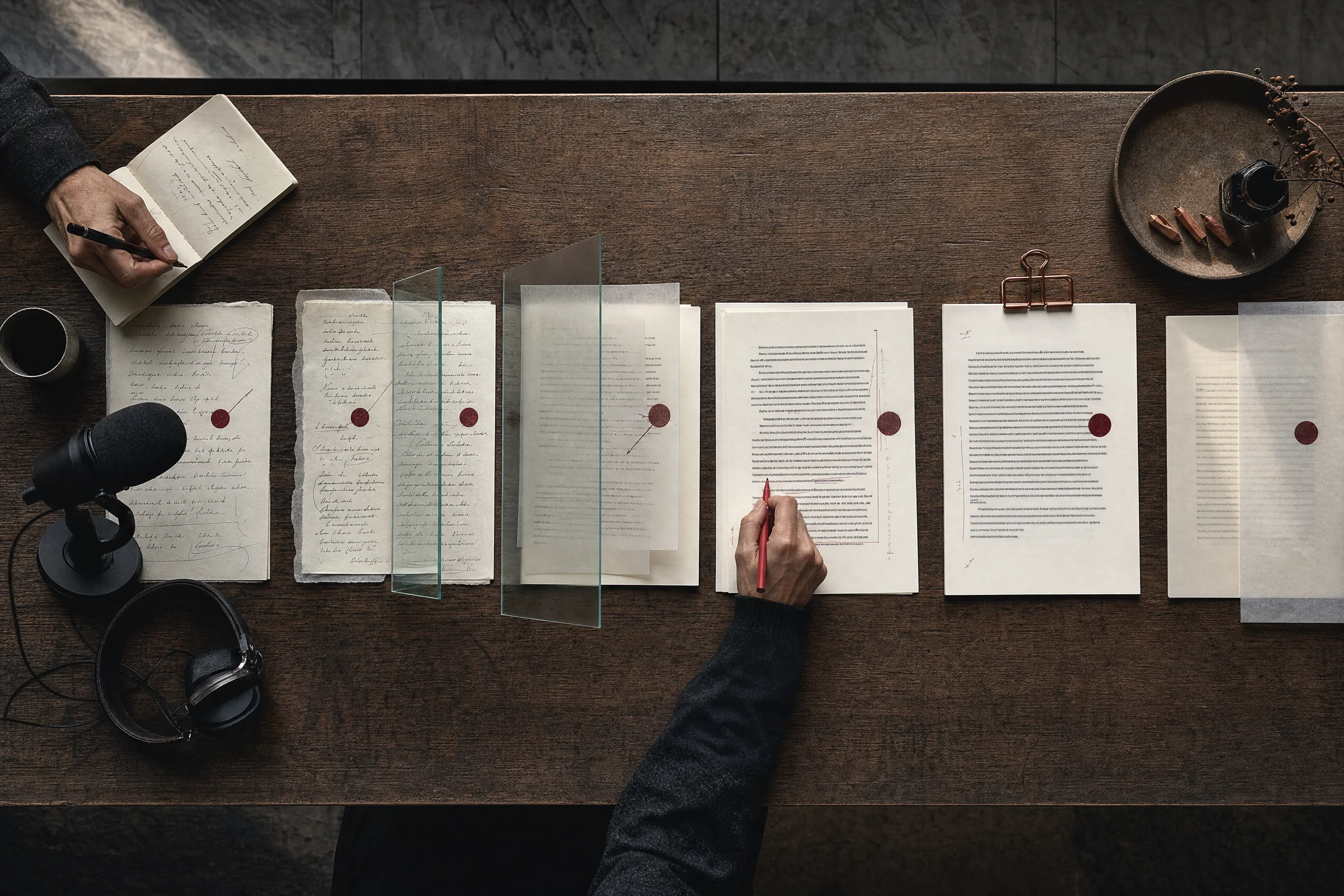
AI shortens the distance to a sentence. It does not shorten the distance to a judgment.
Some work really has disappeared. The mechanical struggle to turn a dyslexic stream of thought into readable sentences is no longer the barrier it once was. I am grateful for that. Pretending otherwise would make the disclosure less honest.
The sentence is still only the visible end of a longer process. The reading happened over decades. The questions came from life. The intuitions formed slowly. Editing still requires attention. The bilingual editions, source checks, imagery, video, design, and technical systems still take time.
This is the distinction I keep returning to: AI compresses expression. It does not compress formation.
These essays are not rabbinic rulings, and they are not substitutes for the books and sources they discuss. Models can make mistakes, invent certainty, flatten disagreements, and wrap a weak claim in beautiful language. Readers should keep their judgment awake. I have to do the same.
When I say the thoughts are mine, I do not mean that they appeared from nowhere. They are indebted to Torah, teachers, books, thinkers, friends, work, and generations of argument. “Mine” means that I have chosen them, tested them, and accepted responsibility for presenting them here.