The children's stones
Walk into any Jewish cemetery older than about a hundred and fifty years and you will notice it before you can name it. The stones are too small. Not a few of them, here and there, the way tragedy is scattered through any human place, rows of them. Whole quiet avenues of stones the size of a shoebox, with a single date instead of two, or two dates separated by a span you could count on your fingers. Stand there long enough and the arithmetic arrives on its own: in the world that carved those stones, half of all the children ever born did not live to grow up. Not in plague years. In ordinary years. That was the weather.
The women of my great-grandmothers' world buried children not only as catastrophes that interrupted life, but as part of the structure that defined it. They recited the same Shema we recite, kept the same Shabbat, said the same Asher Yatzar, and lived inside a fact we can no longer imagine from the inside: no power on earth, no rebbe, doctor, court, or fortune, could promise a mother that her child would be alive next winter. The mesorah they carried wept for the widow and the orphan on every page because every page was written in a world that produced widows and orphans with the regularity of weather.
Then, over about eight generations, a breath in the time-scale of the mesorah, the weather changed. It did not merely soften. It changed in kind. Under-five mortality fell from about 43 percent around 1800 to about 3.7 percent today. Maternal death became vastly rarer. Famine retreated. Smallpox, which killed an estimated 300 to 500 million people in the twentieth century, was eradicated from nature and survives only in official high-security laboratory stocks. A randomly chosen human being alive today is far less likely to be widowed young, orphaned young, starved, disabled by a preventable disease, or buried as a child than in almost any earlier age. This is among the largest moral transformations in recorded history. It was carried out mostly by people who did not know they were answering the Nevi'im.
I want to argue that the mesorah has been waiting for this event for a hundred generations; that the Rambam, the Gemara in Sotah, and the first chapter of Bereishit contain the categories needed to interpret it; that a Jew who enters this work with halakhah in one hand may be doing something for which avodah is not a metaphor; and that our mussar and machshava have not yet been rewritten to say so. That omission is, I believe, one of the largest unaddressed gaps in contemporary Jewish moral teaching.
I have made this argument once before. The first version entered the book and did what serious arguments are supposed to do: it provoked its own opposition. I then wrote that opposition myself, at full strength, as the best counsel I could give the other side, in One Thing I Asked, followed by an answer, Shtayim Zu Shamati. This second writing is not a victory lap. It is the essay rebuilt with the dissent's voice still in my ear, because a framework that has not absorbed its strongest enemy is not a framework; it is a mood. Where the dissent was right, this version concedes in the open. Where it was wrong, this version answers in the body of the argument, not in a footnote. One more thing changed between the two writings, which I will keep for the coda because it belongs there: my own body quietly enrolled me as a test case.
First the facts. No framework that does not take the facts seriously deserves the reader's hour.
What changed between 1800 and now
These are long-run estimates, not exact census readings, and the poverty figure changes when the World Bank updates its line. But the direction and magnitude are not seriously disputed. The sources include Angus Deaton's The Great Escape, Max Roser's Our World in Data, Hans Rosling's Factfulness, the UN and WHO series, and the long-run poverty reconstructions of Bourguignon, Morrisson, and later researchers.
Selected indicators of human flourishing: historical baseline and latest estimate
| Indicator | Historical baseline | Latest estimate | Source |
|---|---|---|---|
| Share of humanity in extreme poverty | ~75 to 80% in 1820 | ~10% at the current World Bank line | Our World in Data; World Bank |
| Global life expectancy at birth | roughly 30 years | ~73 years | UN Population Division; Our World in Data |
| Child mortality (death before age 5) | ~43% around 1800 | ~3.7% | UN-IGME; Our World in Data |
| Adult literacy worldwide | ~10 to 12% in 1820 | ~87 to 88% | UNESCO; Our World in Data |
| Smallpox | 300 to 500 million deaths in the 20th century | 0 natural cases; eradicated 1980 | WHO; CDC |
You can quarrel with a baseline, a poverty line, or a date. You cannot quarrel with the shape of the table. Almost every horror a Jew has ever davened to be spared from has become dramatically less likely to happen to a randomly selected human being on earth. Much of that relief was not administered by a beit din, a chevra kadisha, or a gabbai tzedakah. It came through scientists, physicians, clean-water engineers, farmers with better seed, logisticians, entrepreneurs who lowered prices, public-health workers, and governments capable of delivering a vaccine to the last village.
Hold one example until it hurts. Smallpox made widows and orphans on a scale no rabbinic system could have begun to absorb, with an estimated 300 to 500 million deaths in the twentieth century alone. In 1980 the World Health Organization, standing on Jenner's vaccine and two centuries of refinement, surveillance, persuasion, and logistics, declared it eradicated. A global network of vaccinators, physicians, public-health officials, and local workers prevented orphanhood on a scale no earlier chesed institution could approach. I do not write that as a provocation. I write it as a fact. A fact of that size deserves a theology, not a shrug, suspicion, or a polite change of subject back to the parshah.
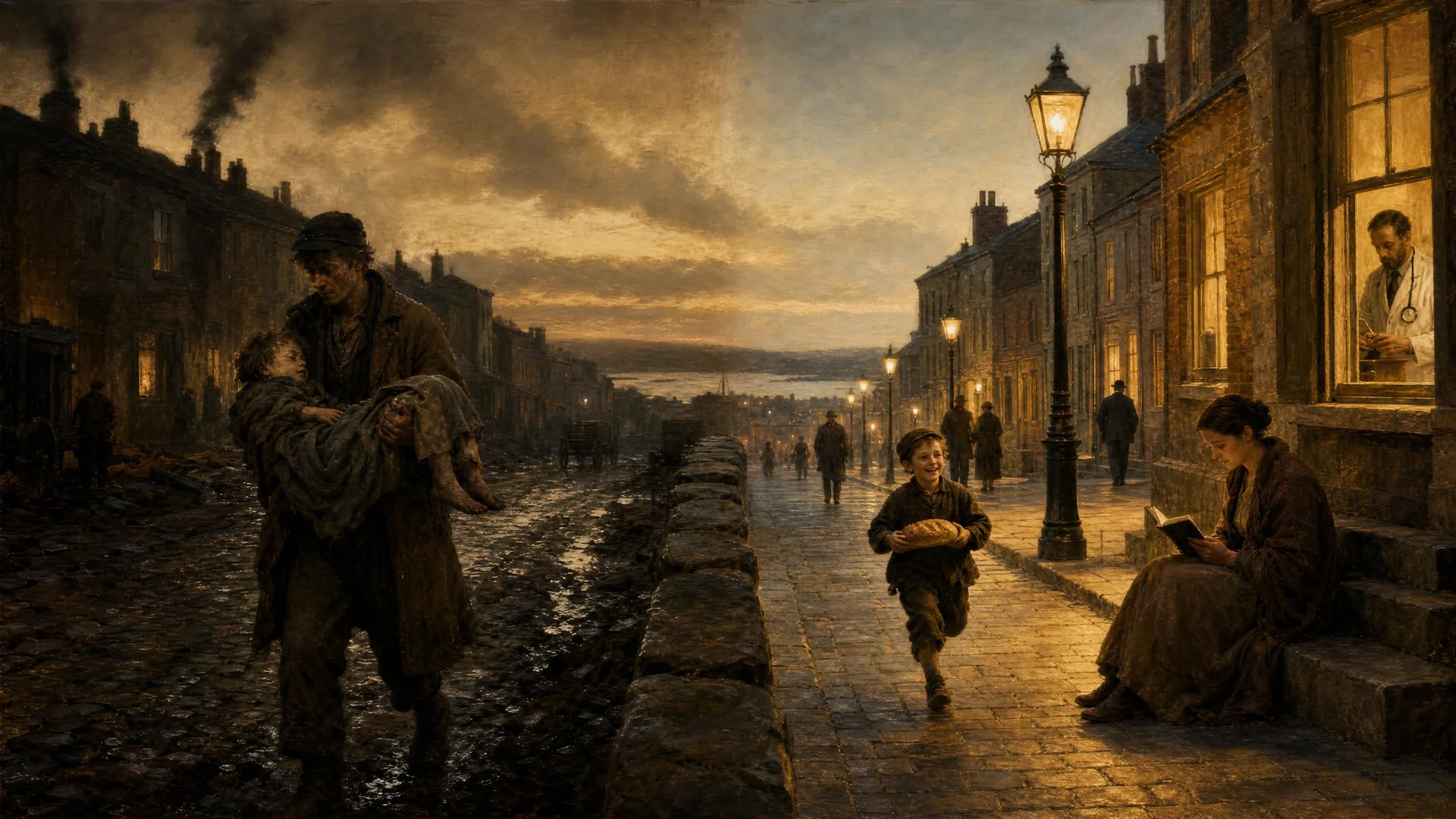
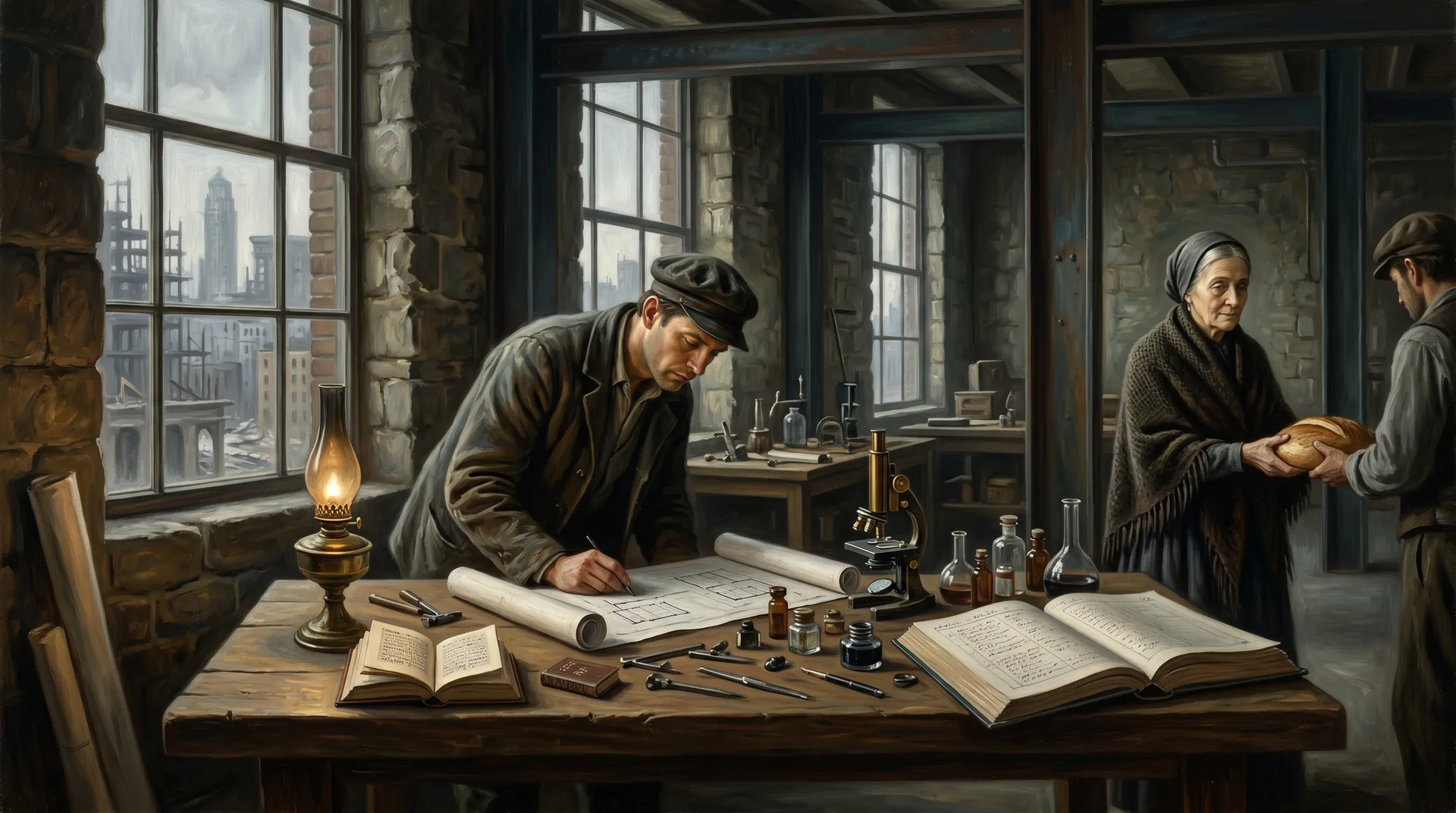
The same street, two hundred years apart. The figures in the foreground are not different people; they are the same people, structurally relieved. The mesorah's central concern is still the foreground figure. The lever has moved.
Chazal filled the box that could not be opened
Before pressing forward I want to give Chazal the credit they are owed, because the argument that follows is not a criticism of them. It is the continuation of them.
Chazal lived under a Malthusian ceiling. From the agricultural revolution until roughly 1800, gains in productive capacity were repeatedly consumed by population growth; a failed harvest could become a famine no one knew how to stop; plague was uncontrollable; many families buried children. Inside that fixed world, Chazal built an ethical machine of staggering generosity: tzedakah as enforceable obligation rather than sentiment, the communal kupah and tamchui, hospitality, bikur cholim, and burial of the unclaimed dead as law. The Torah gives the widow and the orphan a unique grammatical protection: God Himself hears their cry directly (Shemot 22:21-22). Chazal turned that grammar into institutions. Within the limits of pre-modern productive capacity, the mesorah operated near the frontier of the possible.
But there was a ceiling, and the ceiling was the village. You could feed the widow next door; you could not prevent the plague that widowed her. You could redistribute the harvest; you could not enlarge it. You could visit the sick; you could not cure them. Chesed operated inside a closed box, and the genius of Chazal is that they filled the closed box almost completely. What no one in any tradition could do was open the box.
Beginning in the late eighteenth century, and accelerating sharply after 1870, the box opened. Productive capacity began to outrun population. The floor lifted. Plagues became preventable, then rare. Most children stopped dying. Relief that Chazal could administer only case by case, inside a small circle, began to be administered at planetary scale by different actors working through different institutions, usually with no idea whose work they were extending. The question is not whether Chazal were right. They were operating at their frontier. The question is whether we are operating at ours, or whether we are still training a generation to imagine chesed mainly as a one-person transaction on a single afternoon, in a world where the structural form of chesed has expanded beyond anything the authors of our mussar could have imagined.
Where the Torah actually spends its pages
Here is the strongest objection to everything I have said so far, and I state it at full strength because I once wrote it at full strength. You learn what an author cares about by watching where he spends his ink. The Torah spends a third of Shemot on the architecture of a tent and the choreography of nearness inside it. It legislates the calendar, the diet, the seventh day, the fringes, the doorpost. And medicine (allegedly the largest moral lever in history) receives an inference from a doubled verb. If the Torah were a welfare program, it is the strangest welfare program ever drafted: a manual that buries welfare in the footnotes and spends its headlines on kedushah, on intimacy, on I will dwell among them. The headline, says the objection, is nearness. The cures are scaffolding. A man who organizes his life around scaffolding has mistaken the building for its plumbing.
The objection is beautiful, and it commits the one sin it cannot afford: it stops counting the ink too early.
Count the second column. The first parshah after Sinai, the first thing God says to a people still standing inside the smoke, is not the incense recipe. It is Mishpatim: the goring ox, the open pit, the borrower and the guard, the loan to the poor man and the cloak returned by nightfall, honest weights, the widow and the orphan with the sword-backed warning attached. Seder Nezikin, the order of damages and civil law, is the largest order of the Mishnah. Choshen Mishpat, the law of money, labor, fraud, and liability, is the thickest volume of the Shulchan Aruch. The Gemara in Bava Kamma 30a offers several roads to chasidut, and one of them is exacting care in the laws of damages. When Shabbat 31a lists the questions a soul is asked at the door of the next world, the first is not "did you achieve devekut." It is nasata v'natata be'emunah: did you conduct your business faithfully. The first question on the final exam is economic behavior.
So the ink-counting method, honestly applied, does not yield a Torah of pure interiority with welfare in the footnotes. It yields something stranger and more radical: a Torah that refuses the partition the objection assumes. There is no separate newspaper for the body. The God who demands a sanctuary in Terumah demands honest scales in Kedoshim, and the verse that promises the Shechinah says v'shachanti b'tocham, "I will dwell among them." Rabbi Yisrael Salanter, the father of the mussar movement, compressed the non-partition into one sentence that should be carved above this essay's door: the material needs of my neighbor are my spiritual needs. Not alongside. Not beneath. Are. The spiritual life of a Jew is denominated, in significant part, in the bread of someone else. That is not my chiddush. It is the mesorah's own accounting, and it is the foundation everything below builds on.
The Torah never printed a separate newspaper for the body. Its headline was always nearness, and it located the nearness in the market, the field, and the neighbor's bread.The non-partition
The first command ever given
Rav Joseph B. Soloveitchik, in The Lonely Man of Faith, reads the two creation narratives as two typologies of the human person. Adam I, of Bereishit 1, is majestic man: commanded to fill the earth and master it, creative, dignified, plural, an institution-builder who pushes back the boundaries of human helplessness. Adam II, of Bereishit 2, is covenantal man: lonely, inward, the one who hears the call and answers hineni. The Rav's claim is that a Jew is commanded to be both, and that the tension between them is not a problem to be solved but the dignity of a creature made in the divine image.
The Rav aimed his argument at a secular modernity that had amputated Adam II and was puzzled by its own loneliness. Religious culture can perform the symmetric amputation. It can treat Adam I as the lesser brother, with building, mastering, curing, and founding tolerated as concessions to necessity so that the real life of Adam II can be financed. Against this, hold the plain sense of the text. P'ru u'r'vu u'milu et ha-aretz v'kivshu'ha, be fruitful, fill the earth, and master it, is the first utterance addressed by God to humanity. It precedes Sinai by twenty-six generations. It is aimed at every human, not only the Jew. And it is a command. The Rav says it outright: in his building, Adam I "is trying to carry out the mandate entrusted to him by his Maker." The mandate is not Adam I's ambition. The mandate is divine. Adam I may be doing avodah when he builds, even when he has forgotten whose work it is.
The implication is direct. The mesorah does not need to invent a new permission for science, medicine, or the structural relief of poverty. The mandate precedes every later commandment. In our love for Adam II, we have sometimes read past the first words God addressed to humanity.
Rav Chaim and the second lever
Rav Chaim Soloveitchik of Brisk, the father of the analytic revolution in Talmud study and a name almost synonymous with conceptual rigor, was asked what a rav is actually for. Rav Soloveitchik preserves the answer: "to redress the grievances of those who are abandoned and alone, to protect the dignity of the poor, and to save the oppressed from the hands of his oppressor." His life matched the sentence. The Brisker memory of the man compressed the same posture into a single word: rachman. Mercy was not the soft alternative to rigor. It was what the rigor was for.
Now hold that sentence against the ledger of the last two centuries. Rav Chaim's world could redress abandonment and oppression one person at a time. The structural production of widows, orphans, and trapped families was driven by forces no halakhist could reach: war, plague, conscription, pogrom, distance, and early death. The available mercy was case-by-case mercy, and the greatness of Rav Chaim was to bring the full power of Torah to the person standing before him.
There is now a second lever. Widowhood falls when maternal mortality falls, famine ends, and the diseases that kill young parents are prevented. Orphanhood falls the same way. Poverty falls when institutions allow people to earn, build, and become independent, which is, not coincidentally, the moral form of the highest rung of the Rambam's ladder. None of this retires Rav Chaim's lever. The widow still needs the meal; the agunah still needs release; case-by-case chesed is still avodah, and a Jew who abandons persons for "systems" has betrayed the posture this framework is built on. But a Jew who takes the rachman posture seriously, in a world that contains both levers, must take both seriously. To pull only the older one while the newer stands within reach is not piety. It is nostalgia wearing piety's clothes.
"To redress the grievances of those who are abandoned and alone, to protect the dignity of the poor, and to save the oppressed from the hands of his oppressor."Rav Chaim of Brisk, as reported by Rav Soloveitchik in Halakhic Man
Heschel's prophet reads the chart
Rabbi Abraham Joshua Heschel's The Prophets rests on an observation that Jewish religious culture still has not fully absorbed. The Nevi'im do not permit ritual to shield injustice. Their fury, a fury without parallel in ancient literature, falls on the merchant's rigged scale, the bought judge, the ivory couches above the crushed poor, the widow whose case is never heard, and the orphan whose field is stolen. Heschel's claim is that the prophet has caught the pathos of God, God's concern for the world; and the content of that pathos, page after page, is the condition of the weak. Yeshayahu gives it to us as imperatives:
Now perform Heschel's thought experiment honestly. Put the prophet in our century and show him the child-mortality curve from 1800 to today. Tell him what it means: orders of magnitude fewer orphans, fewer widows, fewer mothers dead in childbirth, fewer children buried by fathers. Then tell him who did much of it: laboratories, hospitals, seed breeders, water engineers, vaccine programs, functioning states, and markets that made food and medicine cheap enough for ordinary people to buy. The prophet, if he is faithful to his own pathos, must first ask what happened to the widow and the orphan. He must recognize that much of what he cried for has been done, and that the doers often did not know whose errand they were running. Rav Kook recognized a related structure in the secular builders of the Land: holy work performed by hands that denied the holiness. Heschel's God responds to deeds, not only to the theological self-description of the doer.
The discomfort a religious reader may feel here is not a flaw in the argument. The discomfort is evidence. It tells us that religious culture can learn to give credit in the wrong places and withhold it from the right ones. The Heschelian response is not surrender or applause without judgment. It is the prophet's question: are we participants in the relief of the weak, critics who help the work become just, or spectators? Spectatorship is not among the permitted options.
The ladder that climbs out of itself
The halakhic anchor of the framework is the Rambam, Hilchot Mattanot Aniyim 10:7. Every day-school graduate knows the eight levels of tzedakah, and most misremember the top. The highest rung is not anonymous giving. That is the seventh. The eighth is different not in degree but in kind:
The seven lower rungs are variations on one act: transferring value from giver to receiver, with increasing care for the receiver's dignity. The eighth is different in kind. It does not merely relieve a moment of poverty; it changes the person's relation to the productive world so the moment need not recur. A loan that founds a livelihood. A partnership. A job. The Rambam, in the twelfth century, placed the structural exit from dependence above every form of relief within it.
And notice (because this answers the dissent's sharpest thrust) what the Rambam did to his own ladder. The dissent asked whether a tzedakah that abolishes the need for givers is still tzedakah, or "mercy with no one inside it." But the Rambam himself crowned the ladder with its own retirement. The summit of the mitzvah of giving is the act after which the receiver no longer needs to ask. The tradition did not place the perpetuation of need at the top of its ladder; it placed the abolition of need there, and called it a level above which there is none. If ending dependence were a threat to the mitzvah, the Rambam built the threat into the mitzvah's crown. The ladder climbs out of itself. That is its glory, and it always was.
Now apply the moral form of the category at the scale our world makes possible. A company that employs a thousand people at a dignified wage can instantiate the eighth level's logic a thousand times over. A clinic that prevents disease serves people who never need to become patients. An invention that halves the cost of a human necessity strengthens every poor household newly able to afford it. A school performs the work on the future. This essay's chiddush is not that the Rambam explicitly ruled on corporations, laboratories, or public systems. It is that the form he ranked highest was structural independence rather than recurrent relief, and our age can execute that form at a scale he could not have imagined.
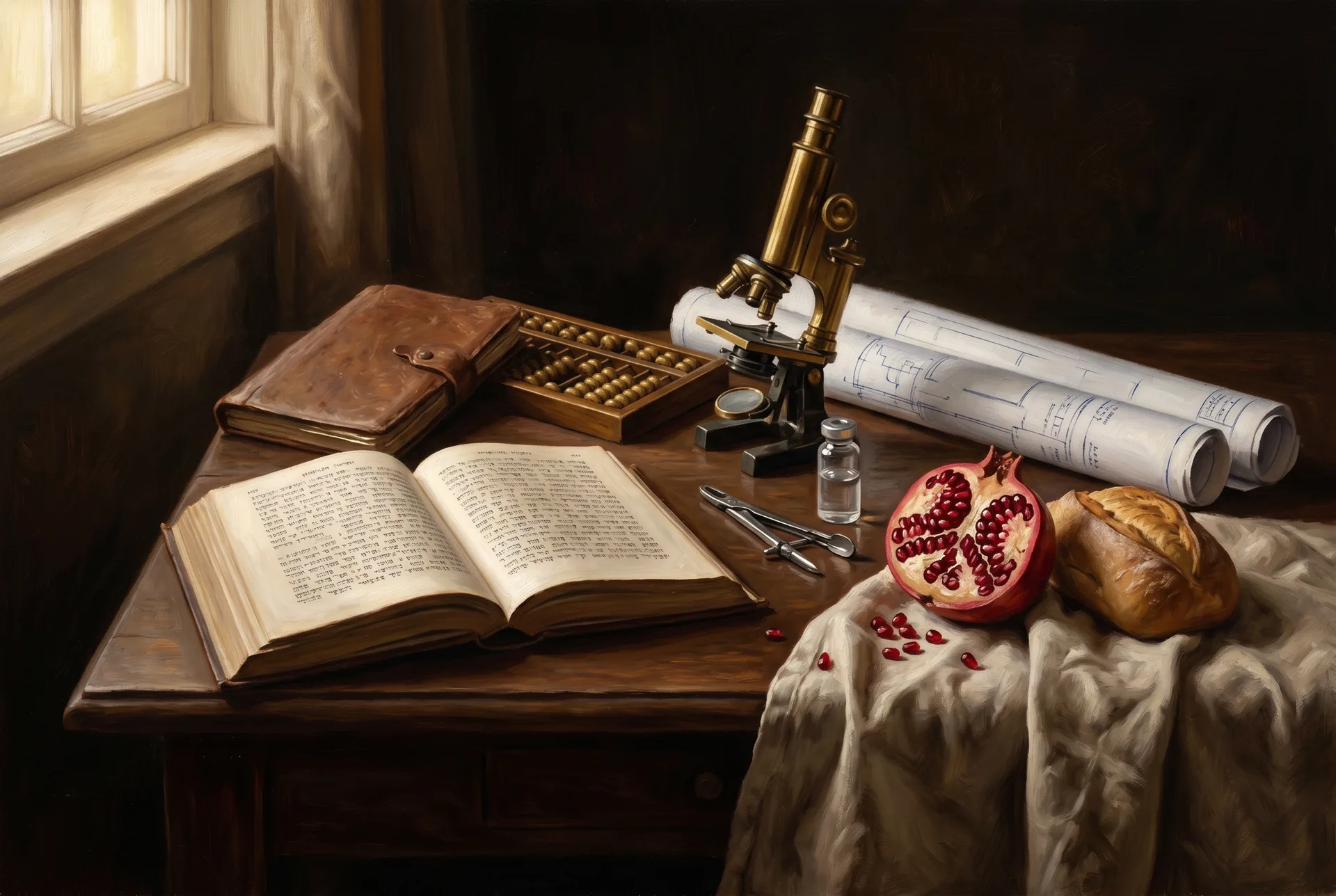
Every object on this table can become an instrument of avodah when it strengthens a human hand and remains bound to halakhah. The framework does not add new tools to the table. It teaches the person at the table what the tools are for.
Medicine and markets, read by the mesorah's own light
The Gemara in Sotah 14a asks what it can mean to walk after God, and answers: walk after His attributes. He clothed the naked. Clothe the naked. He visited the sick. Visit the sick. He comforted mourners and buried the dead. The practical content of imitatio Dei is expressed through care for embodied human beings. Prayer and study have their own glories. Here, when the Torah says walk after Him, the Gemara hears: tend to bodies.
So ask the Gemara's question in our tense. What is bikur cholim when the lever has moved? It is still the bedside, the visit, the soup, the company. Nothing replaces the face. But it now also includes the laboratory that makes an infection survivable, the vaccine program that prevents the illness, and the water plant that makes the cholera year unrepeatable. The objection that these are not "religious" institutions describes who runs the building, not what the building does. On Sotah 14a's moral standard, the building tends bodies. To deny that is to decide that the only authentic care is the kind possible in the year 200, and that preventing the illness is somehow less holy than visiting it.
Markets are the harder case, and honesty has to lead. Markets can reward greed, permit exploitation, and generate inequalities the Nevi'im would have burned against. Any religious teacher who pretends otherwise is selling something. The historical record also does not assign the Great Escape to markets alone. It assigns it to a braid: scientific knowledge, public health, capable states, law, trade, enterprise, and institutions that allowed ordinary people to exchange, invest, and build. Market institutions were part of the braid, and an indispensable part in many places. Deaton calls the result the Great Escape. Acemoglu and Robinson emphasize inclusive institutions. McCloskey emphasizes the new dignity granted to enterprise. The halakhic frame was waiting: Avot's yafeh talmud Torah im derech eretz, and Berakhot 35b's unsentimental record that many followed Rabbi Shimon bar Yochai's learn-only path and failed, while many followed Rabbi Yishmael's work-and-learn path and succeeded.
We do not need Pinker's metaphysics to accept the table he helped popularize. The mature posture reads the table as a record of real relief, much of it melekhet shamayim done by hands that did not know whose work they were doing, while retaining every critical word the religious frame has for what the same systems do badly: exploitation, atomization, manufactured desire, and the loneliness economy. The table is true and incomplete. Gratitude toward what is true is not a betrayal of critique. It is the precondition for making the critique honestly.
Chizkiyahu, read to the end of the story
Now the objection that deserves its own chapter because it is the oldest and the best. A righteous king of Yehudah took his civilization's medical text, the Sefer Refuot, and hid it. The Sages praised him: ganaz Sefer Refuot, v'hodu lo. Rashi reads the danger plainly: people were healed so quickly that lo hayah libam nikhna, their hearts were not humbled before Heaven. The cure was quicker than the soul. Rashi's is not the only classical explanation, but it is the one this essay must face. If the tradition praised a king for suppressing effective medicine, what becomes of an essay that calls the laboratory avodah?
I accept Rashi's reading in full. The danger is real; I have written a whole essay inside it. But read the sugya to the end, because three facts stand between the dissent and its conclusion.
He hid it. He did not outlaw medicine. The verb ganaz matters, even if one should not build an entire halakhah on a verb. Chizkiyahu acted against a book in a particular spiritual emergency. No later posek derived from his act a prohibition on writing or practicing medicine. The Rambam wrote medical works and described healing as a mitzvah included in restoring a person's body. Jewish physicians across the centuries did not understand themselves as breaching Chizkiyahu's fence. The mesorah received the king's act with awe, but not as a standing ban.
The same Mishnah records a second act. In the same list of praised deeds, Chizkiyahu shatters the nechash ha-nechoshet, the bronze serpent Moshe made, because Israel had begun burning incense to it. A healing object had become a god. The Mishnah in Rosh Hashanah asks the question that dissolves the idolatry: does the serpent kill, or does the serpent give life? When Israel looked upward through the instrument, it healed. When they began to worship the instrument, a righteous king ground it to powder. Set the two acts side by side and the teaching assembles itself: an instrument can mediate rescue, and an instrument can become an idol. The difference is the angle of the gaze. The lever without halakhah becomes Nechushtan. The lever bound by halakhah can remain Moshe's serpent.
And the end of the story. The same Chizkiyahu fell mortally ill. The prophet Yeshayahu came to him, the prophet, carrying the word of God. Chizkiyahu prayed and wept, and was answered. And what did heaven prescribe, for the king who buried the Book of Cures?
A remedy. Ordered by a prophet. Applied to the man who hid the medical book. The biblical narrative does not set prayer against treatment. It binds tears, prophecy, and a fig compress into one act of rescue. That is not a tradition simply suspicious of medicine. It is a tradition alert to medicine's spiritual danger when the cure outruns the heart, and equally alert to the folly of refusing the remedy when it is given. The story the dissent opened with is not the case against Avodat HaTikkun. It is Avodat HaTikkun in the language of Melachim.
The problem was never the instrument. The problem is the angle of the gaze: the difference between a tool you look through and a tool you bow to.Nechushtan's law
What the corridor is for
The dissent's deepest move was architectural. This world, says Rabbi Yaakov in Avot, is a corridor before the world to come; prepare yourself in the corridor so you may enter the hall. The Mesillat Yesharim opens with the same map. And so, says the objection, a movement that lengthens, carpets, and floodlights the corridor (and calls that the central religious project of the age) has misjudged not a detail but everything.
Read the next Mishnah. Not a distant one: the very next breath, from the same Rabbi Yaakov.
The same teacher who called this world a corridor declared one hour inside it more beautiful than everything in the hall. There is no contradiction, because Rabbi Yaakov was not teaching a hierarchy of places. He was teaching the difference between the place of work and the place of wage. The hall is where the deed is rewarded; the corridor is the only place in the universe where the deed can be done. Hayom la'asotam: today to do them; tomorrow to receive their reward. The world to come is, in the mussar masters' sharp phrase, a world where no mitzvah, chesed, or teshuvah can still be performed. A saved child is not new carpet in the corridor. A child pulled back from death at age two receives decades of hours in the only world where hours can become deeds.
And the Gemara the dissent leaned on hardest, Yoma 85b, says: desecrate one Shabbat for him so that he may keep many Shabbatot. Read as written, it does not reduce life to a vessel. It identifies future sacred time as part of what rescue preserves. Very well: agree on the currency, and count. A public-health campaign that prevents a million child deaths preserves billions of Shabbatot that could otherwise never be kept. The child-mortality curve, converted at Yoma's exchange rate, is a graph of sacred time returned to the world. The corridor objection, pressed all the way down, does not undermine the framework. It helps fund it.
The cross-examination the framework must carry inside itself
Now the hardest fact, and I refuse to hide it in a rebuttal essay where the casual reader will never find it. It belongs here, in the body of the framework, permanently.
The same two centuries that produced the Great Escape also produced a great emptying. Many of the wealthiest, healthiest, longest-lived societies in human history have seen religious practice fall, marriage delayed or declined, fertility collapse, loneliness rise, and suicide, overdose, and alcoholic death gather under the phrase deaths of despair. The economist who documented those deaths is Angus Deaton, the same Deaton whose Great Escape sits in this essay's bibliography. The man helped write both ledgers. A framework that quotes only one of them is not a framework; it is marketing. Rashi's warning about the cure outrunning the heart has become legible at civilizational scale.
But correlation is not a diagnosis, and a claim built on a ledger must honor every column. Did vaccines cause secularization? Did antibiotics cause loneliness? Or did intellectual, economic, and cultural forces loosen covenantal life, after which abundance proved unable to fill the space it had not created? The observant world offers not a laboratory control group, but a powerful complication. Communities in Jerusalem, Brooklyn, Bnei Brak, and elsewhere live with the same antibiotics, supermarkets, and screens. Many show very high fertility, high rates of marriage, dense networks of mutual obligation, and strikingly high reported life satisfaction. They also contain poverty, marital strain, mental illness, alienation, and suffering that must not be romanticized. Still, their existence demonstrates that abundance does not mechanically dissolve covenant. The decisive question is what the other hand is holding when abundance enters the room.
This is precisely the framework's warning: the lever without halakhah can deform the one who pulls it. The second ledger is not a witness to suppress. It is a permanent cross-examination. It shows what can happen when a civilization receives the medicine without a language of limit, gratitude, obligation, or sacred rest. Observant communities do not prove that the remedy is simple or complete. They do offer living evidence that the lever and the heart can be held together. Avodat HaTikkun is the attempt to describe that holding as avodah and to make its disciplines explicit.
Two construction sites
One more objection stands, and it has our century's name on it. There is a moment in the Torah when humanity unifies around a single technological project, one language, one city, one tower, and God scatters the builders. The Netziv reads the danger with terrifying precision: centralized uniformity enforced against dissent, a tower that watches so no one can leave and a society prepared to punish the person who thinks differently. The text adds another danger: ve-na'aseh lanu shem, let us make a name for ourselves. Power becomes surveillance; building becomes self-worship. And the founding documents of our new abundance, gentle singularities, machines of loving grace, disease abolished and scarcity ended, often read like Yeshayahu with one word changed: the Name replaced by the model. If that is the construction site of the age, what is a framework doing handing Jews a hard hat?
Look at what God did after Bavel. He did not cancel the human building project. He chose a different builder. Two chapters after the scattered tower, the Torah introduces Avraham, and the midrash sets him explicitly against the generation of the dispersion. Avraham is not a hermit fleeing civilization for a cave. He is an entrepreneur of chesed: he plants an eshel at Be'er Sheva, digs wells, cuts treaties, feeds travelers bread and meat. And when the fed guests rose to thank him, the midrash says, he refused the credit: Did you eat from what is mine? You ate from the God of the world. Thank, bless, the One who spoke and the world came to be.
There is the difference, folded into two pictures. Bavel: building so the builders can preserve one name, one center, one authorized mind. Be'er Sheva: building so the eaters will bless the Name. The same materials, the same enterprise, the same human genius for organizing a world. The difference is the direction the building points and the freedom it leaves to the human beings inside it. Avodat HaTikkun is not a proposal to join Bavel. It is a proposal to do to this century's technology what Avraham did to the fruit of his own labor: turn possession into hospitality, power into service, and human achievement into gratitude. If the new prophets are writing Yeshayahu without the Name, who is supposed to carry the Name back onto the construction site? Not the one who walked off it. Yonah was sent into Nineveh. Yosef entered Pharaoh's palace and took hold of the ancient world's grain system. The Jewish posture before a rival redemption cannot be retreat alone. It must also be entry, with the Name in hand and limits in law.
Five refusals
It is not Torah im Derech Eretz. Hirsch's project was the integration of Torah-true Judaism with German civic culture: the gymnasium, the Bildung, the cultivated citizen. It dignified secular learning as an accompaniment to the religious life. This framework claims something different in kind: that certain modern work, the work that structurally relieves poverty, disease, and premature death, is not merely an accompaniment to avodah but a large-scale enactment of the moral form the Rambam placed at the eighth level.
It is not Torah u'Madda. The YU synthesis, in Rav Lamm's articulation, argues that secular knowledge is compatible with Torah, an argument about permission and integration. This framework is not about permission. It is about obligation: a Jew who can prevent the orphan from being orphaned, by participating in the medical or scientific or economic enterprise, has (on the prophets' own grammar) a serious claim on his hours. Torah u'Madda defended the legitimacy of the integration. This framework asserts the centrality of the work.
It is not Torah va'Avodah. The Mizrahi synthesis paired Torah with the pioneering labor of building the Land, magnificent, and narrower than this. The avodah pointed at here is the building of the conditions that prevent the widow and the orphan anywhere on earth; it includes the Land and is not exhausted by it.
It is not the tikkun olam of contemporary liberal usage, a phrase too often thinned into a permission slip for politics the speaker already held, detached from halakhah and from any audit of whether the intervention repairs anything. The Mishnah's mipnei tikkun ha-olam and Aleinu's letakken olam b'malchut Shaddai are not identical formulas, but neither is casual. This framework means to recover their seriousness, which requires exactly the disciplines the diluted slogan discards: halakhah, evidence, humility, and an account of the Kingdom in whose name the repair is attempted.
And it is not a telos. This is the refusal the dissent forced into the open, and the framework is stronger for it. Avodat HaTikkun does not claim that medicine is the meaning of the covenant or that the mortality curve is the purpose of the Torah. The purpose of the Torah is nearness, I will dwell among them, and on that the dissent and I have never disagreed. The claim is about obligation, not ultimate purpose: our responsibility to relieve preventable suffering grows with our capacity to do so, and obligation in this tradition becomes avodah only when it is bound to the service of Heaven. The distinction between a chovah and a telos is the framework in two words. The framework does not enthrone the work. It harnesses it.
Avodat HaTikkun, in eight propositions
First. The concern has not changed. The widow, the orphan, the stranger, the sick, the poor, the agunah, the powerless: this is not a wing of the mesorah but its central moral grammar, from Avraham's tent to the Nevi'im to Rav Chaim. The framework does not redirect the concern. It deepens it.
Second. The lever has changed. Until roughly 1800 the only lever was case-by-case chesed, and the mesorah pulled it as completely as any civilization ever has. Since then a second lever exists: structural change in the conditions that produce the suffering: scientific, medical, institutional, economic. Both levers are real. Both are obligatory. Using only the older one, in the presence of the newer, is unfaithful to the concern both serve.
Third. The Rambam supplied its governing form eight centuries early. The eighth level of tzedakah, strengthening a person's hand until he no longer needs to ask, is the structural lever in miniature. The ladder's summit is its own retirement. The modern world made that form executable at a scale the Rambam could not have imagined.
Fourth. Adam I is doing avodah when he builds. The first command ever given (fill the earth and master it) is a command, not a concession. Soloveitchik's majestic man, bound to halakhah and pointed at the relief of the vulnerable, is not the secular half of a duality. He is a commanded mode of tzelem Elokim.
Fifth. The obligation has an address: lo ta'amod al dam re'echa. Misfortune that cannot be prevented belongs to the vocabulary of gezerah, encounter, and the broken heart before God. But when prevention becomes possible, the moral question changes. The vaccine is proven. The cure exists. The method is known. I am not issuing a new psak from a graph, but I am naming the pressure the verse places on preventable danger: you shall not stand over your neighbor's blood. The granaries of Amos were full of grain. Ours are full of molecules, genomes, methods, and delivery systems. The unstretched hand is still a hand. This is why the framework speaks of chovah rather than admiration. The Torah does not need to predict every amplifier. It spends its commandments on the signal, because the signal is the scarce resource. But once the amplifier can carry rescue to the drowning person, withholding it is no longer morally neutral.
Sixth. Halakhah is the binding form. Without it, the work collapses into one of two failure modes: the Enlightenment-optimist version, which has no Shabbat, no limit, and no equipment for holding lines its own logic wants to cross; or the techno-eschatological version, which swaps the relief of the widow for the abolition of the human, and is, in the prophets' grammar, idolatry. The halakhah binds the work with limits (Shabbat: the project is not yours), with dignity (the laws of the worker, of speech, of the body), and with remembrance (the brachah: the capacity is on loan). The lever without halakhah is Nechushtan. The lever with halakhah is Moshe's serpent.
Seventh. Mussar must be rewritten. The mussar we inherited (magnificent, and true) was composed inside the closed box, for a world with one lever. It cannot, alone, equip a Jew with the moral imagination for the second lever: for choosing work, for wielding scale, for keeping the heart soft inside an institution. We need a companion strand of mussar (not a replacement) that takes the eighth level at its word, reads Adam I as commanded, and trains the practitioner to perform structural work with a rachman's heart. This book is one attempt at a first chapter.
Eighth. The work must know what it is. The framework's posture is Rav Chaim's, not Prometheus's: the work exists because there is still an orphan, still a widow, still a child dying of something we know how to prevent, and the work ends, gladly, when those facts end. Its mood is gratitude, including gratitude to the builders of every faith and of none who pulled the lever before us without knowing its name. And it carries, permanently installed within it, the dissent's cross-examination: the question what is this for, asked under oath, once every seven days, with the tools down. A tikkun that cannot answer that question has a tower in it. A tikkun that answers it is avodah.
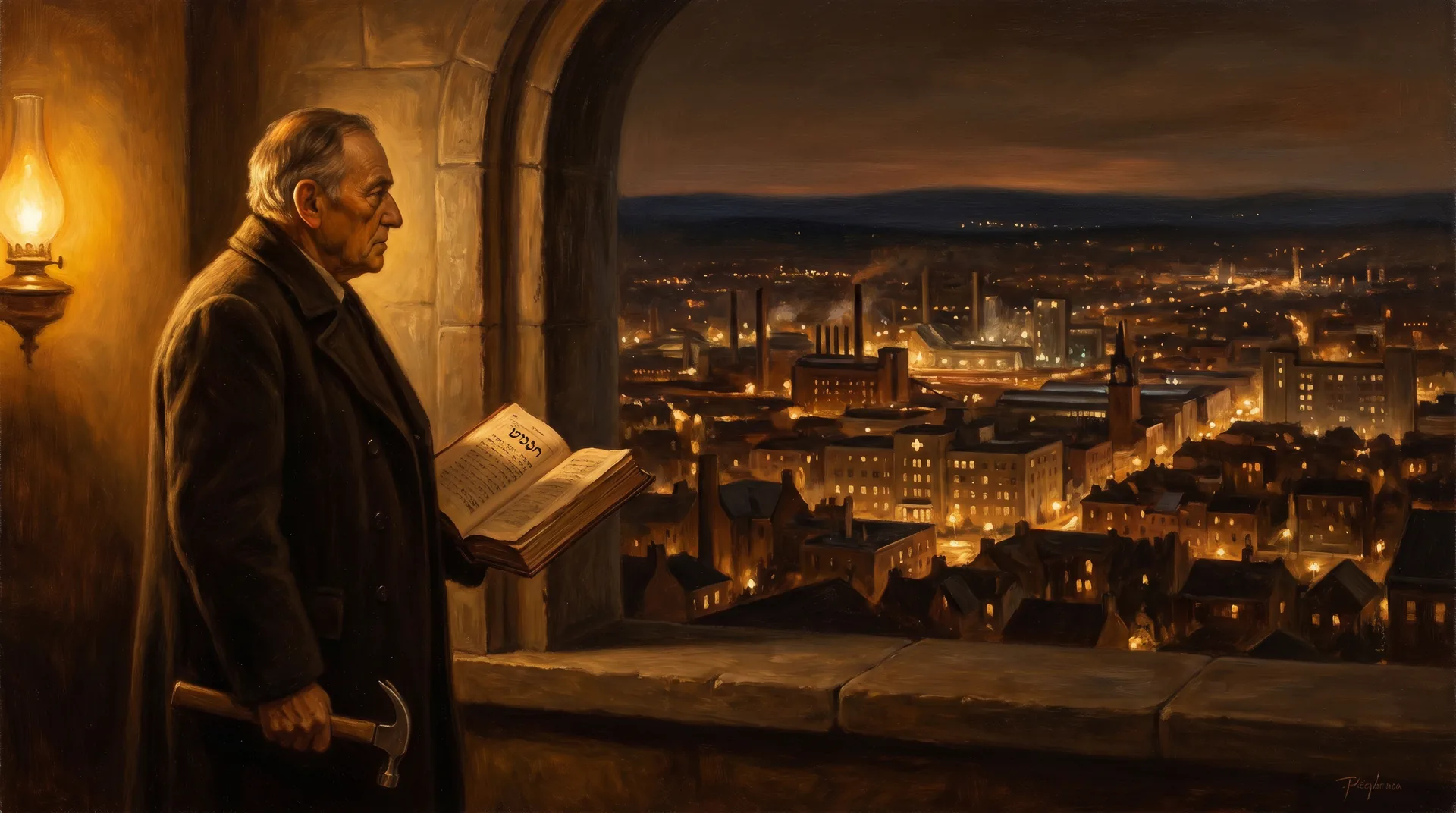
One hand holds the builder's rod: the structural relief of suffering, the eighth level at scale. The other holds the open sefer: the halakhah that keeps the work from becoming the tower. The two hands belong to one person, doing one avodah.
What this asks of a Jew getting dressed for work
An argument that does not change how a Jew gets dressed on Monday morning is not an argument; it is décor. Practically, then:
One. Work, when it contributes to the structural relief of human suffering, is not merely a concession to parnasah. It can be high avodah. The Jew walking to the office may be walking toward one of the most religiously consequential things he can do with his hours. He should know what his hands are for.
Two. Kavanah names and disciplines the act. The same line of code, experiment, hiring decision, or patient encounter is lived differently when the practitioner can say, even briefly, this hour strengthens a hand; this hour may prevent an orphan. Intention does not sanctify bad work or replace outcomes. It keeps good work answerable to its purpose.
Three. The choice of work matters, and may be among the largest moral and religious decisions a modern Jew makes. Work that lifts at scale, medicine, science, education, infrastructure, lowering the price of necessities, employing people with dignity, carries a weight that work which merely rearranges status among the comfortable does not. This is a question each practitioner asks of his own desk, not a license to audit his neighbor's.
Four. Halakhah is the daily ballast, and the more lever a Jew holds, the more ballast he needs. Shabbat is the weekly oath that the project has an Owner. Tefillah is the daily oath that the capacity is on loan. The laws of speech, of business, of the worker are the hourly texture that keeps scale from coarsening the soul. The practitioner of Avodat HaTikkun is more obligated in all of it, not less.
Five. Torah study is not displaced; it is the navigation. Without sustained learning the practitioner forgets the grammar: forgets what Rav Chaim was actually doing, forgets why the eighth rung is the eighth, forgets the difference between Be'er Sheva and Bavel. The work needs the Torah, and the Torah is, in part, for the work.
Six. The village lever does not retire. The meal to the mourner, the visit to the bedside, the call to the lonely: case-by-case chesed is the school in which the heart learns what the institution is for. A Jew who runs the system and cannot sit with one sick person has betrayed the framework, because the framework is anchored in the posture of a rachman, and rachmanut is practiced with persons, not dashboards. The new poverties, loneliness, despair, the person whose body is maintained by systems while no one knows his name, are already filling the visiting list. Bikur cholim has not been made obsolete. It has acquired another address: the soul left alone inside the rescued body.
Seven. The posture is gratitude, not entitlement: toward the generations of builders, believing and unbelieving, who bent the curves before we arrived; and toward the One whose errand they were running. The reflex the framework trains is Avraham's at the eshel: you ate from the God of the world: say it over every cure, every harvest, every shipment that arrives. The work is ours to do. The credit was never ours to keep.
The blessing before the knife
I said at the opening that between the two writings of this essay, my body enrolled me in the argument. Here is what I meant.
This year, on an ordinary afternoon of the kind I once wrote about as a hypothetical, a doctor looked at a scan of my kidney and scheduled a surgery. A duct that should open had closed. The condition is as old as the species; the difference is the century. In my great-grandfathers' world, what I have was a death sentence with a slow clock, one of the ten thousand unremarkable ways the old world made widows. In mine, it is an inconvenience with anesthesia. Some weeks from now, please God, a surgeon I have met twice will put me to sleep and repair, with instruments that did not exist when my grandfather was born, the exact failure mode described in a blessing I have recited after leaving the bathroom perhaps ten thousand times without once hearing it: asher yatzar et ha-adam b'chochmah: who formed man with wisdom, and created in him openings and hollows; if one of them were to rupture or to seal, it would be impossible to stand before You for even an hour.
I know the halakhot of this moment now, from the inside. I know that the fear is not a failure of emunah, vayira Yaakov me'od, and Yaakov had promises I do not. I know that the surgeon does not compete with God; the Gemara gave him his license from a doubled verb, and the Rambam called his work the return of a lost object, the object being me. And I know (this is the part I could not have written in the first version) what the second lever feels like from underneath. It feels like being the orphan who wasn't. Somewhere in the long ledger of the last two centuries, in the anonymous column where the prevented griefs are never itemized, there is a line that would have read: a family, fatherless, mid-century, cause unremarkable. The line was never written. It was deleted in advance by ten generations of Adam I doing his commanded work: by Jenner and by the anatomists, by the engineers of sterile steel, by the chemists of anesthesia, by the unnamed thousands whose work converges on one operating room in which one Jew will sleep, in the middle of a mercy, while strangers keep his ledger-line blank.
So I will do what the framework trains. I will go to the surgeon, because lo ta'amod applies to one's own blood also. I will say the raw bakashah without embarrassment: refa'einu, in the plural, inside all the sick of Israel, because the tradition refuses to let a man be afraid alone. On the far side, please God, I will say Birkat HaGomel in public, the way Berakhot 54b prescribes, because rescue is information and the community is owed its disclosure. And then I will get dressed on some ordinary Monday and go back to the work (the building, the employing, the writing, the small unglamorous repair of a small corner of the world) knowing, with a knowledge that has now passed through my own body, that the lever is real; that the hands that pull it are doing the oldest errand in the Torah; and that every Asher Yatzar I say for the rest of my life will be a citation of this essay, offered by its most grateful reader.
The mesorah's concern has not changed. The lever has. The halakhah is how the lever is wielded without destroying the wielder. And the man under the surgical drape (every man, every woman, every child whose stone will now be full-sized and late) is why the work is called what it is called.
Aleinu's phrase is not a slogan. It is the job description the mesorah has carried for a hundred generations, waiting for the lever that could execute it. The lever exists. The halakhah binds it. The dissent audits it, once every seven days, forever.
הִנֵּנִי