Three sentences, not two
The Torah gives us two scenes that seem to demand opposite religions. At Sodom, Avraham stands before God and argues. At the Akedah, he stands before God and does not. The same man says, "Shall the Judge of all the earth not do justice?" and later, when his own son is named, says only hineni, here I am.
Every easy theology chooses one Avraham and explains away the other. The modern moralist keeps the protester and is embarrassed by the servant. The religious authoritarian keeps the servant and is embarrassed by the protester. The Torah keeps both inside the education of the first Jew.
For a long time I thought that was the whole tension: argument or obedience, conscience or command. But the Akedah contains a third sentence, and without it the first two are dangerous.
Al tishlach yadcha el hana'ar. Do not stretch out your hand against the boy.
The Torah does not leave Avraham between protest and surrender. It gives surrender a limit. That changes the question. Jewish faith cannot be the habit of arguing with God, and it cannot be the habit of obeying without argument. It is the harder discipline of knowing which sentence the covenant requires before another person pays the price.
This is not a formula that removes judgment. It is a way to expose counterfeit piety. Conscience can become vanity. Obedience can become cowardice. Moral confidence and religious certainty are both capable of volunteering someone else for sacrifice.
Sodom: the argument God opened
The Sodom story begins before Avraham speaks. God asks, "Shall I hide from Avraham what I am about to do?" The reason is not intimacy alone. Avraham is to become a great nation so that he will teach his children to keep the way of Hashem through tzedakah u'mishpat, righteousness and justice.
Then God discloses the outcry of Sodom. Avraham approaches.
Avraham does not defend Sodom's cruelty. He asks whether the innocent may be swept away with the guilty. His claim is narrow, fierce, and entirely internal to the covenant. God has just named Avraham as the teacher of righteousness and justice. Avraham now speaks those words back to God.
This is the first fact about Jewish protest. Avraham does not appeal from God to a higher court. He appeals from an apparent decree to what God has revealed about God. The force of chalilah lecha comes from fidelity. Justice is not a foreign demand imposed on the Judge. It belongs to the meaning of the name.
The second fact matters just as much: God opened the conversation. "Shall I hide from Avraham?" reads like an invitation into responsibility. The man charged with teaching justice is shown a judgment in progress, and he does what his calling requires.
Avraham bargains from fifty to ten. He calls himself dust and ashes, but humility does not end the argument. It is the posture from which he continues. At its best, Jewish protest is moral courage without the fantasy of moral omniscience.
Sodom therefore establishes a permanent possibility inside emunah. Sometimes questioning the decree is the work faith has assigned.
The Akedah: the silence that ends with a command
The Akedah is difficult because the Torah makes it difficult.
The command collides with the promise. Yitzchak is the child through whom the covenantal future is to be called. Child sacrifice belongs to the world Avraham's descendants will be taught to reject. The verse slows down over the relationship: your son, your only one, whom you love, Yitzchak. The language prevents numbness.
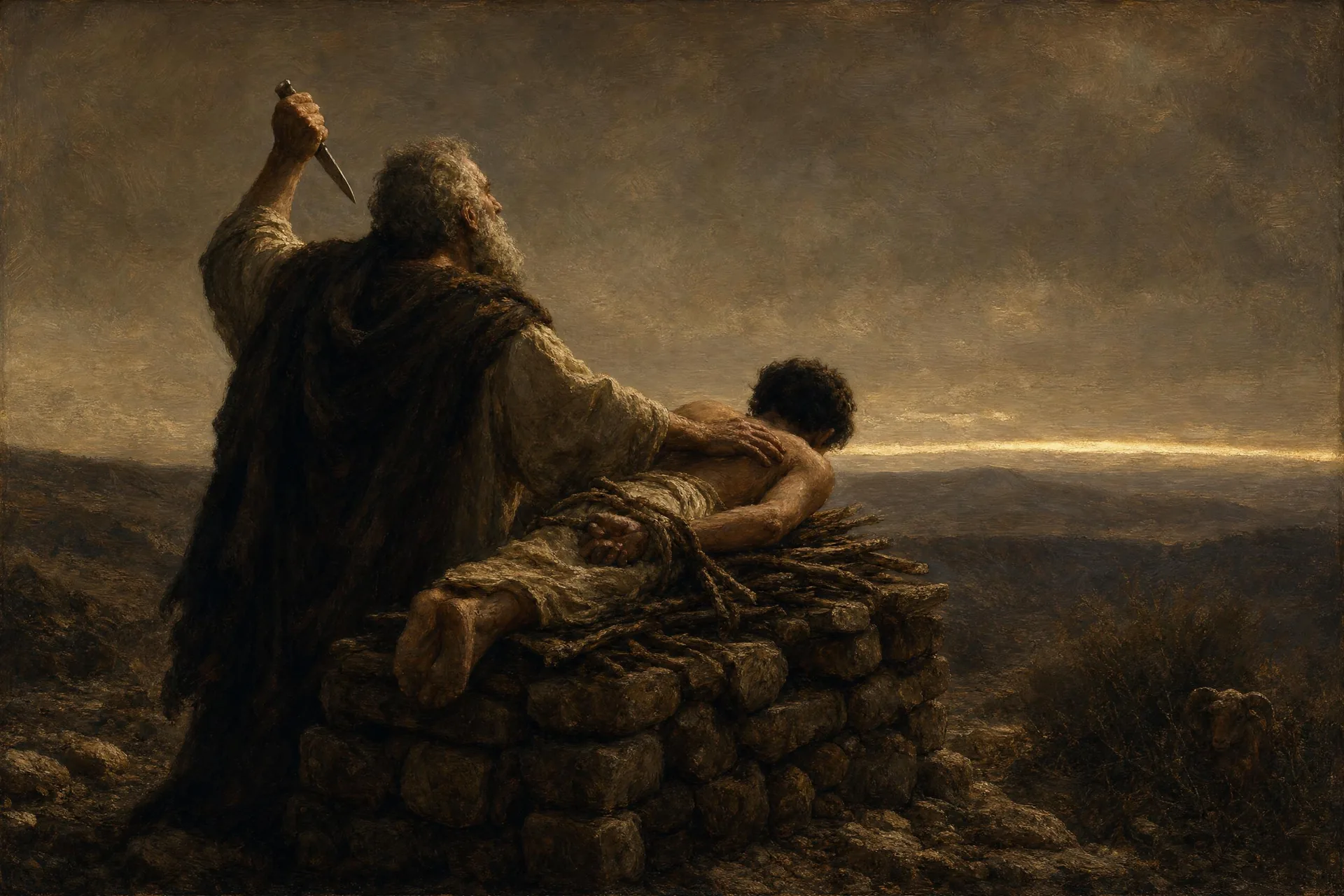
Avraham rises early. He does not bargain. He does not mention the promise. He does not say chalilah lecha. There is only the road, the wood, the fire, the knife, and Yitzchak's question.
The silence reveals something real. Avraham will not turn even the divine promise into a possession. The future does not belong to him. The Ramban explains that the test moves what exists in potential into action. Avraham's availability to God becomes visible in the world.
But availability is not the final word of the story. The final word before the knife falls is a prohibition.
Do not stretch out your hand against the boy.
The test reaches the edge and stops. The ram replaces the child. The covenant continues through the son who comes down the mountain. Rabbinic tradition then places the contradiction back into Avraham's mouth: You said the future would be called through Yitzchak. You told me to raise him up. Now You tell me not to touch him. The argument was not abolished. It waited until the danger had passed.
This makes the Akedah an unrepeatable test rather than a portable permission slip. A private voice does not inherit Avraham's mountain. Jewish life after Sinai is governed by Torah, interpretation, courts, evidence, communal responsibility, and limits on prophetic authority. The reader receives the whole story, including the command that stops the hand.
The daily demand is severe enough: surrender vanity, control, reputation, and the fantasy that the future belongs to you. None of that grants permission to make another human being the raw material of your religious achievement.
The tradition praises argument and judges silence
Avraham at Sodom begins a lineage. Moshe refuses the offer to survive Israel and begin again. He invokes the Exodus, the patriarchs, the divine promise, and God's reputation among the nations. Later he binds his own fate to the people: if You do not forgive them, erase me from the book You have written.
Chana turns the body God created into a plea. Iyov refuses explanations that protect divine justice by accusing the sufferer. Yirmiyahu and Chavakuk ask why evil prospers and why heaven does not answer. Chizkiyahu hears a decree of death, turns to the wall, and prays.
These arguments differ in tone, but they share a structure. They happen inside relationship. They use the language of covenant. The protester stands near enough to refuse indifference.
The tradition also remembers the people who did not speak when speech might have mattered.
When silence fails
- Noach. He builds the ark, but the biblical text records no plea for his generation. The Zohar contrasts him with Avraham and Moshe. Private righteousness was not enough while a world drowned.
- Yiftach and his daughter. A vow consumes a family. Chazal imagine a path of annulment that pride prevented Yiftach and Pinchas from pursuing. They refuse to romanticize religious rigidity when a life stands in the balance.
- The prophetic bystanders. Yeshayahu, Amos, Micha, and Hoshea attack societies whose worship continues while the weak are crushed. Silence in the sanctuary does not purify silence in the street.
- The friends of Iyov. They speak constantly, yet refuse to hear the sufferer. Sometimes the sin of silence is committed with many words.
The difference is not speech versus quiet. Vayidom Aharon, Aharon was silent, comes after an irreversible loss. Noach's silence comes before a destruction for which he might have pleaded. Timing changes the moral meaning. Silence may be holy beside grief. It is not holy when a vulnerable person is waiting for someone with standing to speak.
This is why the phrase your Akedah should make us nervous when spoken by someone who will not carry the burden. It can turn another person's pain into our lesson about obedience. The story does not grant us that right.
If I choose sacrifice for myself, I may be approaching hineni. If I choose sacrifice for someone with less power, I should hear chalilah lecha and al tishlach yadcha before I call my decision faith.
Kierkegaard saw the abyss. Sinai built a fence around it.
Kierkegaard's Fear and Trembling remains unavoidable because it sees what polite religion hides. If Avraham can be explained entirely by ordinary ethics, the Akedah loses its terror. Kierkegaard calls the story a teleological suspension of the ethical. Avraham cannot make his absolute relation to God publicly intelligible.
He sees something real. Faith cannot be reduced to respectable morality. Shabbat, kashrut, prayer, fidelity, restraint, and obligation to people we did not choose exceed the modern claim that the good is whatever the sovereign self sincerely endorses.
Judaism, however, cannot make Kierkegaard's paradox portable. The Akedah happens before Sinai. Jewish life after Sinai does not rest on private encounters that no one may review. Revelation becomes a public covenant. Prophecy has limits. Claims require evidence. Law is argued in courts and communities. A person who hears a private command to murder cannot appeal to Avraham against the Torah that came after Avraham.
Rashi, drawing on the midrash, names all three divine statements: through Yitzchak your future will be called; raise him up; do not touch him. The answer does not remove the terror. It prevents terror from becoming theology's final word.
The Jewish answer to Kierkegaard is that the abyss has borders. Sodom reveals the moral content of covenantal responsibility. The Akedah reveals the cost of covenantal availability. Sinai prevents either story from being seized by private certainty.
The Jew must be capable of surrender. Judaism does not grant the surrendering self sovereignty over another person's blood.
The first question is who pays
The sharpest test of religious surrender is not how intense it feels. It is who bears the cost.
When I relinquish my own status, comfort, control, money, or advantage, hineni may be the right beginning. When I volunteer another person's body, dignity, livelihood, family, or future, my claim to holy surrender becomes suspect. Power is especially skilled at renaming the sacrifice of the weak as obedience.
This is a warning, not an absolute rule. Chana and Iyov protest their own pain. Parents make sacrifices for children who cannot decide. Communities impose real obligations on their members. Halakhah is not reducible to personal consent. Still, the direction of the cost matters. Before praising sacrifice, ask who chose it and who will live with it.
The Torah also gives conscience a language. Tzedek, mishpat, chesed, tzelem Elokim, darchei noam, kavod haberiyot, and v'asita hayashar v'hatov are not decorations. The Ramban reads the command to do what is right and good as a demand beyond any list of rules. Rav Kook warns against a fear of Heaven that suppresses natural morality. Rav Aharon Lichtenstein argues for an ethical demand beyond narrow legal minimalism without turning that demand into a private veto over halakhah.
The moral sense is therefore neither infallible nor irrelevant. It must be educated by Torah and tested by sources, facts, precedent, consequences, opposing arguments, and the testimony of people who bear the result.
Conscience without covenant becomes fashion in sacred vocabulary. Covenant without conscience becomes habit under divine cover.
Five questions before the next hand moves
No checklist can decide infallibly when to protest and when to surrender. It can still expose the easiest frauds.
Before argument or silence
- Who bears the cost? Am I surrendering something of my own, or offering someone else's life as proof of my faith?
- Is the harm still preventable? Silence after irreversible loss may be grief. Silence before preventable harm may be abandonment.
- Which covenantal value is under pressure? Justice, dignity, mercy, truth, peace, and the prevention of suffering have sources, contours, and limits. Can I reason with them rather than use them as slogans?
- Have I heard the person inside the question? A theory about the agunah, the convert, the gay Jew, the disabled child, the survivor, or the person leaving observance can become a way of never meeting one.
- Am I seeking truth or immunity? Some people invoke obedience to escape responsibility. Others invoke conscience to escape command. Both want innocence more than truth.
A contemporary moral intuition is not false because it is contemporary. It is not true for that reason either. Modernity has exposed real moral failures in inherited societies. It has also made idols of appetite, autonomy, and public opinion. The origin of an intuition does not settle its status.
The question is whether it survives serious Torah reasoning, sees the facts accurately, accepts limits, and remains open to correction. The community defending an old practice owes the same discipline. It must ask who is wounded, whether the wound is required, and whether the person carrying it has actually been heard.
Avraham did not say, the world has moved on. He said, shall the Judge of all the earth not do justice? He listened to the outcry. Then he approached.
The hard cases: fidelity without cruelty
This essay does not issue pesak. It cannot resolve in a paragraph questions on which serious halakhic authorities and communities labor for years. It can refuse two evasions.
Contemporary compassion may not erase every text that resists it. Once a text is cited, compassion does not become unemployed.
Consider the lives of gay Jews. An honest Orthodox conversation cannot pretend that explicit biblical and halakhic texts are absent. It also cannot pretend that humiliation, family rejection, casual cruelty, public suspicion, and the reduction of a human being to one prohibited act are mitzvot. They are not. Even where a prohibition stands, questions of language, dignity, confidentiality, belonging, mental health, family, prayer, and friendship remain.
The same structure appears with agunot, converts, women seeking serious Torah learning and leadership, people with disabilities, survivors of abuse, the divorced, the childless, the unmarried, and the person whose faith has fractured. The halakhic question is real. The human being is real. One cannot be made imaginary to protect the other.
The moral pressure of a generation is not pesak. It is not noise either. It is evidence. The mesorah must hear it, test it, separate insight from fashion, identify available legal categories, and answer. Sometimes the answer will change practice. Sometimes it will preserve practice while changing how people are treated. Sometimes it will say no. A serious no must still look at the person who bears it.
The posture of Sodom does not demand that every painful rule disappear. It requires religious authority to remain answerable to the Torah's own claims about justice, dignity, mercy, truth, and the image of God. The posture of the Akedah does not require vulnerable people to accept in silence whatever the powerful place upon them. It requires every participant, especially the powerful one, to surrender certainty, convenience, reputation, and control in the search for a faithful answer.
The two counterfeit religions
One counterfeit makes the present age the final prophet. Whatever contemporary moral intuition affirms becomes sacred. Whatever it finds difficult becomes cruelty. Religion may remain only after reaching the conclusions the surrounding culture already reached. This religion has compassion without covenant and movement without memory.
The other counterfeit makes inherited practice the final prophet. Whatever has been done is presumed identical with what God wants. Every moral cry becomes rebellion. Every victim is told that the pain is the point. This religion has memory without hearing and law without trembling.
One says every limit is cruelty. The other says every cry is disloyalty.
Avraham belongs to neither. At Sodom he refuses to call the decree just merely because it is divine. At the Akedah he refuses to make the promise his possession merely because it is divine. On the mountain he learns that surrender itself must answer to a limit.
The covenant survives because neither argument nor obedience is allowed to become God.
Before the next hand moves
There is Avraham before Sodom saying chalilah lecha, far be it from You. There is Avraham at the foot of the mountain saying hineni, here I am. There is the angel at the altar saying al tishlach yadcha el hana'ar, do not stretch out your hand against the boy.
Argument. Surrender. Limit.
Without chalilah lecha, religion becomes morally deaf. Without hineni, religion becomes a decoration of the autonomous self. Without al tishlach yadcha, religion becomes dangerous.
The work of emunah is not to choose one sentence forever. It is to become the kind of person, and the kind of community, that can know which sentence faithfulness requires before the next hand moves.
Sources and further reading
- Bereishit 18:17 to 33, God's disclosure and Avraham's plea for Sodom.
- Bereishit 22:1 to 19, the Akedah and the command to stop the knife.
- Rashi on Bereishit 22:12, citing the midrashic exchange about the promise, the ascent, and the command not to touch Yitzchak.
- Ramban on Bereishit 22:1, the test as the movement from potential into action.
- Shemot 32:9 to 14 and 32:30 to 32, Moshe's defense of Israel.
- Bamidbar 14:13 to 19, Moshe argues from God's Name and reputation.
- Berakhot 31b, Chana's audacious prayer.
- Iyov 42:7, God's rebuke of the friends who defended Him falsely.
- Yeshayahu 54:9, the phrase "waters of Noach," later read critically by the Zohar.
- Rav Kook on natural morality, including the warning against a fear of Heaven that suppresses moral nature.
- Rav Aharon Lichtenstein on ethics beyond formal law, a qualified moral demand within the world of Torah.
- Kierkegaard and Fear and Trembling, background to the teleological suspension of the ethical.