The question God refused to hide
The Torah places two scenes beside each other and refuses to make them comfortable. In the first, Avraham stands before God and argues for Sodom. In the second, Avraham stands before God and does not argue for Yitzchak. The same man says, "Shall the Judge of all the earth not do justice?" and then, when his own son is named, says only hineni, here I am.
Every easy reading chooses one Avraham and explains away the other. The modern moralist keeps the protester and is embarrassed by the servant. The religious authoritarian keeps the servant and is embarrassed by the protester. The Torah keeps both. It does more than keep both. It places both inside the making of the first Jew.
That is the problem. It is also the education.
Jewish faith is not the habit of arguing with God. Jewish faith is not the habit of obeying without argument. It is the far more demanding discipline of knowing what the covenant asks in this moment. Does fidelity require chalilah lecha, far be it from You? Does it require hineni, here I am? Or does it require the third sentence spoken at the mountain, the sentence that limits every dangerous imitation of the Akedah: al tishlach yadcha el hana'ar, do not stretch out your hand against the boy?
The answer cannot be reduced to a slogan. It has to be learned from the architecture of the stories, from the people Tanach praises for protesting, from the people the tradition faults for remaining silent, and from the guardrails the mesorah built around conscience, command, law, and human dignity.
This essay offers a working rule, not a final formula. It is a rule for people who know that conscience can become vanity, that obedience can become cowardice, and that both corruptions know how to dress themselves in religious language.
Sodom: the argument God opened
The Sodom story begins before Avraham speaks. God asks: "Shall I hide from Avraham what I am about to do?" The reason given is not intimacy alone. Avraham is to become a great nation so that he will command his children to keep the way of Hashem by doing tzedakah u'mishpat, righteousness and justice.
Then God discloses the outcry of Sodom. Avraham approaches.
Avraham does not defend Sodom's cruelty. He does not call evil good. He asks whether the innocent may be swept away with the guilty. His argument is narrow, fierce, and entirely internal to the covenant. God has just named Avraham as the teacher of righteousness and justice. Avraham now uses those words in the presence of God.
This is the first essential fact about Jewish protest. Avraham does not appeal from God to a higher court. He appeals from an apparent decree to what God has revealed about God. The force of chalilah lecha comes from fidelity. The Judge of all the earth must do justice because justice is not a foreign demand imposed on the Judge. It belongs to the meaning of the name.
The second fact is just as important. God opened the conversation. "Shall I hide from Avraham?" The verse reads almost like an invitation into responsibility. God does not merely announce a finished verdict. He tells the man charged with teaching justice what is under consideration, and the man charged with teaching justice begins to argue.
Avraham bargains from fifty to ten. He speaks with humility, but humility does not weaken the claim. I am dust and ashes is not a withdrawal. It is the posture from which he continues. Jewish argument at its highest is neither insolence nor self-erasure. It is moral courage without the fantasy of moral omniscience.
The Sodom scene therefore establishes a permanent possibility inside emunah. There are moments when questioning the decree is not a failure of faith. It is the work faith has assigned.
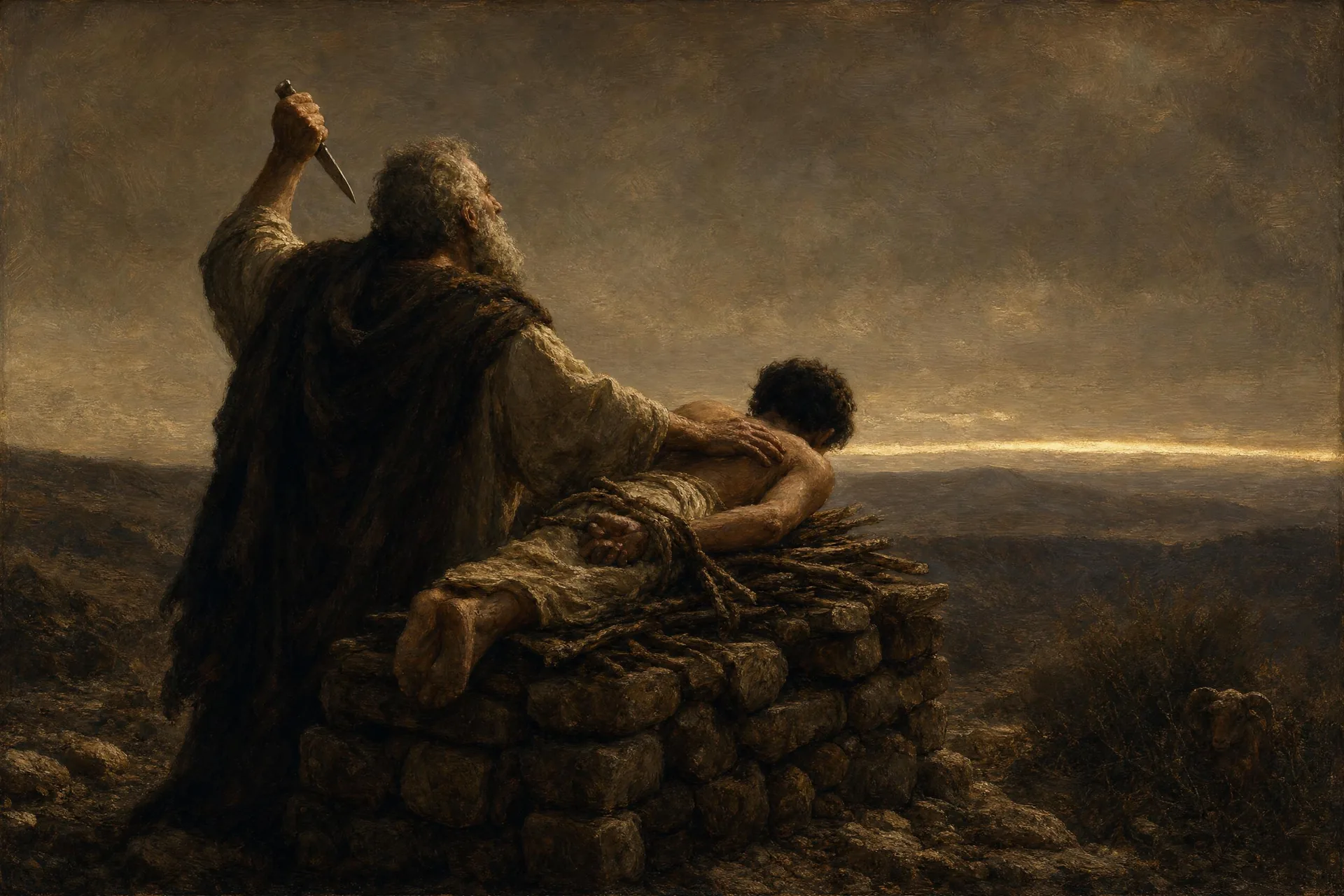
The Akedah: the silence that cannot become a rule
The Akedah is not difficult because modern people have become soft. It is difficult because the Torah made it difficult.
The command collides with everything already promised. Yitzchak is the child through whom the covenantal future is to be called. Child sacrifice belongs to the world Avraham's descendants will be taught to reject. The language slows down over the relationship: your son, your only one, whom you love, Yitzchak. The text does not numb the reader. It prevents numbness.
And Avraham rises early.
There is no negotiation. No reference to the promise. No chalilah lecha. Only the journey, the wood, the fire, the knife, and the answer to Yitzchak's terrible question: God will see to the lamb, my son.
What are we meant to learn from the silence?
Not that conscience is irrelevant. Not that a private command may cancel the moral law. Not that another human being can be reduced to the raw material of my religious achievement. Yitzchak is not simply Avraham's future or Avraham's possession. He is Yitzchak. Any interpretation that forgets his separate life has already learned the wrong lesson from the mountain.
The Akedah can be read safely only because the Torah itself seals it as an unrepeatable test. The knife is stopped. Yitzchak lives. The angel says what every later claimant to sacred violence must hear: do not stretch out your hand against the boy. Rabbinic tradition even places the contradiction back into Avraham's mouth after the test. Yesterday, he says, You told me that the future would be called through Yitzchak. Then You told me to raise him up. Now You tell me not to touch him. The silence of the journey does not abolish the argument. It postpones it until the danger has passed.
The Ramban explains that a divine test does not teach God something God did not know. It gives the human being a field in which what existed in potential can become action. The Akedah reveals the depth of Avraham's availability to God. It reveals that nothing in his life, not even the promise through which he understood his purpose, could be turned into an idol.
But the story's final revelation is equally binding: God does not desire the completed sacrifice. The test reaches the edge and stops. The ram replaces the child. The covenant continues through the son who comes down the mountain.
This is why the Akedah cannot become a portable permission slip for fanaticism. It is not a precedent for the person who says that God told him to suspend law, ethics, and the humanity of the person in front of him. In Judaism, revelation becomes Torah, and Torah becomes a public covenant with rules for prophecy, testimony, judgment, and life. A private voice does not inherit Avraham's mountain.
What survives as a daily teaching is narrower and harder: surrender your vanity, your control, your fantasy that the future belongs to you. Do not confuse that surrender with permission to destroy someone else.
Tanach's authorized protest
Avraham at Sodom is not an exception that the rest of Tanach corrects. He begins a lineage.
The argument: a partial ledger
- Moshe after the Golden Calf. God offers to destroy the people and begin again through Moshe. Moshe refuses the promotion. He invokes the Exodus, the patriarchs, the divine promise, and the judgment of Egypt. Later he says: if You do not forgive them, erase me from the book You have written. The leader ties his own fate to the people under judgment.
- Moshe after the spies. He argues from the meaning of God's Name among the nations. What will Egypt say if the people die in the wilderness? He quotes God's own attributes back to God. The decree changes shape.
- Chana at Shiloh. Berakhot hears audacity inside her prayer. She takes the body God created and turns its unfulfilled purpose into a plea. The prayer is intimate, almost prosecutorial, and the Gemara does not dismiss it as irreverence.
- Iyov. He refuses the explanations offered by friends who protect divine justice by accusing the sufferer. At the end, God rebukes the friends: you have not spoken of Me what is right, as My servant Iyov has. The defender of God can speak falsely. The wounded arguer can speak truly.
- Yirmiyahu and Chavakuk. The prophets address injustice directly upward. Why does the way of the wicked prosper? How long shall I cry and You will not hear? Prophecy does not eliminate protest. It gives protest a grammar.
- Chizkiyahu. Told to set his house in order because he will die, he turns to the wall and prays. The decree is not treated as a command to stop asking.
These arguments differ in tone and outcome, but they share a structure. They are made inside relationship. They use the language of covenant. They ask God to be faithful to promises, attributes, justice, mercy, or the meaning of creation. The protester does not stand outside and declare independence. The protester stands near enough to refuse indifference.
That nearness matters. There is a form of argument that is only disguised withdrawal. It has already decided that the relationship is false and uses the question as a performance of departure. Tanach knows that posture too. Its holy arguers are different. They risk anger because they have not left. Their protest is a form of presence.
Jewish prayer inherits this structure. We praise, remember, petition, confess, and ask. We tell God what the world looks like from below. We invoke God's compassion to God. We say heal us, forgive us, restore justice, hear our voice. The siddur is not the language of a people who think every decree makes petition meaningless.
When silence becomes the sin
Religious silence has its beauty. Vayidom Aharon, Aharon was silent, is one of the Torah's most devastating responses to irreversible loss. There are moments when explanation would be obscene, when the faithful act is to remain beside what cannot be repaired by speech.
But the silence after catastrophe cannot be imported into the moment before a preventable harm.
The silence: when tradition refuses to praise it
- Noach. God tells him the world will be destroyed. He builds the ark and, in the biblical text, offers no recorded plea for the generation. The Zohar contrasts him with Avraham and Moshe and connects the flood's later name, the waters of Noach, to the prayer he did not offer. The criticism is severe because private righteousness was not enough when a world was drowning.
- Yiftach and his daughter. A vow consumes a family. Rabbinic tradition imagines a path of annulment that pride prevented Yiftach and Pinchas from pursuing. Whatever one concludes about the difficult biblical narrative, Chazal refuse to romanticize religious rigidity when a life stands in the balance.
- The prophetic bystanders. Yeshayahu, Amos, Micha, and Hoshea attack societies whose worship continues while the weak are crushed. Korbanot do not compensate for hands full of blood. Silence in the sanctuary does not purify silence in the street.
- The friends of Iyov. They speak rather than remain silent, but their speech performs a deeper silence. They refuse to hear the sufferer's testimony. They defend a theory of God by making the wounded man guilty. Sometimes the sin of silence is committed with many words.
The difference is not simply speech versus quiet. Aharon's silence receives a loss he can no longer prevent. Noach's silence precedes a destruction for which he might have pleaded. The first may be grief without falsehood. The second can become piety without responsibility.
This is the moral danger of invoking the Akedah too quickly. People often call a burden your Akedah when they are not the ones carrying it. They transform another person's pain into a lesson about obedience and leave the person alone on the mountain. The story does not grant us that right.
If I choose sacrifice for myself, I may be approaching hineni. If I choose sacrifice for someone else, especially someone with less power, I had better hear chalilah lecha and al tishlach yadcha before I call my decision faith.
Kierkegaard saw the abyss, but Judaism does not live there
Kierkegaard's Fear and Trembling remains unavoidable because it sees what polite religion tries to hide. If Avraham can be explained entirely by ordinary ethics, then the Akedah has lost its terror. Kierkegaard calls the story a teleological suspension of the ethical. Avraham's absolute relation to God cannot be justified in the universal language of society. He becomes the knight of faith precisely because he cannot make himself publicly intelligible.
Kierkegaard sees something real. Faith cannot be reduced to respectable morality. The covenant makes demands that the autonomous self would not invent. Shabbat, kashrut, prayer, fidelity, restraint, obligation to people one did not choose, a life shaped by command rather than preference, all of this exceeds the modern idea that the good is whatever the sovereign self sincerely endorses.
But Judaism cannot make Kierkegaard's paradox portable.
The Akedah occurs before Sinai. Jewish life after Sinai is not governed by private, unreviewable encounters with the Absolute. It is governed by Torah, interpretation, courts, evidence, communal responsibility, and limits on prophetic authority. The prophet who claims a permanent repeal of Torah is false. The person who claims a divine command to murder cannot appeal to Avraham against the covenant that came after Avraham.
Rabbinic tradition also refuses to leave the contradiction mute. Rashi, drawing on the midrash, imagines Avraham naming the three divine statements: through Yitzchak your future will be called; raise him up; do not touch him. The answer insists that the command to raise him did not become a license to slaughter him. The midrash does not remove the terror, but it prevents terror from becoming theology's final word.
So the Jewish answer to Kierkegaard is not that obedience has no abyss. It is that the abyss has borders. The Akedah reveals the cost of covenantal availability. Sodom reveals the moral content of covenantal responsibility. Sinai prevents either story from being seized by private certainty.
The Jew must be capable of surrender, but Judaism does not grant the surrendering self sovereignty over another person's blood.
The mesorah built two safeguards
The tradition did not solve the tension by choosing conscience over law or law over conscience. It built safeguards against the corruption of both.
The first safeguard: conscience must learn the language of Torah
The Torah contains moral concepts that are not decorative: tzedek, mishpat, chesed, tzelem Elokim, darchei noam, kavod haberiyot, lifnim mishurat hadin, v'asita hayashar v'hatov. They do not erase specific law. They prevent law from being mistaken for a machine that has no need of judgment, character, context, or responsibility.
The Ramban reads you shall do what is right and good as a demand that exceeds the possibility of listing every decent act in advance. The Meiri's treatment of peoples bound by religion shows a halakhist reassessing application through categories internal to the tradition. Rav Kook states the principle with unusual sharpness: fear of Heaven that suppresses natural morality is not pure fear of Heaven. Rav Aharon Lichtenstein argues that Torah demands an ethical moment beyond narrow legal minimalism, while refusing the idea that an external ethic may simply overrule halakhah.
These are not identical positions. Together they establish that the moral sense is neither infallible nor irrelevant. It requires cultivation, Torah learning, self-suspicion, and hearing the testimony of people who bear the consequences of our conclusions.
The second safeguard: conscience does not rule alone
A sincere feeling is not yet a legal argument. A generation's moral confidence is not revelation. Human beings are skilled at naming appetite compassion, fear principle, and social approval justice. The person who invokes conscience must submit conscience to sources, precedent, facts, consequences, opposing arguments, and people authorized to decide.
That is not a device for suffocating moral truth. It is a device for preventing the self from becoming its own Sanhedrin.
Halakhic process can be slow, frustrating, and vulnerable to institutional failure. Yet the answer to bad process is accountable process, not private abolition. The tradition moves through argument disciplined by text, expertise, communal memory, and the knowledge that today's certainty may be tomorrow's embarrassment.
The two safeguards need each other. Conscience without covenant becomes fashion with sacred vocabulary. Covenant without conscience becomes habit with divine cover.
A working rule for the moment before speech
No formula can tell us infallibly when to say chalilah lecha and when to say hineni. But four questions can expose the counterfeit versions of both.
Four questions before argument or silence
- Who bears the cost? If I am volunteering another person's body, dignity, livelihood, family, or future, my claim to holy surrender is weak. If I am relinquishing my own status, comfort, control, or advantage, hineni may be the right beginning. This is not absolute. Chana and Iyov protest their own pain. It is a warning against making someone else's sacrifice the proof of my faith.
- What covenantal value is speaking? Can I name the Torah concept under pressure, and can I show that I am not using it as a slogan? Justice, dignity, mercy, truth, peace, and the prevention of suffering have sources, contours, and limits. The work is to reason with them, not merely pronounce them.
- Have I heard the person inside the question? Abstraction is morally cheap. A theory about the poor, the agunah, the convert, the gay Jew, the disabled child, the person with mental illness, or the person leaving observance can become a way of never meeting one. The covenant is not only a library of texts. It is also the demand not to avert one's eyes.
- Am I seeking truth, or immunity? Some people invoke obedience so they will not have to feel responsible. Others invoke conscience so they will not have to feel commanded. Holy argument remains answerable to the covenant. Holy surrender remains answerable to the humanity of the person affected.
One more correction is necessary. A contemporary moral intuition is not false because it is contemporary. Nor is it true because it is contemporary. Modernity has discovered real moral failures in inherited societies. Modernity has also turned appetite, autonomy, and public opinion into idols. The origin of an intuition does not settle its status.
The question is whether the intuition can survive translation into serious Torah reasoning, whether it sees facts accurately, whether it is willing to accept limits, and whether the communities defending the old practice are equally willing to examine whom the practice wounds and whether that wound is required.
Avraham did not say, the world has moved on. He said, shall the Judge of all the earth not do justice? But neither did he say, a decree is a decree, and therefore my moral hearing must be false. He listened to the outcry. Then he approached.

The hard cases: fidelity without cruelty
This essay does not issue pesak. It cannot resolve, in a paragraph, the questions on which serious halakhic authorities and communities labor for years. But it can refuse two evasions.
The first evasion says that contemporary compassion may erase any text that resists it. That is not mesorah. The second says that once a text is cited, compassion has no further work to do. That is not mesorah either.
Consider the lives of gay Jews. An honest Orthodox conversation cannot pretend that explicit biblical and halakhic texts are absent. It also cannot pretend that humiliation, family rejection, casual cruelty, public suspicion, and the reduction of a human being to one prohibited act are themselves mitzvot. They are not. Even where a prohibition stands, every surrounding question remains: language, dignity, confidentiality, belonging, mental health, family, prayer, friendship, and the obligation not to weaponize Torah against a person already carrying pain.
The same structure appears elsewhere. Agunot. Converts. Women seeking serious Torah learning and leadership. People with disabilities. Survivors of abuse. The divorced, the childless, the unmarried, the person whose faith has fractured. In every case, the halakhic question is real, and the human being is also real. One cannot be made imaginary to protect the other.
The moral pressure of a generation is not, by itself, pesak. It is also not noise. It is evidence. The mesorah must hear it, test it, separate insight from fashion, identify available legal categories, and answer. Sometimes the answer will change practice. Sometimes it will preserve practice while changing everything about the way people are treated. Sometimes it will say no. But a serious no must still be able to look at the person who bears it.
Here the Sodom posture is not a demand that every painful rule disappear. It is a demand that religious authority remain accountable to the Torah's own claims about justice, dignity, mercy, truth, and the image of God. Here the Akedah posture is not the command that vulnerable people silently accept whatever others place upon them. It is the willingness of every participant, especially the powerful one, to sacrifice certainty, convenience, reputation, and control in the search for a faithful answer.
The two counterfeit religions
There are two ways to end the argument.
The first makes the present age the final prophet. Whatever contemporary moral intuition affirms becomes sacred. Whatever it finds difficult becomes cruelty. Religion is permitted to remain only after it has translated itself into conclusions the surrounding culture already reached. This religion has compassion but no covenant, movement but no memory, and no reason to exist once the culture has spoken.
The second makes inherited practice the final prophet. Whatever has been done is presumed identical with what God wants. Every moral cry is treated as rebellion. Every victim is told that the pain is the point. This religion has memory but no hearing, law but no trembling, and no defense against the prophets who repeatedly told the observant that their worship had become an offense.
One counterfeit says every limit is cruelty. The other says every cry is disloyalty.
Avraham belongs to neither. At Sodom he refuses to call the decree just merely because it is divine. At the Akedah he refuses to make the promise his possession merely because it is divine. In both scenes he is faithful to God against the idolatry available in the scene: the idolatry of moral self-certainty in one direction, the idolatry of religious self-certainty in the other.
The covenant survives because neither argument nor obedience is allowed to become God.
Three sentences on the mountain
The image to carry is no longer a simple double exposure.
There is Avraham before Sodom saying chalilah lecha, far be it from You. There is Avraham at the foot of the mountain saying hineni, here I am. And there is the angel at the altar saying al tishlach yadcha el hana'ar, do not stretch out your hand against the boy.
Argument. Surrender. Limit.
All three belong to the covenant.
Without chalilah lecha, religion becomes morally deaf. Without hineni, religion becomes the decoration of the autonomous self. Without al tishlach yadcha, religion becomes dangerous.
The first Jew had to learn all three. So do we.
The work of emunah is not to choose one sentence forever. It is to become the kind of person, and the kind of community, that can know which sentence faithfulness requires before the next hand moves.
Sources and further reading
- Bereishit 18:17 to 33, God's disclosure and Avraham's plea for Sodom.
- Bereishit 22:1 to 19, the Akedah and the command to stop the knife.
- Rashi on Bereishit 22:12, citing the midrashic exchange about the promise, the ascent, and the command not to touch Yitzchak.
- Ramban on Bereishit 22:1, the test as the movement from potential into action.
- Shemot 32:9 to 14 and 32:30 to 32, Moshe's defense of Israel.
- Bamidbar 14:13 to 19, Moshe argues from God's Name and reputation.
- Berakhot 31b, Chana's audacious prayer.
- Iyov 42:7, God's rebuke of the friends who defended Him falsely.
- Yeshayahu 54:9, the phrase "waters of Noach," later read critically by the Zohar.
- Rav Kook on natural morality, including the warning against a fear of Heaven that suppresses moral nature.
- Rav Aharon Lichtenstein on ethics beyond formal law, a qualified moral demand within the world of Torah.
- Kierkegaard and Fear and Trembling, background to the teleological suspension of the ethical.