
What happens after progress works? We know how to make life longer, safer, faster, and more comfortable. We are less sure what all that saved life is for.
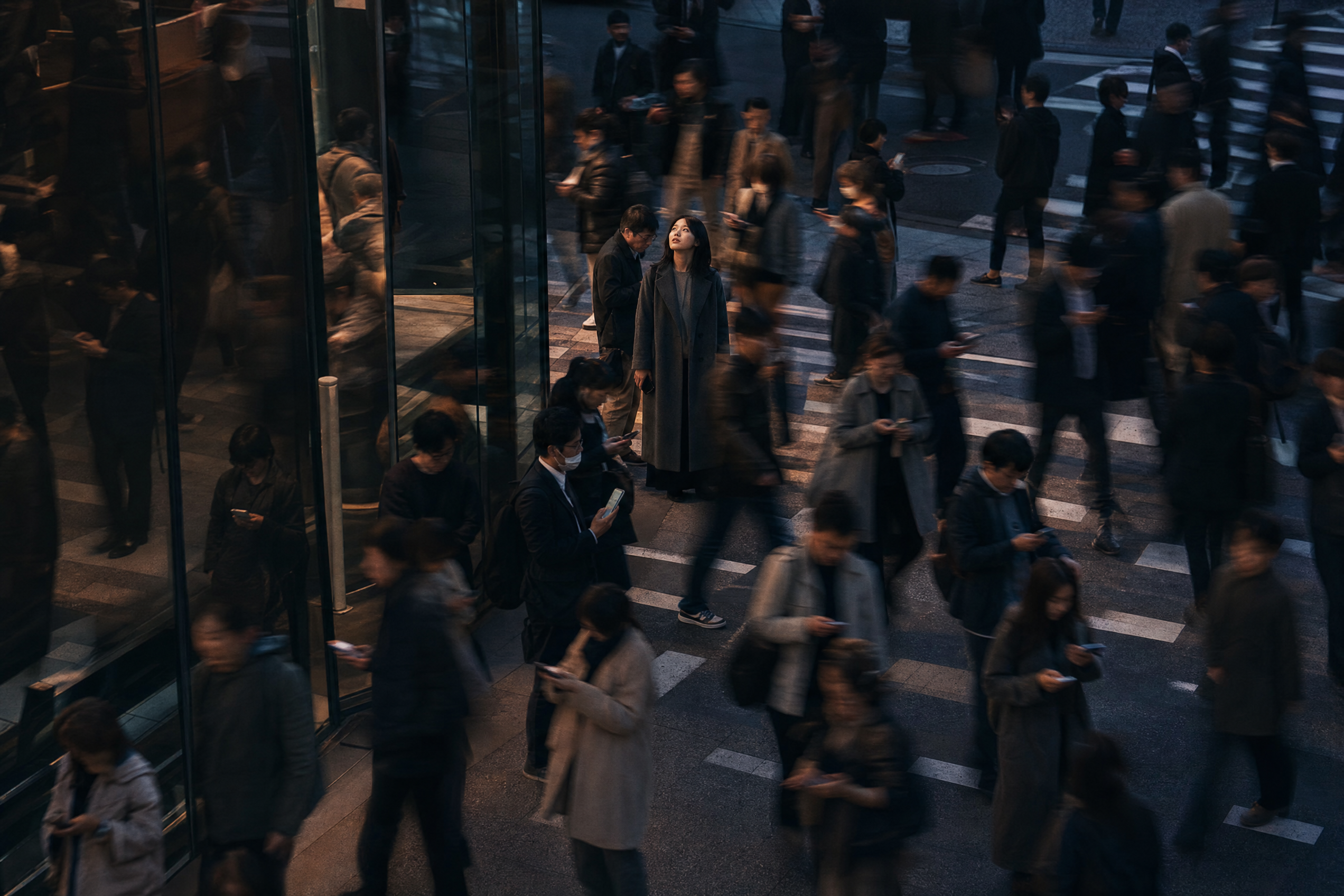
The first thing many of us touch in the morning is not another person, the floor, water, or even our own face. It is a rectangle of glass.
Before the body has fully returned from sleep, the world is already waiting. Messages, markets, war, weather, other people's children, other people's victories. A machine has arranged reality according to our prior reactions, and we enter it before we have decided what deserves our attention.
The phone is not a villain. It may contain a note from someone we love, an answer that saves an hour, or a scan that saves a life. Its danger is quieter. It can answer us so quickly that we stop noticing which questions require more than an answer.
For two centuries we have made the physical world more survivable. Childbirth became safer, food more abundant, work less brutal, infection more treatable, and childhood death less common. Global life expectancy has more than doubled since 1900.10 Annual deaths of children under five fell from roughly 12.5 million in 1990 to 4.9 million in 2024.11 The old catastrophes did not vanish. They retreated far enough that we can forget how much knowledge, courage, and organized care forced them back.
The second ledger is harder to read. Recent global estimates report close to 1.2 billion people living with mental disorders, now among the largest sources of disability on earth.12 Population growth, better diagnosis, reduced stigma, war, inequality, family instability, and the pandemic all belong in the explanation. Blaming one object in our pockets would be intellectually lazy.
But the contrast exposes a real mistake. Competence is not meaning. A body can be safer while a life becomes harder to inhabit.
Arthur C. Brooks has spent years studying that gap. His earlier work described three parts of happiness: enjoyment, satisfaction, and meaning. It also named four investments that tend to sustain a life: faith, family, friendship, and work that serves. His newer argument, in The Meaning of Your Life, is that pleasure has become easier to obtain, achievement remains available to strivers, and meaning has become harder to reach.5
Technology did not create the entire crisis. It became an unusually efficient way to avoid hearing it.
The loop is ordinary. We feel lonely, bored, anxious, or vaguely unreal, so we reach for the phone. It relieves the discomfort without explaining it. The need remains, and ordinary life feels flatter when we return. So we reach again.
Nothing forces us. Convenience trains us. Each time discomfort is removed before it speaks, silence becomes harder to bear the next time.
The minutes we no longer inhabit
Brooks's most compelling insight concerns boredom.1 The modern phone has not merely changed what we do. It has colonized the intervals in which we once did nothing.
The elevator. The line at the pharmacy. The red light. The two minutes before a friend arrives. The silent stretch after a difficult sentence. The first hour of the morning and the last hour of the night. These were once small chambers in which the mind wandered without instruction. Now they are inventory.
To call those minutes boredom makes them sound disposable. Brooks asks us to see them as the workshop of meaning. When attention is not occupied by a task, the mind begins to integrate. It replays an encounter, imagines a future, recognizes an unease, forms a question. Not every empty minute produces revelation. Most do not. But a life with no empty minutes produces almost no conditions under which revelation can arrive.
This is why the phone can feel like relief while functioning as deprivation. It saves us from the discomfort that precedes reflection. We consume the anesthetic and lose the operation.
Brooks sometimes explains the split through a broad left-brain and right-brain story drawn from Iain McGilchrist. One side handles narrow questions of what and how. The other receives beauty, mystery, love, and the question of why.
The neuroscience is too neat. Researchers find lateralization for particular tasks, not two moral personalities living in separate hemispheres. Critics are right to resist turning a networked brain into a sermon illustration.6
The better distinction is not between two halves of the brain. It is between questions that end when information arrives and questions that ask the person receiving the information to change.
A day made entirely of solvable tasks can starve the part of us that lives by questions no machine can settle. What is worth loving? What do I owe? What is my work for? Who am I when no one is measuring, liking, buying, or replying?
A search engine can retrieve other people's answers. It cannot do the answering for us.
The evidence is quieter than the panic
The case against digital life is easiest to dismiss when it tries to explain everything. Screens do not produce one effect in every person. A lonely child who finds a real community online is not having the same experience as a secure child who spends three hours comparing her body with edited strangers. A video call across an ocean is not equivalent to a feed that replaces dinner with the people in the next room.
Large reviews often find small average relationships between screen use and mental health. The effect changes with age, vulnerability, platform, content, time of day, and whether the person is creating, speaking, scrolling, or comparing.
Mixed evidence does not acquit every design choice. It tells us that the important question is not simply how many hours a screen is present, but what human activity it carries, interrupts, or replaces.
In a University of Pennsylvania experiment, 143 students were randomly assigned either to continue their normal use of Facebook, Instagram, and Snapchat, or to limit each platform to ten minutes a day. After three weeks, the limited group reported less loneliness and depression.7 In a much larger experiment published in the American Economic Review, people paid to deactivate Facebook for four weeks gained about an hour a day, spent more time offline with friends and family, and showed a small but significant improvement in subjective well-being. They also knew less news. The trade was real.8
Another experiment placed groups of friends and family in restaurants. Some kept their phones on the table. Others put them away. The people with phones available felt more distracted and enjoyed the meal less. Nothing dramatic happened. No one had a breakdown. The machine simply took a thin slice of the experience, and then another.9
This is how the device age often takes something from us. Not through one dramatic theft, but through slight subtraction repeated until the missing thing becomes difficult to name.
Brooks's most useful rule is that technology should carry us toward human relationship rather than stand in for it. A message that arranges a meeting helps. A video call when presence is impossible helps. An endless exchange of low-resolution contact that replaces the meeting, the touch, the shared room, and the unedited face does something else.
A screen is a good window. It becomes dangerous when we begin living beside the picture and forget there is a world outside it.
Representation is not presence
Digital life is real. That is why the problem is difficult.
A FaceTime call with a grandparent is real. A text that reaches a despairing friend at the necessary moment is real. Digital money buys real bread. A person with a rare disease may find the only people who understand her through a screen. Technology has not abolished reality. It has carried real mercy across distances that once defeated it.
The problem begins when representation crowds out encounter.
Mediation has become the default layer between the self and almost everything it meets. The meal arrives through an app. The friend arrives as a notification. Work arrives as a dashboard. Desire arrives already ranked. Beauty arrives cropped and evaluated. Suffering arrives as content. Even memory returns as a prompt from a platform.
Each thing is real enough to hide what it lacks. A feed contains people without requiring our presence. It contains events without participation, information without wisdom, and evidence of other lives that can quietly remove us from our own.
In one of my earlier essays, I argued that simulation theory is the secular world's strange confession that visible reality is not the bottom layer. The simulation theorist asks, "What if none of this is real?" The Jewish answer is more demanding: it is real, but its reality is borrowed, veiled, and waiting to be lifted.
That difference matters here. The answer to the Matrix is not contempt for the material world. Judaism is not a religion of escape from the body. Food matters. Sex matters. Money matters. Time matters. The face matters. The table matters. Repair happens inside the world, not by fleeing it.
The task is not to become less embodied so that we can compete with the machine. It is to become embodied again.
The cure was faster than the soul
This is where Brooks's research enters a much older argument in the Jewish tradition.
A Mishnah records that King Chizkiyahu hid a Book of Cures, and the Sages praised him. Rashi's explanation is unsettling: the remedies worked so well that the sick recovered before illness could humble the heart. The cure arrived before the soul knew what to do with it.
The Rambam protests. Medicine is like bread. We do not tell a hungry person to refuse food in order to deepen his trust in Heaven. We bless the bread and eat. A cure belongs to the suffering body, and hiding it would be cruel.
The disagreement becomes clearer when we separate two questions.
The Rambam tells us what to do: heal. Build. Use knowledge to relieve suffering. A child is not a teaching aid, and a widow's cry is not material for someone else's spiritual growth. The Book of Cures belongs open.
Rashi tells us what success can do to us. When relief arrives immediately, competence can begin to feel like a complete theology. Dependence disappears from view. A world tended by extraordinary systems starts to look as if it tends itself.
Technology did not betray us by failing. It succeeded in one domain so completely that we began treating the victory as a complete account of the person who had been saved.
The argument appears again in Rav Joseph B. Soloveitchik's two Adams. Adam I is majestic humanity, the builder, scientist, founder, physician, and engineer. He asks how. He is commanded to master the earth, and his mastery is part of the divine image. Adam II is covenantal humanity, lonely, addressed, receptive, and answerable. He asks why. He does not conquer the world. He stands inside it and listens.
Modernity did not create Adam I. Genesis did. The error was not building. The error was imagining that the builder was the whole person.
We perfected Adam I's tools and left Adam II homeless.
Arthur Brooks describes the result as a meaning crisis. Rav Soloveitchik described it as structural loneliness. The languages are different, but the room is the same. The human being has enormous power and no one to be powerful for. He has more years, more choices, more comfort, and fewer inherited answers to the question of what any of them mean.
The mental health crisis cannot be reduced to this spiritual diagnosis. Depression is an illness, not a philosophical failure. Anxiety has biological, social, economic, and traumatic causes. No one should be told to replace treatment with a sermon on meaning.
But the reverse reduction is also a mistake. Not every pain is a chemical error. Some forms of despair are intelligible responses to a life stripped of coherence, purpose, and significance. A society may need more therapists and also need more reasons to wake up. Treatment can help a person survive the question. It cannot decide the answer.
Progress was not the mistake
The easiest wrong turn is nostalgia.
We imagine the pre-digital village as a realm of thick community, honest labor, stable identity, and unbroken attention. Some of it was. It was also a place where women died in childbirth, children died of infections, strangers could remain strangers forever, disabled people were confined by distance, and knowledge moved at the speed of a horse.
Nostalgia is not a moral framework. Pain did not become holy merely because it was common.
I remain on the side of progress. The physical layer is the floor, not the ceiling. Once the floor stops collapsing, the higher questions do not disappear. We can finally hear them.
Material abundance does not produce happiness by itself. That is not an argument against abundance. It is a warning against asking material tools for a spiritual result.
The laboratory cannot supply meaning, but that does not make the laboratory a mistake. The market cannot teach gratitude, but that does not make prosperity a sin. The phone cannot love us, but that does not make communication across distance worthless. We keep asking our tools to answer the question of what the tools are for, then resenting them for their silence.
A hammer cannot tell you whether to build a hospital or a tower. An algorithm cannot decide whether attention should serve love or appetite. A model can optimize the signal it is given. It cannot consecrate the signal.
The cure for technological domination is not less technology in every domain. It is less technological logic in the domains it cannot govern.
Let machines solve solvable problems. Let them reduce waste, find tumors, translate languages, route medicine, and carry a daughter's face across an ocean. But do not ask the machine to decide what deserves attention, what suffering means, who should be loved, or what a human being is for. Those are not difficult engineering problems awaiting more compute. They belong to another category.
They require covenant, obligation, memory, sacrifice, and presence. They require other people in rooms.
Shabbat and the right to stop
Brooks's practical advice is intentionally modest.234 Keep the first hour of the day free of the phone. Keep devices away from meals. Put them down for the last hour before sleep. Create phone-free rooms. Turn off notifications. Take walks without headphones. Practice boredom. Use technology to arrange embodied life rather than replace it.
These are good rules. Their smallness is a virtue. A meaning crisis experienced through thousands of tiny substitutions may have to be reversed through thousands of tiny refusals.
Jewish tradition goes beyond digital hygiene. It gives attention a form that does not depend on willpower.
A blessing before bread interrupts consumption with gratitude. Prayer interrupts self-direction with address. A minyan interrupts private spirituality with obligation to other bodies. Mourning has a calendar. Joy has a calendar. Work has a boundary. Desire has a form. The law does not wait for the right mood. It carries the person when the mood cannot carry itself.
And then there is Shabbat.
For twenty-five hours, conquest stops. The builder is not told that building was evil. He is reminded that he is more than the builder. The merchant cannot transact. The executive cannot measure. The creator cannot modify. The phone can sit dark while the world continues without his management.
Shabbat returns us to the part of reality that productivity hides.
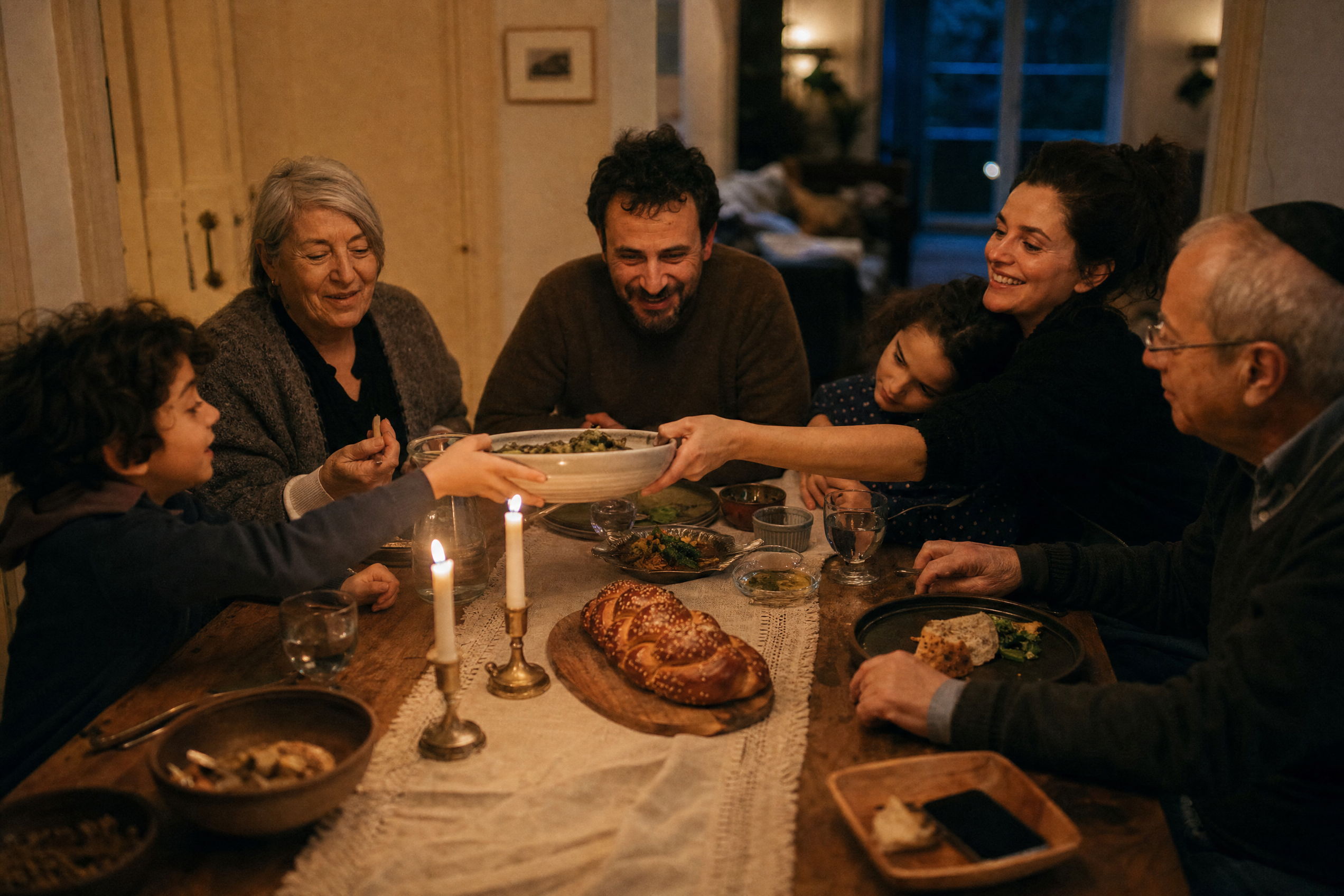
Shabbat places bodies around a table. It slows food into a meal and contact into company. It makes a person encounter the frightening fact that existence does not have to justify itself through output. It is the weekly rehearsal for the world Brooks fears we have forgotten, a world in which love, beauty, worship, conversation, and rest are not recovery strategies for more work. They are part of what the work was for.
In an age of abundance, Shabbat stops looking like an ancient inefficiency. It starts looking like advanced civilizational knowledge.
The phone offers a personalized world with no stopping point. Shabbat offers a shared world with a border. The feed says there is always more. The table says this is enough. The device asks what else. The blessing asks whether we have noticed what is already here.
The practice of the real
If the meaning crisis is real, the remedy cannot remain a private optimization plan. One person can turn off notifications. One person cannot create a culture of presence alone.
We need homes in which devices have doors they do not cross. Schools in which attention is treated as a human capacity worth protecting. Workplaces that do not convert every silence into availability. Religious communities that offer more than content and branding, and ask for actual attendance, service, learning, and responsibility. Cities with places where people can linger without being required to purchase distraction.
We also need a more demanding idea of friendship. Brooks's four pillars include family and friendship because meaning is not primarily manufactured inside the isolated self. It is conferred through being needed, known, and bound. The question is not only whether I have people I can call. It is whether there are people who can call me and make a claim on my time.
That claim is often inconvenient. This is how we know it is real.
The digital world is built to remove friction. Love often arrives as friction. A child interrupts. A friend repeats himself. A spouse is not optimized to preference. A community asks us to show up when we are tired. A body becomes sick. A parent ages. The meaning of these relationships is inseparable from the fact that they resist customization.
The Matrix is frictionless because nothing in it is finally allowed to make a claim on the person consuming it. Reality is full of claims.
The answer is not a theatrical rejection of technology. It is a hierarchy.
The book belongs open. The hospital belongs built. The model belongs trained. The message belongs sent when it carries real mercy. And the phone belongs face down when a face is in front of us.
We should keep making the body safer. We should keep curing, building, and discovering. But the success of that work creates a second obligation, one the engineers cannot discharge for us. We must build lives capable of receiving the world we have repaired.
That means protecting boredom long enough for a question to form. Protecting silence long enough for an answer not to be immediate. Protecting meals, mornings, evenings, worship, friendship, beauty, and the unmeasured presence of another person. It means teaching our children that attention is not merely a resource to be allocated. It is the substance of love.
Arthur Brooks is right about the crisis, even where his neural map is too neat. We are not unhappy because everything technological is false. We are unhappy because too many true things now reach us in forms too thin to nourish us, and because the devices that relieve our loneliness are poorly designed to end it.
The remedy is to become human on purpose.
The machine can help us reach the world, the person across the table, the work, and the Source. It cannot decide that any of them matter.
That decision begins each morning, before the glass is touched. It is renewed at the table, when a face asks more of us than a feed ever can. And one day in seven, the tools are set down so the world we worked to heal can finally become a home.