
The first argument for God that I trust is not an argument. It is the way my children look back at me. It is my wife loving them when no one is watching. It is what enters a room when a child is born, when someone dies, when a business begins to work, or when the ground under it gives way. The facts in those moments are real. They also seem to point beyond themselves.
That is not proof. A feeling can mislead, and human beings are remarkably good at finding patterns that are not there. Philosophy matters for exactly that reason. I care about the cosmological argument, the moral argument, consciousness, fine-tuning, and the old question of whether existence explains itself. But the arguments arrive after experience. Before I can say what God is, the world already feels addressed. Love seems larger than appetite. Grief seems larger than chemistry. Joy feels not merely pleasant, but given.
Abraham Joshua Heschel called this radical amazement. “The beginning of awe is wonder,” he wrote, “and the beginning of wisdom is awe.” That is where I begin. Not with certainty as a possession, but with awe as a form of perception.
My claim is simple, though not small: belief is the default setting of the human soul. I do not mean that every doubt is dishonest or every believer perceptive. I mean that meaning, obligation, relationship, and surprise meet us before any theory about them does. A secular explanation may account for those experiences. It does not become neutral merely by leaving God out.
Nor do I mean a thin, sentimental belief in a God who asks nothing. I do not mean the vague God of inspirational posters, or Aristotle’s unmoved mover watching an orderly cosmos from a metaphysical balcony. I mean the God of Sinai. The God who interrupts the week, limits appetite, commands justice, and asks to be answered.
Aristotle’s God will not ask whether you sent one more email on Shabbos. Sinai will.The claim of covenant
A demanding God is an inconvenient invention.
Disbelief can be courageous. Some people reach it honestly, after suffering, study, or years of unanswered prayer. I respect that. What I do not accept is the cultural filing system that places disbelief under adulthood and belief under childhood. That is not reasoning. It is a social convention wearing the clothes of reasoning.
If people invented God only for comfort, they designed a strange comfort. The God of the Torah says, “Rest now,” when the business is exploding; “forgive,” when you are right; “give,” when you are afraid; and “sanctify,” when you would rather consume. This God does not flatter every instinct. He places a claim against it.
That does not prove the claim comes from heaven. Human beings can invent demanding systems too. It does mean that faith cannot be dismissed simply as the easier life. Faith is difficulty placed inside a covenant, with the possibility that the demand itself is holy.
Maimonides begins his great code of Jewish law with the sentence: “The foundation of all foundations and the pillar of wisdom is to know that there is a Primary Being.” He does not begin Judaism with mood, tribe, nostalgia, or comfort. He begins with a claim about reality. Heschel adds that reality is not merely something to prove. It is also something to encounter.
Blaise Pascal put it in a line that survived because it names a limit our rationalist age dislikes admitting: “The heart has its reasons which reason knows nothing of.” This is not an attack on reason. It is an objection to shrinking reason until it recognizes only what can be measured, then calling everything outside the ruler unreal.
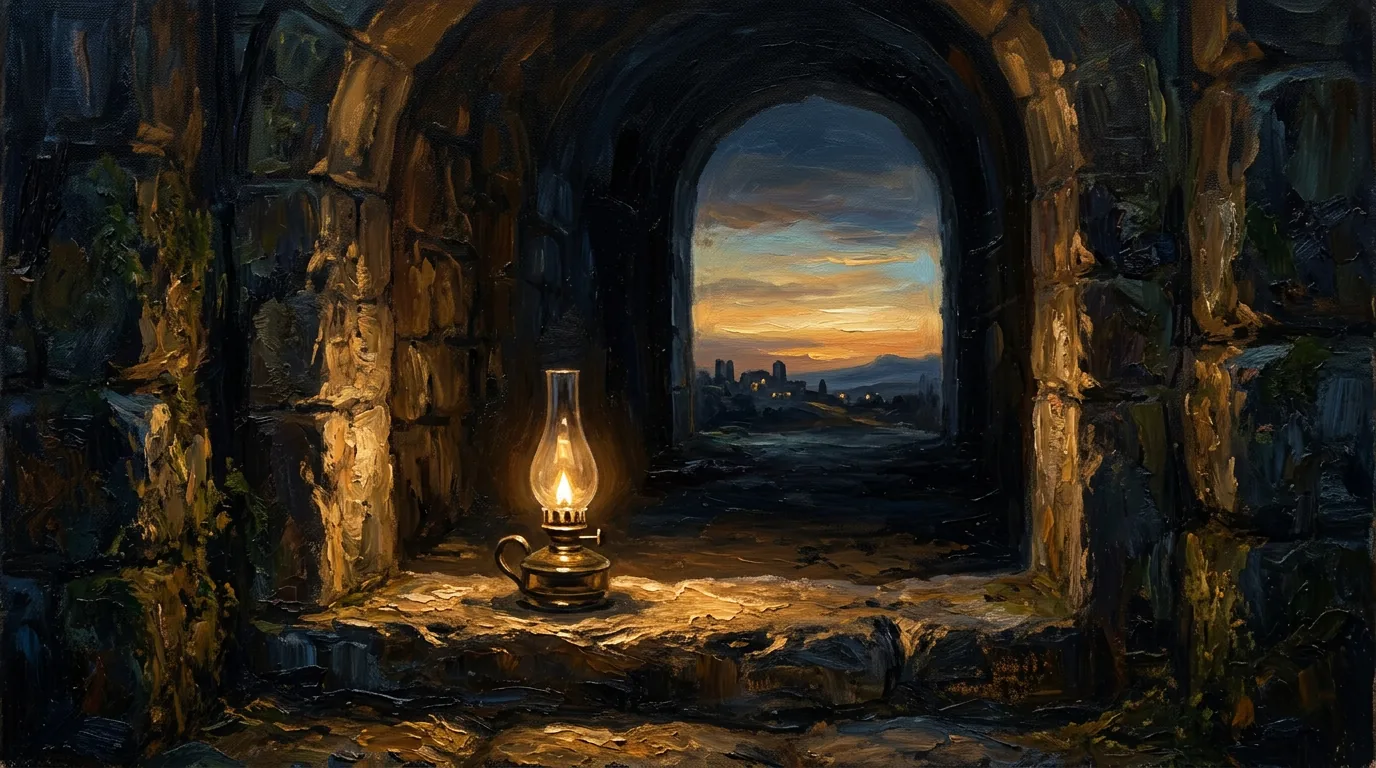
The hardest test of belief is not logic. It is grief.
A serious person can look at the world and go either way on God. God’s existence is not a math problem with an answer waiting at the bottom of the page. Belief explains some things and makes others harder. It tells me why love feels sacred, why murder is more than damage, and why beauty can feel like a summons. Then it places me in front of Job: Why suffering? Why silence? Why would a good God make a world with so many hospital rooms?
Any faith that cannot remain in that room is too small. Faith does not remove the questions. At its best, it refuses to insult them with an easy answer and gives them the dignity of being asked to Someone.
When tragedy struck my family, belief did not make grief tidy. Nothing could. Explanations can become obscene while the wound is open. Judaism does not hand the mourner a theory. It tells the mourner to sit low, tear a garment, receive food, say Kaddish, and let a community carry what one body cannot. It does not explain the dead. It sanctifies the act of mourning them.
That mattered to me. Belief gave grief somewhere to stand. It let tears be more than chemistry and memory more than neural residue. It allowed love to remain true even when the person I loved was no longer available to my senses.
The secular account is not false because it is incomplete. Evolution can explain parental attachment. Neuroscience can describe grief. Economics can describe a business. My claim is narrower: those descriptions do not exhaust the life I experience. I encounter children entrusted to me, chesed in my wife’s love, blessing that can become pride, and failure that can be mistaken for abandonment.
“To believe in God means to see that the facts of the world are not the end of the matter.”Ludwig Wittgenstein
“I believe in Christianity as I believe that the sun has risen, not only because I see it but because by it I see everything else.”C. S. Lewis
I would say something similar about emunah. I do not see God directly at every moment. Often I do not see Him at all. I believe because creation makes more sense of the whole life than accident does, including the parts that resist belief.
Jewish history cannot prove Sinai. It can still test the story.
Jewish survival is not a laboratory proof for God. History has too many causes, and faith should not need bad statistics to defend it. A people can survive through geography, institutions, family structure, literacy, luck, and the pressure of enemies. Naming those causes does not make the survival ordinary.
Imagine standing at Sinai more than three thousand years ago and hearing this claim: a small people will carry a law, a language, a memory, and an account of the universe’s moral structure. They will be exiled, conquered, mocked, massacred, scattered, tempted by every surrounding civilization, and repeatedly told that their chapter is over.
Thousands of years later, how would you test whether Sinai had failed?
Three questions seem fair.
On all three tests, the result is astonishing. The old Jewish joke says: they tried to kill us, we survived, let’s eat. It is funny because the compression is absurd. It is also recognizable.
Jews are roughly two-tenths of one percent of humanity and have received a radically disproportionate share of the Nobel Prizes. That statistic is not an argument for Sinai, and achievement is not moral superiority. It is one consequence of a continuity that deserves attention. Einstein changed our understanding of matter and time. Freud changed the vocabulary of desire. Marx changed the politics of history. One can admire them, reject them, or do both. Jewish minds kept appearing wherever modernity was trying to understand itself.
The pattern continues in technology. No serious history of computing or artificial intelligence can avoid John von Neumann, Norbert Wiener, Marvin Minsky, Judea Pearl, Yoshua Bengio, and Ilya Sutskever. Many were secular, skeptical, or far from observance. Still, they inherited a chain built by people who kept Shabbos under pressure, learned Torah in poverty, taught children to read, married into the people, and refused to disappear. Halakhah carried the chain long enough for some of its descendants to rebel against it.
This creates no religious debt. Faith is not an invoice, and ancestral sacrifice does not compel observance. It does mean that the modern Jewish story often forgets the infrastructure that made a modern Jewish story possible.
The modern Jew who rejects the tradition may still be standing on a bridge the tradition built.The forgotten infrastructure

A belief that never reaches the calendar has not yet been tested.
The modern world wants spirituality without commandment. It wants transcendence as an experience, preferably one that fits between meetings. Judaism asks a less flattering question: can your spirituality survive contact with your calendar, your table, your speech, your marriage, your employees, and your bank account?
Some mitzvot feel luminous at once: Shabbos, charity, honoring parents, visiting the sick, guarding speech, returning lost objects, letting workers rest, and leaving the corners of a field for the poor. Others are harder. Some feel strange or ancient in the wrong way. Some collide with modern moral intuition. A serious believer should not pretend otherwise or turn each difficulty into a slogan.
My discomfort matters, but it is not infallible. Every age mistakes some prejudice for moral clarity. A commandment that embarrasses me may reveal a genuine moral problem. It may also expose an assumption I have never examined. Humility has to cut in both directions.
Rav Kook’s great phrase was: “The old will be renewed, and the new will be sanctified.” The religious task is neither to freeze the old because it is old nor worship the new because it is new. It is to test both, then renew the old and sanctify the new.
Halakhah is the technology of that test. It takes the largest claims a person can make and brings them into the smallest units of life. What do you eat? When do you stop? How do you speak about someone who is absent? What do you owe a worker? What blessing belongs in your mouth before bread? The infinite enters finite life through detail.
The Midrash says God desired “a dwelling place in the lower worlds.” Not an escape from the world, but a dwelling within it: kitchens, courts, bedrooms, hospitals, businesses, and calendars. The point is not to float above ordinary life. It is to make ordinary life capable of hosting God.
Emunah begins where certainty ends and fidelity remains.
I believe with the difficulty included. I take in the beauty and the friction, the commands that illuminate me and the ones that unsettle me, the days when God feels near and the days when prayer strikes the ceiling and falls back into the room.
I do not believe because every question has been answered. I believe because the alternative explains too little of the world I inhabit. It explains mechanism but not meaning, the body but not the face, reproduction but not the trembling awe of parenthood. It explains grief’s chemistry without touching grief’s sacredness. It can describe Jewish survival as accident, Jewish law as sociology, Jewish longing as nostalgia, and Jewish return as politics. Each account may contain truth. Together they still feel thinner than the life they describe.
The world is not self-explanatory. Neither are consciousness, moral obligation, love, the Jewish people, or the human hunger for meaning. I have read secular accounts of all of them and learned from those accounts. I simply do not think description becomes explanation because God was omitted from the sentence.
Faith, for me, is not a leap away from reason. It is a refusal to remove the parts of reality that do not fit inside a smaller frame. It is trust in the fuller account, followed by the harder step of living as if that account makes a claim on me.
Not blind belief. Not easy belief. Not the absence of doubt.
Emunah is trust under pressure. It is Abraham walking without a map, Moses arguing at the bush, Job protesting from the ashes, Jews lighting candles in exile, and parents whispering Shema to children who will have questions of their own.
It is the old Jew looking toward heaven and saying, “Master of the Universe, I do not understand You, but I am still here.” Then he puts on tefillin.
That may be the most Jewish theology ever written: complaint and covenant in the same breath.
I believe because my children seem entrusted to me, not merely produced by me. I believe because Shabbos makes the world sane for twenty-five hours. I believe because the Jews are still here and Sinai is still speaking.
Beneath the arguments and counterarguments, before the books and after the grief, the world still feels addressed.
The default is belief. The work of a life is learning how to answer.
Key sources woven into the essay include Abraham Joshua Heschel, Who Is Man? and God in Search of Man; Maimonides, Mishneh Torah, Yesodei HaTorah 1:1; Joseph B. Soloveitchik, The Lonely Man of Faith; Pascal, Pensées; Wittgenstein, Notebooks 1914-1916; C. S. Lewis, “Is Theology Poetry?”; Rav Kook, Igrot HaRa’ayah; Midrash Tanchuma; Pirkei Avot; Berakhot; Shevuot; and Sanhedrin.