The small gravestones
Walk through an old Jewish cemetery and you will notice something before you can say what it is. The stones are too small. Some are the size of a shoebox. There are whole rows with one date instead of two, or with two dates only a few years apart.
Those were not plague years, mostly. They were ordinary years. In the world that carved those stones, close to half of all children died before they grew up. Losing a child was not a break in the pattern of life. It was part of the pattern. My great-grandmothers lived in that world. They said the same Shema we say and kept the same Shabbat, but nothing on earth could promise a mother that her child would still be alive next winter. Not a doctor, not a rebbe, not money.
Once you see the stones, something in the mesorah comes into focus. The widow and the orphan are everywhere in the Torah because the world made widows and orphans everywhere. Their suffering was not an edge case. It was one of the main facts of human life.
Then the fact changed.
Around 1800, roughly 43 percent of children died before the age of five. In 2023, the global figure was about 3.7 percent. Life expectancy rose. Famine retreated. Maternal death became far less common. Smallpox, which killed an estimated 300 million people in the twentieth century, was eradicated. A child born now is far less likely to be buried young, orphaned, or starved than a child born in almost any earlier age.
We are so used to this that we call it normal. Historically, it is astonishing.
Who did it? Scientists, doctors, farmers, engineers, public health workers, businesspeople, civil servants, and many others whose names never entered the story. Most did not think they were answering the Nevi'im. Some had left religion entirely. Their motives were the usual human mixture of compassion, curiosity, ambition, money, and the desire to solve a hard problem. Motives matter. Still, the children lived.
Religious thought has trouble knowing where to put this. One instinct treats it as better plumbing, useful but outside the real spiritual story. Another turns progress into redemption and blesses every new power because it is new. The first cannot recognize mercy when it arrives through a laboratory, a sewer, or a supply chain. The second forgets that Bavel was a building project too.
There is a question between those two mistakes. What does Torah call the work of preventing suffering rather than only responding to it? What does it ask of a person whose hands can now reach farther than his eyes?
I think the mesorah already contains an answer. It is scattered across the prophets' concern for the weak, the first command to Adam, the Rambam's highest level of tzedakah, Rav Chaim's definition of a rav, Chizkiyahu's hidden medical book, the bronze serpent, Shabbat, Bavel, and Avraham's tent. Together they describe a kind of service: use human power to reduce suffering, then place that power under law, gratitude, and restraint.
I call it Avodat HaTikkun, the service of repair.
The second lever
For most of history, chesed worked beneath a hard ceiling. A community could feed the widow next door, but it could not prevent the disease that made her a widow. It could divide a harvest more justly, but it could not reliably make the harvest larger. It could visit the sick. Often it could not cure them.
Chazal built close to the edge of what their world allowed. Tzedakah became an obligation that a community could compel. The kupah and tamchui fed people. Hospitality, bikur cholim, pidyon shvuyim, and burial became communal duties. The Torah says that God hears the cry of the widow and orphan directly, and Chazal turned that sentence into institutions.
They filled the available space with care. The limit was not moral imagination. The limit was the instrument.
Modernity changed the instrument. Production began to outrun population. Disease became understandable and sometimes preventable. Food, medicine, knowledge, and credit could travel farther. Compassion still had to answer the person already suffering, but it gained a second lever: it could change some of the conditions that produced the suffering.
The historical estimates are imperfect. Records thin out as we go back, and definitions change. But the uncertainty is about the exact size of a transformation whose direction is not in doubt.
| Measure | Around 1800 | Recent estimate | Main sources |
|---|---|---|---|
| Children dying before age five | about 43% | about 3.7% | UN IGME; Our World in Data |
| Global life expectancy | roughly 30 years | about 73 years | UN Population Division; Our World in Data |
| Humanity living in extreme poverty | nearly 80% | about 10% at the current World Bank line | World Bank; Our World in Data |
| Adult literacy | about 10 to 12% | about 87% | UNESCO; Our World in Data |
| Smallpox | about 300 million deaths in the twentieth century | no natural cases; eradicated in 1980 | WHO |
Dispute one cell if you like. The table still says what it says. Many of the disasters Jews spent three thousand years praying to escape became much less likely.
Most of that relief came through places our religious imagination does not instinctively recognize as places of chesed. It came through sanitation, vaccines, refrigeration, seed science, roads, schools, contracts, and the unglamorous competence required to make a system work far from its center.
Smallpox makes the point cleanly. It created widows and orphans on a scale no local charity could absorb. Its eradication required vaccination, surveillance, persuasion, manufacturing, and logistics across the world. The achievement did not turn the World Health Organization into a religious institution. It revealed that religion needs a category for what happened.
Our picture of chesed has not caught up. We still imagine someone crossing a room with a bowl of soup. That picture is holy and should never disappear. But compassion can also move through a water system, a clinical trial, a school, an insurance design, or a company that makes something necessary cheaper. The soup reaches one person tonight. Clean water keeps thousands from becoming sick next year.
The person did not change. The lever did.
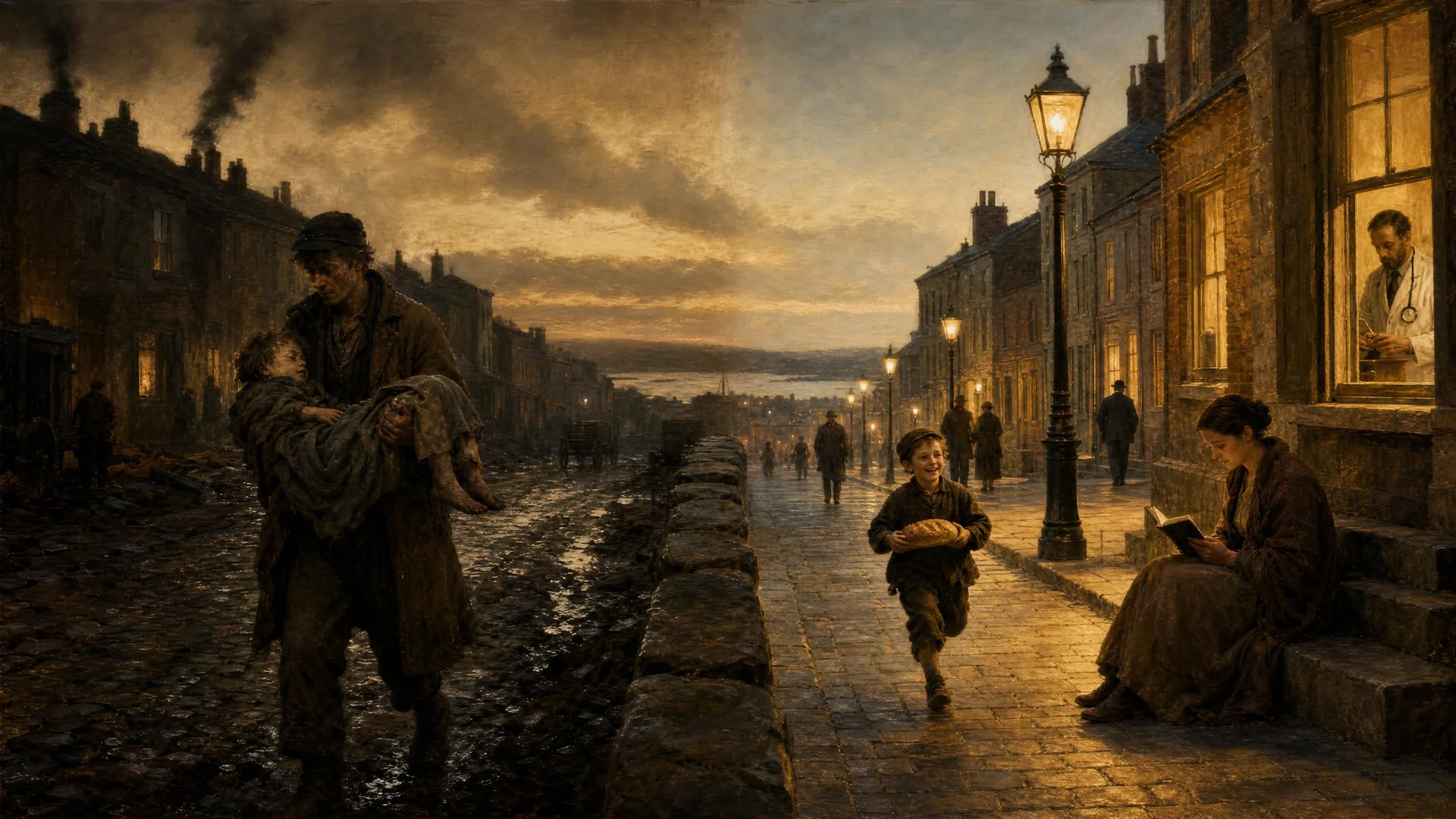
The people in the foreground are the same people. What changed is everything around them. The mesorah still cares about the person in the foreground. It can reach them earlier now.
The Torah's second column
A religious reader may still hesitate. Preventing disease is useful, but does it belong to avodah?
Watch where the Torah spends its ink. A vast part of Shemot describes the Mishkan, the architecture of nearness. The calendar, the diet, the seventh day, the fringes, and the doorpost all train a Jew to live before God. The promise is v'shachanti b'tocham, I will dwell among them. That is the center. Nothing in this argument moves it.
But there is a second column of ink, and it is thicker than we tend to remember. The first parshah after Sinai is Mishpatim. A people still standing inside the smoke hears about the goring ox, the open pit, loans, collateral, honest judgment, the widow, and the orphan. Seder Nezikin occupies an enormous part of the Mishnah. Choshen Mishpat gives immense space to money, damage, property, responsibility, and trust. Bava Kamma says that care in the laws of damages is a road to chasidut. When the Gemara imagines the questions asked of a person at the end of life, the first is nasata v'natata be'emunah: did you conduct your business faithfully?
הַאי מַאן דְּבָעֵי לְמֶהֱוֵי חֲסִידָא, לְקַיֵּים מִילֵּי דִּנְזִיקִין.He who wishes to be a chasid, let him fulfill the laws of damages.Bava Kamma 30a
The Torah does not publish one newspaper for the soul and another for the body. The God who asks for a sanctuary in Terumah asks for honest scales in Kedoshim. The marketplace does not interrupt nearness. It tests it.
Rabbi Yisrael Salanter said it in a sentence that should hang in every Jewish office, clinic, and boardroom: the material needs of my neighbor are my spiritual needs. Another person's hunger is not outside your religious life. It enters it as a claim.
Rav Joseph B. Soloveitchik found both kinds of responsibility in the two accounts of creation. Adam I builds, organizes, and pushes back helplessness. Adam II hears a call and answers hineni. Modernity often kept Adam I, lost Adam II, and then wondered why power felt empty. Religious life can make the opposite mistake. It can treat building, curing, and organizing as lower activities whose purpose is merely to finance the real work of the soul.
The first command to humanity will not allow that. P'ru u'r'vu u'milu et ha'aretz v'kivshuha: be fruitful, fill the earth, and master it. The command comes before Sinai and is addressed to humanity. Adam I is not a concession. He is commanded.
His danger begins when the mandate becomes a possession, when mastery turns into self-authorship and the builder forgets that he was told to build. The answer is not to stop building. It is to keep the builder answerable to the One who gave the assignment.
Rav Chaim Soloveitchik of Brisk gave this obligation a face. Asked what a rav is for, he answered, as Rav Soloveitchik records:
To redress the grievances of those who are abandoned and alone, to protect the dignity of the poor, and to save the oppressed from the hands of his oppressor.
Brisk remembered Rav Chaim with one word: rachman. Mercy was not the soft alternative to rigor. Mercy was what the rigor was for.
Rav Chaim usually had one person in front of him. War, plague, conscription, pogrom, and early death were larger than any instrument he possessed. His mercy therefore had to be immediate mercy, and his greatness was to bring the full force of Torah to the person standing in the room.
We have that lever, and another one. We can still feed the widow. Sometimes we can also prevent the illness that would have made her one. We can visit the patient. Sometimes we can keep the next patient from becoming sick. A rachman with two levers has to learn to see both.
The prophets make the demand harder to avoid. They attack rigged scales, bought judges, stolen fields, and luxury built on crushed people. In their world, the available commands were to defend the orphan, plead for the widow, judge honestly, and open the hand. If a hospital can now keep a child from becoming an orphan, the same prophetic concern reaches the hospital before its doors open. It says: build it. Then it stands at the entrance and asks who is being kept out.
לִמְדוּ הֵיטֵב, דִּרְשׁוּ מִשְׁפָּט, אַשְּׁרוּ חָמוֹץ, שִׁפְטוּ יָתוֹם, רִיבוּ אַלְמָנָה.Learn to do good. Seek justice. Strengthen the oppressed. Defend the orphan. Plead for the widow.Yeshayahu 1:17
Put Yeshayahu beside the child mortality curve. The curve is not a secular fact he politely acknowledges. It is what his demand can look like once mercy acquires science and institutions. Discover the vaccine, and carry it to the last village. Enlarge the harvest, and keep the scale honest. Ask whether the instrument works, whom it reaches, whom it leaves out, and what new damage it creates.
All four questions belong to the same concern.
Strengthen the hand
The halakhic center of the argument is a Rambam many people know and many remember incorrectly. Anonymous giving is not the highest level of tzedakah. It is the seventh. The highest level is different in kind:
מַעֲלָה גְדוֹלָה שֶׁאֵין לְמַעְלָה מִמֶּנָּה: הַמַּחֲזִיק בְּיַד יִשְׂרָאֵל שֶׁמָּךְ, וְנוֹתֵן לוֹ מַתָּנָה אוֹ הַלְוָאָה, אוֹ עוֹשֶׂה עִמּוֹ שֻׁתָּפוּת, אוֹ מַמְצִיא לוֹ מְלָאכָה, כְּדֵי לְחַזֵּק אֶת יָדוֹ, עַד שֶׁלֹּא יִצְטָרֵךְ לַבְּרִיּוֹת לִשְׁאוֹל.The greatest level, above which there is none, is to strengthen the hand of one who has fallen with a gift, a loan, a partnership, or work, until he no longer needs to ask.Rambam, Hilchot Mattanot Aniyim 10:7
The first seven levels improve what passes from giver to receiver. They protect dignity, privacy, and intention. The eighth changes the receiver's position in the world. A loan can begin a livelihood. A partnership gives a person standing. Work turns an open hand into a strong one.
The top of the ladder is the act that makes the ladder unnecessary. The tradition did not place the maintenance of need at the summit. It placed escape from need there.
That gives modern institutions a religious test. A clinic that prevents disease helps people who never become patients. A school does its work on the future. Reliable contracts let strangers cooperate without placing their lives in the hands of the powerful. An honest company can strengthen hundreds or thousands of hands by giving people useful work and dignified pay.
Size does not make an institution holy. A company can employ people and humiliate them. A platform can lower prices while consuming everyone's attention. A medicine can work and remain unavailable to the people who need it. Scale increases the good a system can do and the damage it can hide.
The Rambam's category is not a blessing over large organizations. It is a question they must answer: whose hand became stronger?
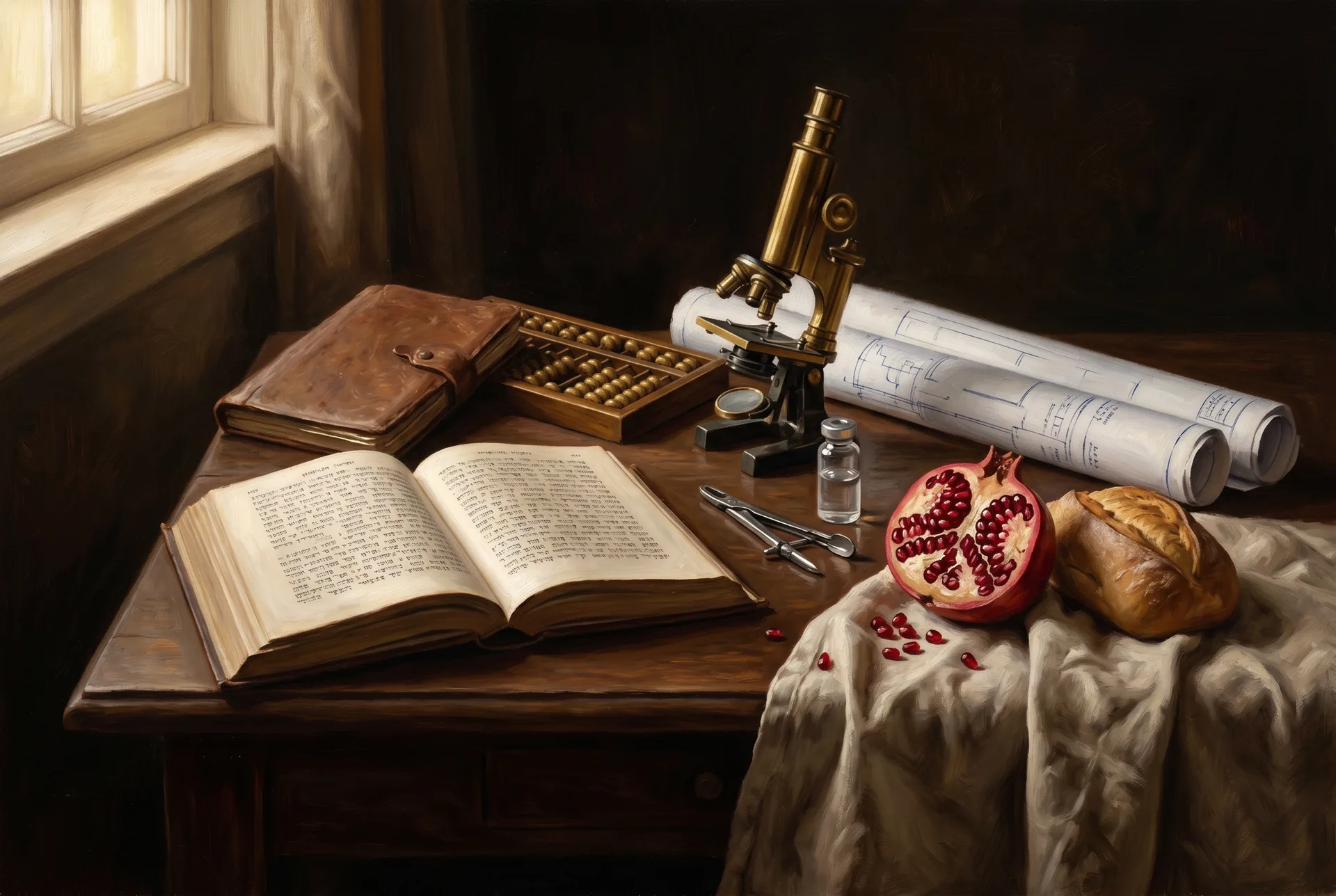
The tools are already on the table. The question is what they are for, and to whom the hand using them remains answerable.
Notice how bodily his phrase is. Machazik b'yado, strengthen his hand. The hand signs the contract, writes the code, holds the scalpel, hires, fires, gives, and withholds. Scale has not made the hand disappear. It has made it harder for the hand to know whom it touches.
The tool you look through
Sotah 14a asks how a human being can walk after God. The answer is practical. He clothes the naked, so clothe the naked. He visits the sick, comforts mourners, and buries the dead. To walk after God is to care for embodied people.
What happens to bikur cholim once medicine can prevent illness? It still begins at the bedside. Nothing replaces the visit or the face. But care for the sick can now include the laboratory that makes an infection survivable, the vaccine that prevents it, the water plant that keeps cholera away, and the delivery system that carries a remedy farther than its inventor could travel. It would be strange to say that visiting a sick person is religious care while preventing the sickness is spiritually neutral.
Markets are harder to speak about honestly. They reward useful work and greed. They lower prices and manufacture appetites. The prophets would recognize many of their abuses on sight. Still, the escape from mass poverty did not come from science alone. It required law, trade, capable public institutions, and systems that allowed ordinary people to exchange, invest, specialize, and build.
The right posture is gratitude without gullibility. Bless the harvest, and ask who paid its hidden cost. Honor the builder, and do not mistake him for the source of being.
Jewish tradition understands that tools are spiritually dangerous for the same reason they are attractive: they work.
Chizkiyahu hid the Sefer Refuot, the Book of Remedies, and the Sages approved. Rashi explains that its cures worked so quickly that people no longer bent their hearts toward Heaven. The cure moved faster than the soul. As tools improve, that warning becomes more important. A reliable instrument can make dependence invisible. We begin to imagine that the body, the intelligence that studied it, and the laws that make healing possible all originated with us.
But Chizkiyahu hid a book. He did not ban medicine. The Rambam wrote medical works and practiced as a physician. Jewish doctors did not understand healing as a rebellion against Heaven.
The same Chizkiyahu destroyed the bronze serpent Moshe had made after people began burning incense to it. The Mishnah asks: does a serpent kill or give life? Israel was healed when they looked upward through the instrument and subjected their hearts to Heaven. Once the instrument became the object of devotion, the king ground it to dust.
Then Chizkiyahu himself became gravely ill. He prayed and wept. Yeshayahu answered with a remedy:
וַיֹּאמֶר יְשַׁעְיָהוּ: שְׂאוּ דְּבֶלֶת תְּאֵנִים. וַיִּשְׂאוּ וַיָּשִׂימוּ עַל־הַשְּׁחִין, וַיֶּחִי.Yeshayahu said: bring a cake of figs. They laid it on the boil, and he lived.Melachim II 20:7
A remedy, ordered by a prophet, applied to the man who had hidden the Book of Remedies. The story refuses to make us choose between prayer and treatment. It places tears, prophecy, and a fig compress inside one rescue.
The danger was never the instrument. The danger was what the instrument taught people to see.
There is a difference between a tool you look through and a tool you bow to.
Shabbat turns that distinction into a weekly practice. Six days the hand changes the world. On the seventh it stops, and the world continues. Shabbat does not humiliate Adam I. It prevents him from becoming his own project. A person who cannot stop building eventually stops being a builder and becomes a brick.
Rabbi Yaakov calls this world a corridor before the world to come. That can sound like a reason not to repair the corridor. But the next Mishnah, from the same Rabbi Yaakov, says that one hour of teshuvah and good deeds in this world is more beautiful than the entire life of the world to come.
יָפָה שָׁעָה אַחַת בִּתְשׁוּבָה וּמַעֲשִׂים טוֹבִים בָּעוֹלָם הַזֶּה, מִכָּל חַיֵּי הָעוֹלָם הַבָּא.One hour of repentance and good deeds in this world is more beautiful than the entire life of the world to come.Avot 4:17
The corridor is where the deed can be done. Hayom la'asotam, today to do them. A child saved at two has not merely been kept alive longer. She has been given decades in which hours can become Shabbat, tzedakah, teshuvah, love, and choice.
Yoma says that we break one Shabbat so a person may keep many Shabbatot. A public health campaign that prevents a million child deaths returns billions of future Shabbatot to the world. In Yoma's currency, the mortality curve records sacred time restored.
The body rescued, the person still waiting
The vanished graves are not the whole story. The same centuries that rescued the body altered the conditions of the soul. Some of the healthiest, wealthiest, longest-lived societies in history have seen religious practice decline, marriage weaken, fertility fall, and loneliness rise. Suicide, overdose, and alcoholic death gathered under the name deaths of despair. Angus Deaton wrote about both facts: the escape from material misery and the misery that appeared inside abundance.
The causes are not simple. Vaccines did not cause secularization. Clean water did not dissolve the covenant. Older structures loosened for many reasons, and abundance did not know how to replace them. Systems became better at maintaining the body while the person became less known. Choice expanded until it became exhausting. Work grew more productive while often feeling less connected to anything shared.
Observant communities are not utopias. They contain poverty, mental illness, abuse, and pain. But communities in Jerusalem, Brooklyn, and Bnei Brak establish something important: modern medicine and long life do not automatically dissolve covenant. The instrument can enter the room without taking it over. What matters is what the other hand is holding.
This is why Avodat HaTikkun cannot mean progress with Hebrew labels. Human power can improve the conditions of life. It cannot tell us what life is for. Medicine can keep a heart beating, but it cannot tell the heart why. A market can coordinate a million strangers without making two of them brothers. A platform can connect everyone and leave each person alone.
The second lever therefore makes direct chesed more necessary. The meal to the mourner, the visit to the bedside, and the call to the lonely train the heart to remember what the system is for. A person who can improve a product for a million users but cannot sit with one frightened human being has acquired reach without rachmanut.
The new visiting list is already long. There is the worker whose productivity is measured more carefully than his dignity, the child protected from infection but handed to an economy of attention, the elderly person kept alive in a room no one enters, and the family with every convenience except a common table. The old world's wounds were visible. The new world's wounds often are not. We do not get to choose which century's suffering counts.
Halakhah enters as a discipline of limits. Shabbat stops production. Brachot stop entitlement. Tefillah stops the fantasy of self-sufficiency. The laws of speech, money, labor, appetite, and privacy keep power from treating people as material.
Repair is not the whole covenant. It is one way the covenant enters history. Halakhah keeps the repair human.
Two construction sites
The Torah's great warning about organized human power is not a story about disorder. Bavel is almost perfectly coordinated. One language, one city, one tower, one project. The moment humanity learns to build at scale, it says ve'na'aseh lanu shem: let us make a name for ourselves.
The Netziv reads the tower as a system of enforced uniformity. It keeps people from leaving and punishes the person who thinks differently. Cooperation hardens into sameness. Building becomes self-worship. What is frightening about Bavel is the kind of society a finished tower would have produced.
Our century knows the temptation. Its largest promises sometimes sound like Yeshayahu with the Name removed: end disease, end scarcity, multiply intelligence, defeat death. A project begins by healing people and quietly shifts toward redesigning them. Inherited limits start to look irrational. Law looks like friction. Gratitude becomes unnecessary. Anyone who declines the project begins to look like a defect in the system.
God does not answer Bavel by ending human building. Two chapters later the Torah gives us Avraham. He plants an eshel, digs wells, makes treaties, buys land, manages a large household, and feeds travelers. He builds too. When his guests rise to thank him, the midrash says that he redirects the credit: you did not eat from me. You ate from the God of the world. Thank the One who spoke and the world came to be.
The Torah gives us two construction sites. Bavel builds to preserve one name and one authorized mind. Be'er Sheva builds so a stranger can eat and bless. Both require intelligence, wealth, land, tools, organization, and ambition. What differs is where the building points and how much freedom remains for the people inside it.
Avodat HaTikkun carries Avraham's direction into a technological age. Possession becomes hospitality. Scale becomes service. Discovery ends in gratitude, and power ends in a strengthened human hand. That does not require us to admire every construction site. It requires us to enter the ones capable of repair with the Name in mind and the limits already accepted.
There is precedent for entering. Yosef administered Pharaoh's grain system. Esther entered the machinery of empire. Jewish fidelity sometimes means standing outside power and telling it the truth. Sometimes it means entering a dangerous room without forgetting who sent you.
A name worth keeping
Jewish thought already has names for the meeting between Torah and the modern world. Another name is worth adding only if it forms a different kind of person.
Torah im Derech Eretz dignified secular learning, civic culture, and disciplined work under the rule of Torah. It asked how a faithful Jew could enter the cultivated life of his time without surrendering the covenant. Avodat HaTikkun begins with the obligation created by capacity. Once knowledge and institutions can prevent suffering at scale, what does Torah ask us to do with that ability?
Torah u'Madda is mainly a claim about knowledge. Sacred and secular learning can inhabit one mind because truth need not fear truth. Avodat HaTikkun is mainly a claim about action. Once science can heal, feed, or protect, it stops being only knowledge to integrate. It becomes a demand on the hand.
Torah va'Avodah restored religious dignity to labor, pioneering, and building the Land. Avodat HaTikkun inherits its builder but finds the same obligation wherever a human hand can be strengthened: a clinic, a classroom, a factory, a household, or a line of code.
Contemporary tikkun olam often becomes a religious label for a politics someone already held. The phrase then describes the speaker's identity more clearly than the condition of anyone helped. Avodat HaTikkun is suspicious of moral self-description. It asks whether the intervention worked, whose hand became stronger, what broke elsewhere, and which halakhic boundary remains a boundary even when crossing it promises a benefit. Letakken olam b'malchut Shaddai does not let us delete the Kingdom and keep the repair.
Secular humanitarianism has done immense good, and gratitude should come before criticism. Utilitarian thought taught institutions to measure outcomes and to notice that a preventable death far away is still a death. This work needs that seriousness about results. It refuses the reduction of a person to a unit in a ledger. A good total cannot purify a forbidden means. A curve cannot tell us what a human being is for. The person who will never move a global metric still has a claim on us.
Technological progress can also become a rival religion. It promises that enough intelligence, money, and computation will abolish the condition that made religion necessary. Avodat HaTikkun accepts the instruments and declines the salvation story. Progress is real, mixed, fragile, and always on trial. A tool may serve redemption. It does not become the redeemer.
None of this baptizes ambition. Prestige is not holiness, and scale is not proof of service. A parent, teacher, nurse, local rav, or honest employer may strengthen people more deeply than a famous founder. Sometimes the religious act is to build an institution. Sometimes it is to refuse the institution's incentives and leave. The measure is not how important the worker becomes. The measure is what becomes possible for the person served.
Avodat HaTikkun is therefore less a theory of work than a way to arrange a life. Choose work partly by asking whose hand it can strengthen. Demand evidence, because good intentions do not make a medicine effective. Continue direct chesed, because a face teaches a system what it is for. Keep learning Torah, because power forgets its grammar. Accept the halakhic limits before violating them becomes profitable. Bless the instrument, use it well, and put it down on Shabbat.
This life holds two timescales at once. One contains the person standing here, whose pain cannot wait. The other contains the structures that determine how many people will stand there tomorrow. Give the meal and ask why the hunger keeps returning. Visit the patient and support the work that may prevent the next illness. Do not sacrifice the person to the system. Do not use love for the person as an excuse to leave the system broken.
The office is not a beit midrash, and pretending otherwise would cheapen both. But the office is not outside the covenant. Work becomes avodah when it is taken on as obligation, disciplined by halakhah, judged by its effects on people, interrupted by Shabbat, and returned in gratitude to the One who made action possible.
That is Torah taking responsibility for life.
Monday morning
An argument about work eventually has to survive an ordinary morning. The alarm sounds. You get dressed. The train arrives, the laptop opens, or the clinic lights come on. What is actually different?
Work that reduces suffering at its source is not merely a concession to parnasah. It can be avodah of a high order. That should not make the worker feel grand. It should make the worker careful. If the work matters, honesty and competence matter more. So do the effects on people you will never meet.
Kavanah gives the act a name. The same line of code, hiring decision, lesson, or patient encounter changes when the person doing it can say, even briefly: this hour may strengthen a hand. Intention does not make bad work good, and it cannot replace evidence. It keeps good work attached to its purpose.
The choice of work may be one of the largest religious decisions a modern Jew makes. Work that heals, teaches, employs with dignity, or makes a necessity cheaper weighs differently from work that mainly rearranges status among comfortable people or manufactures a new appetite. That is not permission to judge another person's career from across the room. It is a question for your own desk.
Halakhah is the ballast. The more power you hold, the more you need it. Shabbat says the project has an Owner. Tefillah says capacity is borrowed. The laws of speech, business, labor, privacy, and the body keep scale from making the soul coarse.
Torah study is the navigation. It reminds us why the eighth rung is highest, why the widow and orphan keep returning, why Adam I needs Adam II, why Chizkiyahu hid a book and later accepted a remedy, and why Be'er Sheva is not Bavel. Power forgets quickly. Learning is how a Jew remembers.
The village lever never retires. Bring the meal. Visit the bedside. Call the lonely person. Stay beside the problem that will never scale. A person who can run a system but cannot sit with one sick person has lost the posture of the rachman. Rachmanut is practiced with people, not dashboards.
Then give thanks. Thank the generations of builders, believing and unbelieving, whose work bent the curves before we arrived. Thank the people who made the vial, maintained the road, cleaned the room, checked the shipment, and carried the medicine through the last mile. Thank the One whose world made any of it possible.
Practice Avraham's gesture at the eshel: you ate from the God of the world. Say it over the cure, the harvest, the paid invoice, the bridge that holds, the clean scan, the functioning sewer, and the child coming home from the hospital.
The work is ours. The credit is not.
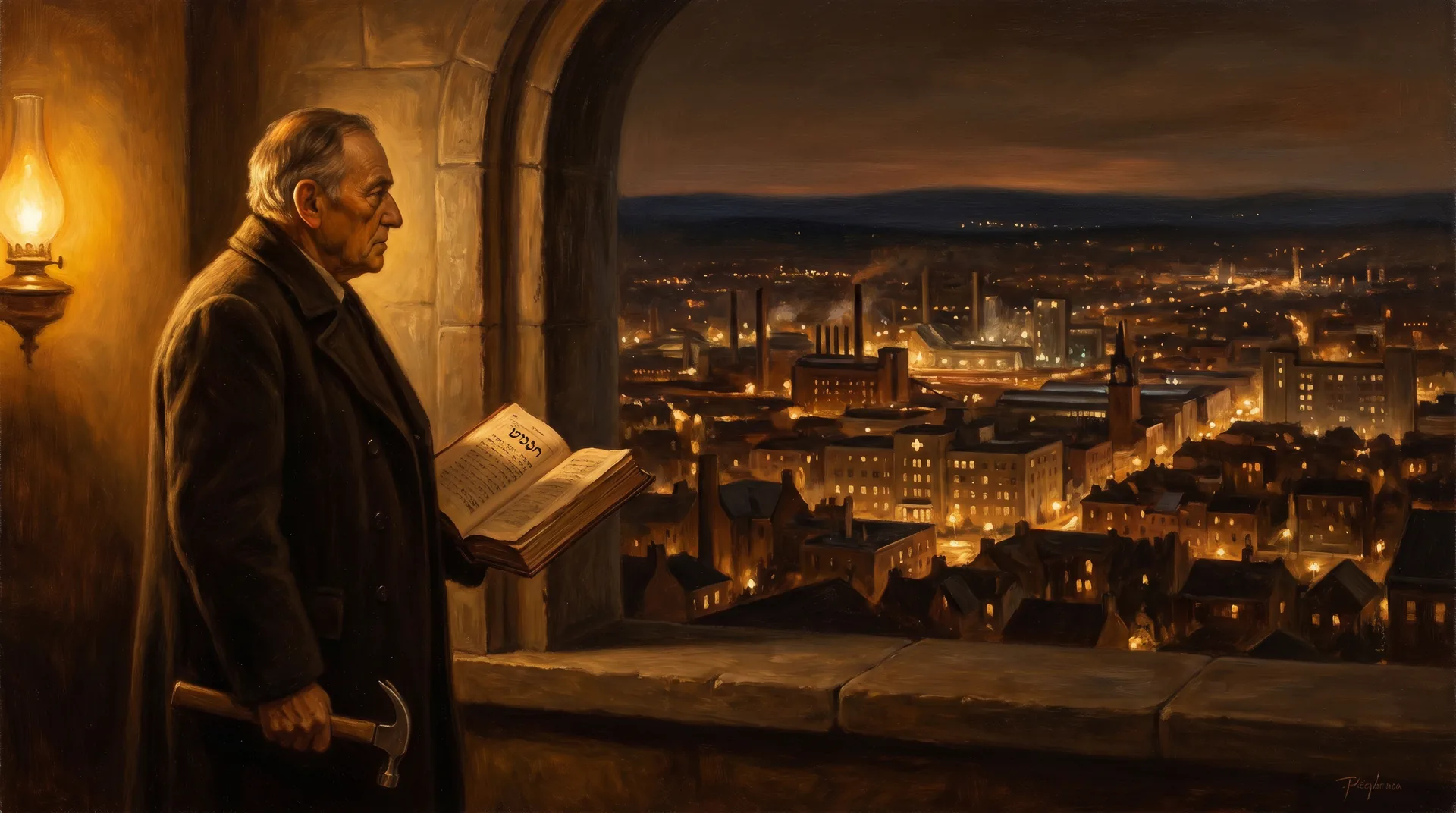
One hand holds the builder's rod. The other holds an open sefer. Both belong to the same person.
The blessing before the knife
This argument stopped being abstract for me on an ordinary afternoon, when a doctor looked at a scan of my kidney and scheduled surgery. A duct that should have remained open had closed. The condition is ancient. The treatment is not.
In my great-grandfathers' world, this might have been a death sentence with a slow clock, one of the ordinary ways the old world made widows. In mine, it is a problem with anesthesia. A surgeon I have met twice will put me to sleep and repair, with instruments that did not exist when my grandfather was born, the exact failure described in a blessing I have said perhaps ten thousand times:
אֲשֶׁר יָצַר אֶת הָאָדָם בְּחָכְמָה, וּבָרָא בוֹ נְקָבִים נְקָבִים, חֲלוּלִים חֲלוּלִים... שֶׁאִם יִסָּתֵם אֶחָד מֵהֶם אוֹ אִם יִפָּתֵחַ אֶחָד מֵהֶם, אִי אֶפְשַׁר לְהִתְקַיֵּם וְלַעֲמוֹד לְפָנֶיךָ.Who formed the human being with wisdom and created within him openings and hollows. If one of them were to close or one of them were to open, it would be impossible to endure and stand before You.
I had said the words. I had not heard them.
I know the fear from inside now, and I know that fear is not a failure of emunah. Vayira Yaakov me'od. Yaakov was very afraid, and Yaakov had promises I do not. I also know that the surgeon is not competing with God. The Gemara gives the physician permission to heal. The Rambam describes healing as returning a lost object, except the lost object is the body itself.
Now I know what the second lever feels like from underneath.
It feels like being the orphan who was not.
Somewhere in the long ledger of the last two centuries, there could have been a line that read: one family, fatherless, cause unremarkable. The line will not be written. Generations of Adam I deleted it in advance. Anatomists mapped the body. Chemists learned anesthesia. Engineers made sterile instruments. Machinists, nurses, and thousands of people whose names I will never know brought their work into one operating room, where one Jew will sleep inside a mercy while strangers keep his line in the ledger blank.
I will go to the surgeon because lo ta'amod al dam re'echa applies to your own blood too. I will say the plain bakashah, refa'einu, in the plural, because the tradition refuses to let a person be afraid alone. On the other side, please God, I will say Birkat HaGomel in public, because rescue is something the community should hear about.
Then I will get dressed on an ordinary Monday and return to work. I will build, employ, write, and try to repair a small corner of the world. I will return knowing in my body that the lever is real, that human hands can run one of the Torah's oldest errands, and that every Asher Yatzar I say afterward will sound different.
The mesorah's concern has not changed. The widow, the orphan, the stranger, the sick, the poor, the worker, and the person without power were never a decorative wing of Torah. What changed is our reach. We can still feed, visit, clothe, lend, redeem, bury, and comfort. Sometimes we can arrive earlier. We can keep the orphan from becoming an orphan and strengthen the hand before it has to open.
That capacity brings obligation, not innocence. A useful result does not excuse a forbidden means. A powerful tool does not explain the purpose of life. Halakhah binds the lever. Shabbat teaches the hand to open. Gratitude keeps the builder from becoming the tower.
The person under the surgical drape is why the work has its name. So is every man, woman, and child whose stone will now be full-sized and late.
To repair the world is a job description spoken before the King of kings. The lever exists. It is not God. On Monday, the work begins again.
הִנֵּנִי