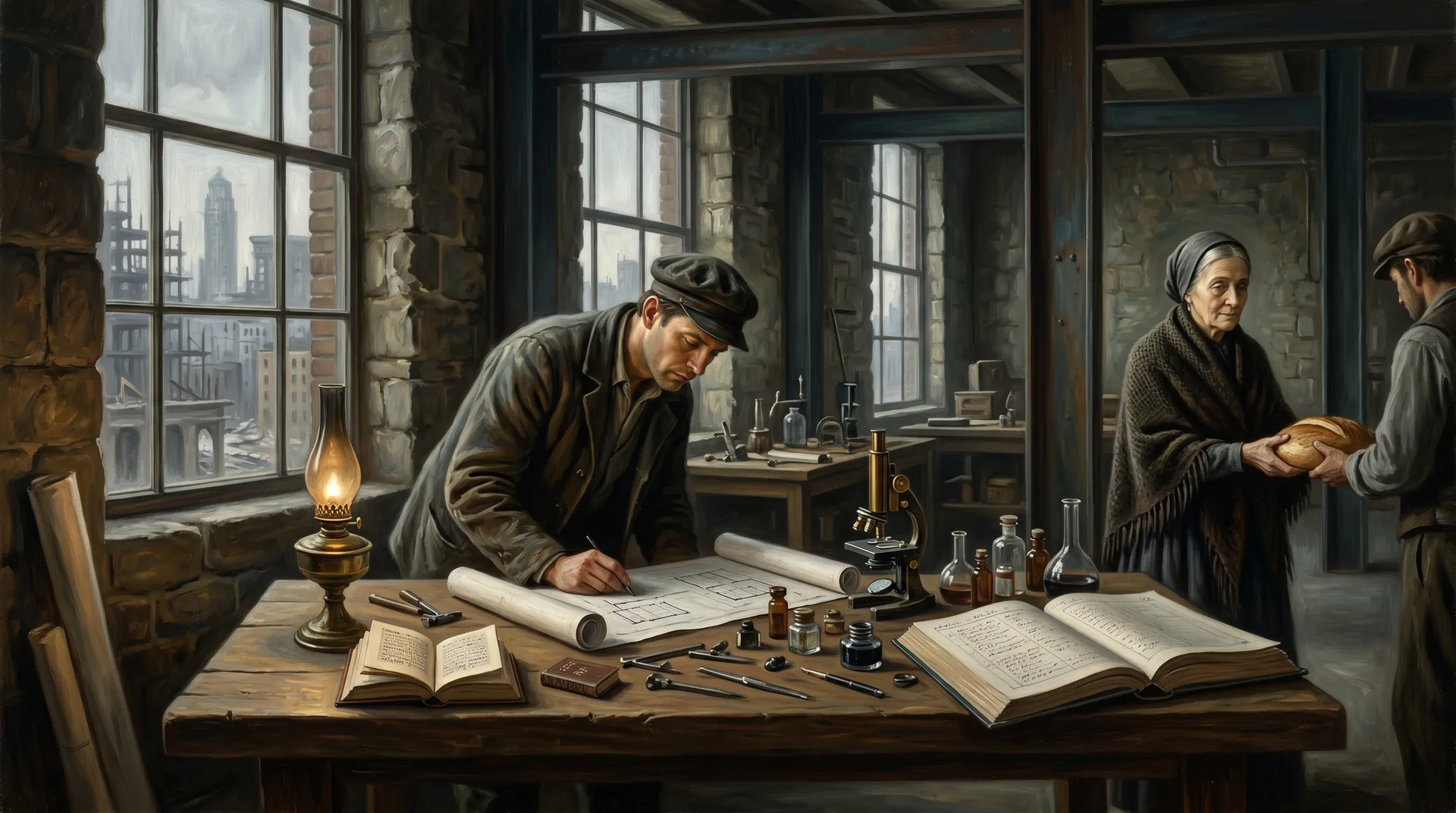
The Small Gravestones
Walk into any Jewish cemetery older than about a hundred and fifty years and you will notice it before you can name it. The stones are too small. Not a few of them, here and there, the way tragedy is scattered through any human place. Rows of them. Whole quiet avenues of stones the size of a shoebox, with a single date instead of two, or two dates separated by a span you could count on your fingers. Stand there long enough and the arithmetic arrives on its own: in the world that carved those stones, half of all the children ever born did not live to grow up. Not in plague years. In ordinary years. That was the weather.
The women of my great-grandmothers' world buried children not only as catastrophes that interrupted life, but as part of the structure that defined it. They recited the same Shema we recite, kept the same Shabbat, said the same Asher Yatzar, and lived inside a fact we can no longer imagine from the inside: no power on earth, no rebbe, doctor, court, or fortune, could promise a mother that her child would be alive next winter. The mesorah they carried wept for the widow and the orphan on every page because every page was written in a world that produced widows and orphans with the regularity of weather.
Then, over about eight generations, a breath in the time scale of the mesorah, the weather changed. It did not merely soften. It changed in kind. Under-five mortality fell from about 43 percent around 1800 to about 3.7 percent today. Maternal death became vastly rarer. Famine retreated. Smallpox, which killed an estimated 300 to 500 million people in the twentieth century, was eradicated from nature. A randomly chosen human being alive today is far less likely to be widowed young, orphaned young, starved, disabled by a preventable disease, or buried as a child than in almost any earlier age.
This is among the largest moral transformations in recorded history. It was carried out by scientists, physicians, farmers, engineers, public-health workers, entrepreneurs, logisticians, civil servants, and institutions that learned how to carry a discovery from one mind to millions of bodies. Many of the people who performed this work did not know they were answering the Nevi'im. Some rejected the religious world entirely. Some built from compassion, some from ambition, some from curiosity, some for money, and most from several motives at once. The motives matter. The result also matters. Children lived.
A religious account of modernity can fail in two directions. It can look at this transformation and treat it as spiritually neutral, a secular improvement in the plumbing of life while the real story continues elsewhere. Or it can call progress redemption, bless every expansion of human power, and forget that the tower of Bavel was also a technological achievement. The first response cannot recognize a mercy when it arrives through an unfamiliar door. The second cannot distinguish a tool from a god.
There is another possibility. The mesorah may already contain the grammar for this work: the concern of the Nevi'im, the first command to Adam, the Rambam's highest form of tzedakah, Rav Chaim's definition of a rav, the Gemara's account of walking in the ways of God, Chizkiyahu's buried book, the bronze serpent, the corridor and the hour, the tower and Avraham's tent. Read together, they offer neither suspicion nor surrender. They offer a name, a purpose, and a discipline. The name is Avodat HaTikkun, the service of repair.
When the village ceiling broke
Long-run historical estimates are never exact census readings. Poverty lines change. Records are incomplete. Baselines can be disputed. The direction and magnitude, however, are not seriously in doubt. The broad record assembled by the World Bank, the United Nations, the World Health Organization, Our World in Data, Angus Deaton, Hans Rosling, and many others describes a transformation too large to be explained away by a quarrel over one date.
Selected indicators of human flourishing: historical baseline and latest estimate
| Indicator | Historical baseline | Latest estimate | Source |
|---|---|---|---|
| Share of humanity in extreme poverty | about 75 to 80% in 1820 | about 10% at the current World Bank line | Our World in Data; World Bank |
| Global life expectancy at birth | roughly 30 years | about 73 years | UN Population Division; Our World in Data |
| Child mortality, death before age 5 | about 43% around 1800 | about 3.7% | UN-IGME; Our World in Data |
| Adult literacy worldwide | about 10 to 12% in 1820 | about 87 to 88% | UNESCO; Our World in Data |
| Smallpox | 300 to 500 million deaths in the 20th century | 0 natural cases; eradicated in 1980 | WHO; CDC |
You can quarrel with a baseline, a poverty line, or a date. You cannot quarrel with the shape of the table. Almost every horror a Jew has ever davened to be spared from has become dramatically less likely to happen to a randomly selected human being on earth. Much of that relief did not arrive through a beit din, a chevra kadisha, or a gabbai tzedakah. It came through clean water, vaccines, antibiotics, seed science, refrigeration, roads, law, trade, credit, schools, public institutions, and the unromantic competence required to make all of them reach the person farthest from the center.
Hold one example until it hurts. Smallpox made widows and orphans on a scale no rabbinic system could have begun to absorb. In 1980 the World Health Organization, standing on Jenner's vaccine and two centuries of refinement, surveillance, persuasion, and logistics, declared it eradicated. A global network of vaccinators, physicians, public-health officials, and local workers prevented orphanhood on a scale no earlier chesed institution could approach. A fact of that size deserves a theology. Not a hymn to the WHO, and not a polite change of subject back to the parshah. A theology.
To say this is not to criticize Chazal for failing to invent modern medicine or the modern economy. It is to understand the world in which their institutions were built. From the agricultural revolution until roughly 1800, human beings lived under what economists call a Malthusian ceiling. Gains in productive capacity were repeatedly consumed by population growth. A failed harvest could become a famine no one knew how to stop. Plague was uncontrollable. Many families buried children. In that fixed world, Chazal built an ethical machine of staggering generosity: tzedakah as enforceable obligation rather than sentiment, the communal kupah and tamchui, hospitality, bikur cholim, the redemption of captives, and burial of the unclaimed dead as law.
The Torah gives the widow and the orphan a unique grammatical protection. God Himself hears their cry directly. Chazal turned that grammar into institutions. Within the limits of premodern productive capacity, the mesorah operated near the frontier of the possible.
But there was a ceiling, and the ceiling was the village. You could feed the widow next door; you could not prevent the plague that widowed her. You could redistribute the harvest; you could not reliably enlarge it. You could visit the sick; you could not cure them. Chesed operated inside a closed box, and the genius of Chazal is that they filled the closed box almost completely. What no one in any tradition could do was open the box.
Then the box opened. Productive capacity began to outrun population. Plagues became preventable, then rare. Most children stopped dying. Relief that had once been administered only person by person could now be built into the conditions of ordinary life. The person remained the concern. The lever changed.
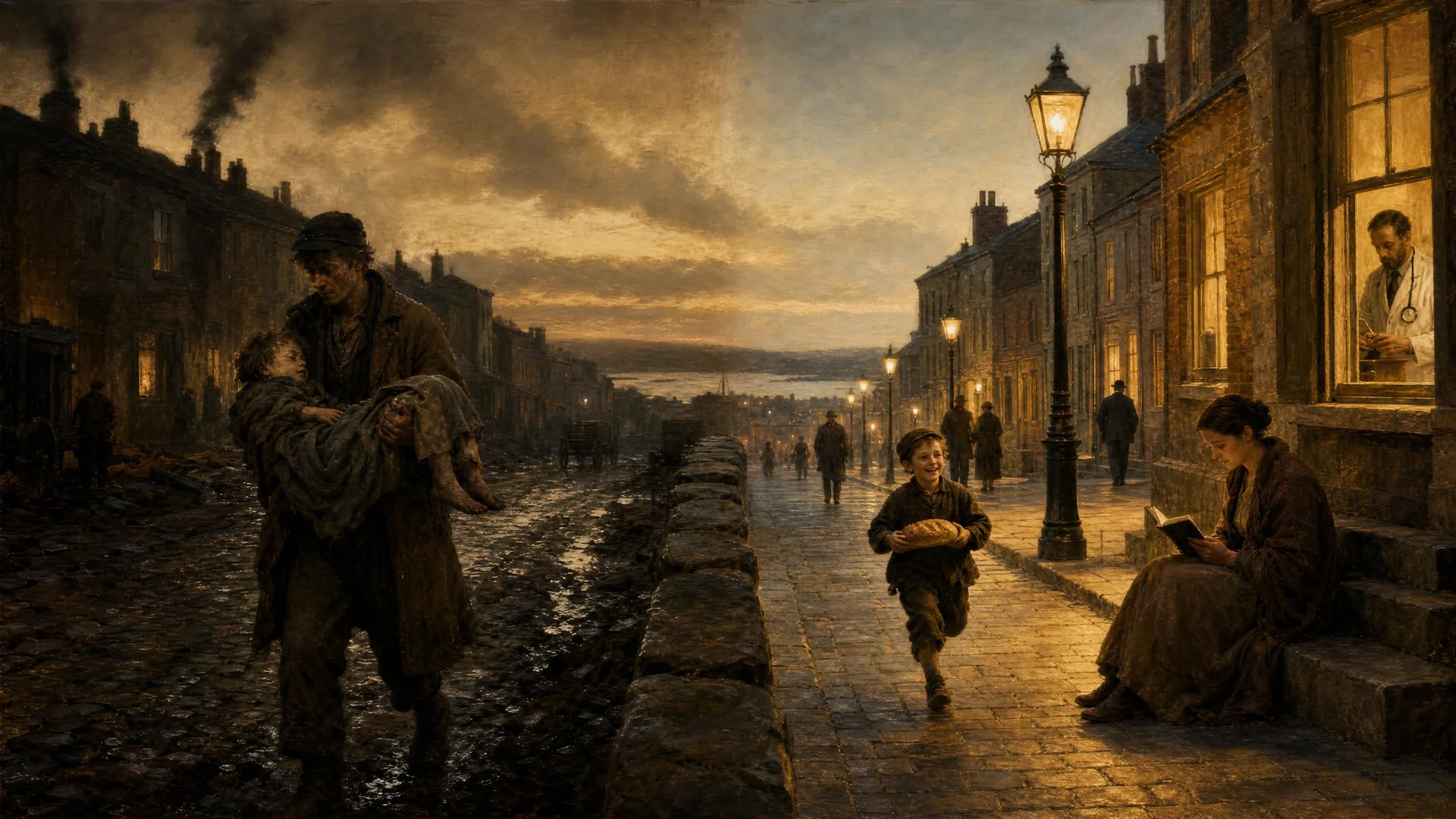
The figures in the foreground are not different people. They are the same people, structurally relieved. The mesorah's concern is still the foreground figure. The lever has moved.
Our religious imagination has not fully caught up with that movement. We still tend to picture chesed as a person crossing a room with a bowl of soup. It is a holy picture. It must never disappear. But the same compassion can now travel through a water system, a clinical trial, an insurance design, a supply chain, a school, a company that lowers the cost of something necessary, or a public institution that functions when a person needs it. A bowl of soup reaches one body tonight. A clean-water system prevents ten thousand bodies from becoming sick tomorrow. The moral source can be the same even when the instrument has become difficult to see.
The second column of ink
There is a reason a religious reader hesitates before calling any of this avodah. You learn what an author cares about by watching where he spends his ink. The Torah spends a third of Shemot on the architecture of a tent and the choreography of nearness inside it. It legislates the calendar, the diet, the seventh day, the fringes, the doorpost. Its great promise is not that life expectancy will rise. It is v'shachanti b'tocham, I will dwell among them. The center is covenant, kedushah, and the presence of God.
That center must remain the center. But count the ink carefully.
The first parshah after Sinai, the first thing God says to a people still standing inside the smoke, is Mishpatim: the goring ox, the open pit, the borrower and the guard, the loan to the poor man and the cloak returned by nightfall, honest weights, the widow and the orphan with the sword-backed warning attached. Seder Nezikin, the order of damages and civil law, is the largest order of the Mishnah. Choshen Mishpat, the law of money, labor, fraud, and liability, is the thickest volume of the Shulchan Aruch. The Gemara in Bava Kamma offers exacting care in the laws of damages as one road to chasidut. When Shabbat 31a lists the questions a soul is asked at the door of the next world, the first is not whether one achieved devekut. It is nasata v'natata be'emunah: did you conduct your business faithfully?
The Torah does not print a separate newspaper for the body. The God who demands a sanctuary in Terumah demands honest scales in Kedoshim. The nearness is not protected from the marketplace. It is tested there. Rabbi Yisrael Salanter compressed the matter into a sentence that should stand above every Jewish office, laboratory, clinic, and boardroom: the material needs of my neighbor are my spiritual needs. Not adjacent to my spiritual needs. Not a distraction nobly tolerated. They are my spiritual needs.
The Torah never printed a separate newspaper for the body. Its headline was nearness, and it located the nearness in the market, the field, and the neighbor's bread.The non-partition
The first chapter of Bereishit widens the frame further. Rav Joseph B. Soloveitchik reads the two creation narratives as two forms of the human person. Adam I is majestic man: creative, plural, institutional, commanded to fill the earth and master it, pushing back the boundaries of human helplessness. Adam II is covenantal man: lonely, inward, summoned, the one who hears the call and answers hineni. The Rav's claim is not that one must defeat the other. A human being made in the divine image is commanded to inhabit both.
The Rav aimed much of his argument at a secular modernity that had amputated Adam II and was puzzled by its own loneliness. Religious culture can perform the symmetric amputation. It can speak as if Adam I were the lesser brother, as if building, curing, organizing, and founding were concessions to necessity so that the real life of Adam II could be financed. Yet the plain text resists that demotion. P'ru u'r'vu u'milu et ha-aretz v'kivshu'ha, be fruitful, fill the earth, and master it, is the first command addressed by God to humanity. It precedes Sinai by twenty-six generations. It is aimed at every human being. And it is a command.
Adam I's error is not that he builds. His error begins when he forgets that building is a mandate rather than a possession, when mastery becomes self-authorship, when the tool becomes a name for the self. The cure for that error is not to withdraw the command. It is to bind majestic action to covenantal memory.
Rav Chaim Soloveitchik of Brisk gave the binding a human face. Asked what a rav is actually for, he answered, as Rav Soloveitchik records, "to redress the grievances of those who are abandoned and alone, to protect the dignity of the poor, and to save the oppressed from the hands of his oppressor." The Brisker memory of the man compressed the same posture into one word: rachman. Mercy was not the soft alternative to rigor. It was what the rigor was for.
"To redress the grievances of those who are abandoned and alone, to protect the dignity of the poor, and to save the oppressed from the hands of his oppressor."Rav Chaim of Brisk, as reported by Rav Soloveitchik in Halakhic Man
Rav Chaim's world could redress abandonment one person at a time. The forces producing widows, orphans, and trapped families were often beyond reach: war, plague, conscription, pogrom, distance, and early death. The available mercy was immediate mercy, and the greatness of Rav Chaim was to bring the full power of Torah to the person standing before him.
We now possess a second kind of reach. Widowhood falls when maternal mortality falls, famine ends, and the diseases that kill young parents are prevented. Orphanhood falls the same way. Poverty falls when people can earn, build, learn, and become independent. None of this retires Rav Chaim's mercy. The widow still needs the meal. The agunah still needs release. The lonely person still needs someone to enter the room. But the rachman who lives in a world with two levers must learn to see both. Compassion that notices only the suffering already present, and not the suffering that could have been prevented, has not yet measured its own possibilities.
Heschel's reading of the prophets deepens the claim. They do not permit ritual to shield injustice. Their fury falls on the merchant's rigged scale, the bought judge, the ivory couches above the crushed poor, the widow whose case is never heard, and the orphan whose field is stolen. But prophecy is not merely a protest against the unjust distribution of goods that already exist. It is a demand that suffering itself be answered. In the ancient world, where the power to prevent disease, famine, and early death was sharply limited, that demand spoke through the institutions then available: defend the orphan, plead for the widow, judge honestly, open the hand. If a hospital can now prevent the widow and the orphan from being made, the same prophetic concern does not wait outside the finished building merely to audit its admissions. It says first: build the hospital. Then it stands at the door and insists that the poor not be turned away.
Put the prophet before the child-mortality curve. The curve is not merely a fact he must acknowledge after someone else has done the work. It is a record of the prophetic demand becoming institution, knowledge, and capacity. The same voice says both things: build the hospital, and admit the person who cannot pay; discover the vaccine, and carry it to the last village; enlarge the harvest, and do not rig the scale. Creation and distribution are not rival prophetic concerns. The capacity to heal is itself part of justice, and universal access is the test of whether that capacity has remained just. The prophet asks whether we built the lever, whom it reaches, whom it excludes, and what new suffering it may create. He cares about the hospital because he cares about suffering. He cares who enters it for exactly the same reason.
The level above which there is none
The halakhic center of the argument is the Rambam, Hilchot Mattanot Aniyim 10:7. Every day-school graduate knows the eight levels of tzedakah, and many misremember the highest. Anonymous giving is not the summit. It is the seventh level. The eighth is different not merely in degree but in kind:
The seven lower rungs are variations on one act: value passes from giver to receiver, with increasing care for the receiver's dignity. The eighth changes the person's relation to the productive world. A loan founds a livelihood. A partnership creates standing. Work turns the open hand into a strengthened hand. The Rambam, in the twelfth century, placed the structural exit from dependence above every form of relief within it.
There is something startling in the architecture of the ladder. The summit of the mitzvah is the act after which the recipient no longer needs the mitzvah in its familiar form. The tradition did not place the perpetuation of need at the top. It placed the abolition of need there and called it a level above which there is none. The ladder climbs out of itself. That is its glory.
Our age can execute that moral form at a scale the Rambam could not have imagined. A company that employs a thousand people at a dignified wage can instantiate the logic of the eighth level a thousand times over. A clinic that prevents disease serves people who never need to become patients. An invention that lowers the cost of a human necessity strengthens every poor household newly able to afford it. A school performs the work on the future. A legal institution that makes contracts trustworthy allows strangers to cooperate without placing their lives in the hands of the powerful. A road, a payment rail, a refrigerator, a reliable electrical grid can become quiet forms of machazik b'yad, strengthening the hand.
This does not mean that every company is tzedakah, every market outcome is just, or every invention is repair. The category is moral before it is economic. It asks what the work does to human dependence, dignity, and vulnerability. A business can create work and also humiliate workers. A platform can lower a price and also colonize attention. A medicine can heal and still be withheld from the people who need it. Scale magnifies the deed, but it also magnifies the sin. The eighth level does not confer holiness on an institution merely because the institution is large. It gives us a way to ask what large institutions are for.
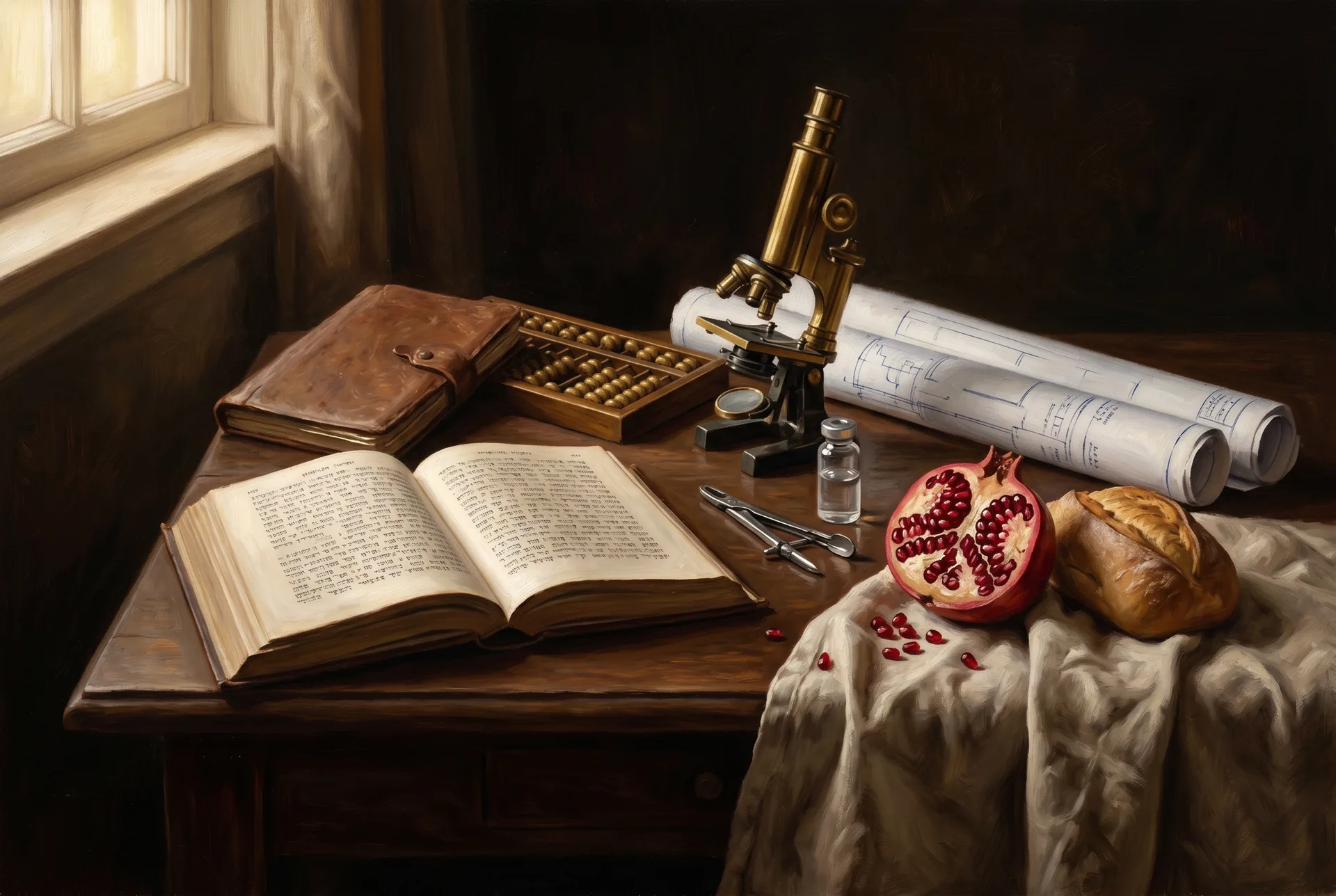
The framework does not add new tools to the table. It teaches the person at the table what the tools are for, and before Whom the hand remains answerable.
The phrase the Rambam chooses is bodily: machazik b'yado, strengthen his hand. The hand is where intention enters the world. It gives, signs, calculates, writes code, holds the scalpel, hires, fires, lifts, and closes. The question of modern work is therefore not whether scale has made the hand obsolete. It is whether the hand can still know whom it is strengthening.
The tool you look through
The Gemara in Sotah 14a asks what it can mean to walk after God and answers: walk after His attributes. He clothed the naked. Clothe the naked. He visited the sick. Visit the sick. He comforted mourners and buried the dead. When the Torah says walk after Him, the Gemara hears care for embodied human beings.
What is bikur cholim when the lever has moved? It remains the bedside, the visit, the soup, the company. Nothing replaces the face. But care for the sick now also includes the laboratory that makes an infection survivable, the vaccine program that prevents the illness, the water plant that makes the cholera year unrepeatable, and the distribution system that carries the remedy farther than the inventor can travel. To insist that only the bedside counts as religious care would mean that preventing illness is somehow less responsive to the body than visiting it after it arrives.
Markets are harder to speak about without becoming foolish. They can reward greed, permit exploitation, convert appetite into industry, and generate inequalities the Nevi'im would have burned against. No religious teacher should romanticize them. The historical record also refuses a simple story in the other direction. The Great Escape from mass poverty was produced by a braid: scientific knowledge, public health, capable states, law, trade, enterprise, and institutions that allowed ordinary people to exchange, invest, specialize, and build. Market institutions were part of the braid, and in many places an indispensable part.
The mature religious posture is gratitude without naivete. It can receive the medicine, bless the harvest, recognize the real relief carried by enterprise, and still ask who bears the hidden cost. It can honor the builder without believing that the builder is the source of being. It can accept the table of progress while declining the metaphysics that says the table is all there is.
The tradition has always known that instruments are spiritually dangerous precisely because they work.
Chizkiyahu, the righteous king of Yehudah, hid the Sefer Refuot, the Book of Cures, and the Sages praised him. Rashi explains that people were healed so quickly that their hearts were no longer humbled before Heaven. The cure was quicker than the soul. This is not an embarrassment to be removed from the record. It is one of the deepest warnings in it. A successful instrument can erase the consciousness of dependence. The more reliable the tool becomes, the easier it is to forget the world in which nothing is self-originating, not the body, not the intelligence that studied it, not the laws that make healing possible.
Yet Chizkiyahu hid a book. He did not outlaw medicine. No later posek derived from his act a standing prohibition on healing. The Rambam wrote medical works and described healing as part of the obligation to restore a person's body. Jewish physicians across the centuries did not understand themselves as violating the king's fence.
The same Chizkiyahu also shattered the bronze serpent made by Moshe because Israel had begun burning incense to it. The Mishnah in Rosh Hashanah asks the question that dissolves the idolatry: does the serpent kill, or does the serpent give life? When Israel looked upward through the instrument, it healed. When the instrument became the destination of the gaze, a righteous king ground it to powder.
Then Chizkiyahu himself became mortally ill. The prophet Yeshayahu came to him carrying the word of God. The king prayed and wept. Heaven answered. And what did the prophet prescribe for the man who had buried the Book of Cures?
A remedy, ordered by a prophet, applied to the man who hid the medical book. The biblical narrative does not force us to choose between prayer and treatment. It binds tears, prophecy, and a fig compress into one act of rescue. The danger was never simply the instrument. The danger was the angle of the gaze.
The difference is between a tool you look through and a tool you bow to.Nechushtan's law
Shabbat gives this difference a weekly form. For six days the hand makes, masters, repairs, and carries. On the seventh it opens. The world continues without our intervention. The hospital remains necessary, but the self is no longer permitted to imagine itself as the source of necessity. Shabbat does not humiliate Adam I. It saves him. It tells the builder that the project has an Owner, that the creation he enters was already good before he touched it, and that a human being who cannot stop building has ceased to be a builder and become a brick.
Rabbi Yaakov calls this world a corridor before the world to come. The image can sound like a demotion of all earthly repair, as if medicine merely carpets a hallway everyone must eventually leave. But the very next Mishnah, from the same Rabbi Yaakov, says something astonishing:
The same teacher who called this world a corridor declared one hour inside it more beautiful than everything in the hall. The hall is where the deed is received. The corridor is the only place in the universe where the deed can be done. Hayom la'asotam: today to do them. A child pulled back from death at age two has not merely been kept in a corridor longer. That child has been given decades of hours in the only world where hours can become Shabbat, tzedakah, teshuvah, love, courage, and choice.
Yoma 85b teaches that one desecrates a Shabbat so that a person may keep many Shabbatot. Count the currency honestly. A public-health campaign that prevents a million child deaths preserves billions of Shabbatot that could otherwise never be kept. The child-mortality curve, translated into Yoma's language, is a graph of sacred time returned to the world.
The body rescued, the person still waiting
No account of the modern transformation is honest if it looks only at the graves that disappeared. The same centuries that rescued the body also altered the conditions under which the soul lives. Many of the wealthiest, healthiest, longest-lived societies in human history have seen religious practice fall, marriage delayed or declined, fertility collapse, loneliness rise, and suicide, overdose, and alcoholic death gather beneath the phrase deaths of despair. Angus Deaton helped describe both realities: the Great Escape from material misery and the new forms of misery that appeared inside abundance.
The facts do not assemble into an easy causal story. Vaccines did not cause secularization. Antibiotics did not cause loneliness. Clean water did not dissolve the covenant. Intellectual, economic, political, and cultural forces loosened inherited structures, and abundance often proved incapable of filling the space they left behind. The body was maintained by systems while the person became less known. Desire was liberated, then professionally stimulated. Choice expanded, then became exhausting. Work became more productive and, for many, less intelligible as a contribution to a shared world.
Observant communities offer no utopia and should never be romanticized. They contain poverty, marital strain, mental illness, alienation, abuse, status, and pain. Yet communities in Jerusalem, Brooklyn, Bnei Brak, and elsewhere also demonstrate that modern medicine, supermarkets, technology, and long life do not mechanically dissolve covenant. High fertility, marriage, dense networks of obligation, sacred time, and strong reported life satisfaction can coexist with abundance. The decisive question is not whether the instrument exists. It is what the other hand is holding when the instrument enters the room.
This is why Avodat HaTikkun cannot mean progress with Hebrew labels. The task is not only to enlarge human power. It is to repair the conditions of life without allowing repair to become a substitute for life before God. Medicine can keep a heart beating. It cannot tell the heart why to beat. A market can coordinate strangers. It cannot make them brothers. A platform can connect everyone and leave each person alone. An institution can prevent the old suffering while producing a new kind of invisibility.
The second lever therefore makes the first lever more necessary, not less. The meal to the mourner, the visit to the bedside, the call to the lonely, the patience to hear a person whose problem cannot be solved by a system: these are not quaint remnants from the village. They are the school in which the modern practitioner remembers what the institution is for. A person who can improve a dashboard for a million users and cannot sit with one frightened human being has acquired reach without rachmanut.
The new visiting list is already long. It includes the person whose body was rescued but whose life feels unnecessary, the worker whose productivity is measured more precisely than his dignity, the child protected from infection and exposed to an economy of attention, the elderly person kept alive in a room no one enters, the family with every convenience and no common table. The old world produced visible wounds. The new world often produces hidden ones. The religious task is not to choose which century's suffering counts.
Halakhah enters here not as an ornamental seal but as a discipline of human limits. Shabbat interrupts production. Brachot interrupt entitlement. Tefillah interrupts self-sufficiency. The laws of speech interrupt the use of persons as material. The laws of labor and money interrupt power. Kashrut interrupts appetite. Torah study interrupts the fantasy that the latest instrument is the first word ever spoken about the human condition. The disciplines do not oppose repair. They keep repair human.
Two construction sites
The Torah's great warning about organized human power is not a story of chaos. It is a story of coordination. One language, one city, one tower, one project. Humanity discovers how to build together and immediately says, ve-na'aseh lanu shem, let us make a name for ourselves.
The Netziv reads the danger with terrifying precision: centralized uniformity enforced against dissent, a tower that watches so no one can leave, and a society prepared to punish the person who thinks differently. Power becomes surveillance. Cooperation becomes compulsory sameness. Building becomes self-worship. The problem is not that the tower fails. The problem is the human order created by its success.
Our century knows the temptation. Its grandest promises often sound like Yeshayahu with the Name removed: disease abolished, scarcity ended, intelligence multiplied, death defeated, friction eliminated. The dream is not merely to heal the human being but to redesign him, then to wonder why inherited limits should constrain the redesign. When a tool promises salvation, gratitude becomes unnecessary, law appears as delay, and the person who refuses the project begins to look like a defect in the system.
Yet God does not answer Bavel by cancelling the human building project. Two chapters later the Torah introduces Avraham. The midrash places him against the generation of dispersion, but Avraham is not a hermit fleeing civilization for a cave. He plants an eshel at Be'er Sheva, digs wells, cuts treaties, acquires land, organizes a household, feeds travelers bread and meat. He builds.
When the fed guests rise to thank him, the midrash says, Avraham refuses the credit: did you eat from what is mine? You ate from the God of the world. Thank and bless the One who spoke and the world came to be.
There are the two construction sites. Bavel builds so the builders can preserve one name, one center, one authorized mind. Be'er Sheva builds so the stranger can eat and bless the Name. Bavel treats people as units inside the project. Avraham treats the project as a vessel for people. The materials may be the same: intelligence, organization, wealth, land, tools, ambition. The difference is the direction in which the building points and the freedom it leaves to the human beings inside it.
Avodat HaTikkun is the attempt to bring Avraham's direction into the technological age. It asks what it would mean to turn possession into hospitality, scale into service, discovery into gratitude, and power into a strengthened human hand. It does not tell the Jew to admire every construction site. It tells him to enter the site capable of repair with the Name in hand and limits in law.
Yosef entered Pharaoh's palace and took hold of the ancient world's grain system. Yonah was sent into Nineveh. Esther entered the machinery of empire. Jewish fidelity has never meant only standing outside power and shouting the truth, though sometimes that is exactly what it means. It has also meant entering dangerous rooms without forgetting who sent us there.
Not another synthesis
Once this work is given a name, the name must be placed among the other Jewish names that have tried to describe the meeting between Torah and the modern world. The distinctions are not exercises in branding. Each formula forms a different kind of person. Each tells the Jew what the world outside the beit midrash is, why he enters it, what he is meant to do there, and how he knows whether he has succeeded.
Torah im Derech Eretz
Rabbi Samson Raphael Hirsch's Torah im Derech Eretz dignified worldly learning, civic culture, disciplined work, and participation in society under the sovereignty of Torah. It answered a question of integration: how can a faithful Jew enter the cultivated life of his age without surrendering the covenant? Avodat HaTikkun shares Hirsch's refusal to abandon the world, but it begins with a different question. What does Torah demand once human knowledge and institutions can prevent suffering at scale? The world is not only an arena in which Torah can be integrated with civilization. It is a field of obligation. This is not merely permission to enter. It is a reason to go.
Torah u'Madda
Torah u'Madda is principally a claim about knowledge. Sacred learning and secular knowledge can illuminate one another because truth need not fear truth. Avodat HaTikkun is principally a claim about action. Science is not only knowledge that may be integrated into a Jewish mind. Once it can heal, feed, protect, or strengthen, it places a demand upon Jewish hands. The question in the laboratory is not only whether this knowledge fits within a Torah worldview. It is also whose blood it may save, whose dependence it may end, and what responsibility follows from being able to do so.
Torah va'Avodah
Torah va'Avodah restored religious dignity to labor, pioneering, and the building of the Land and the Jewish people. Avodat HaTikkun inherits the image of the builder, but does not confine the building to one national project, one geography, or manual labor. Wherever a human hand can be strengthened structurally, in a clinic, a classroom, a factory, an institution, a household, or a line of code, the moral form of the work is present. Building the Land belongs inside this path. The path is not exhausted by it.
Tikkun olam as a political identity
In contemporary speech, tikkun olam can become a religious name attached to a politics the speaker already holds. The phrase then describes the moral identity of the actor more clearly than the condition of the person supposedly repaired. Avodat HaTikkun is deliberately suspicious of moral self-description. It asks for evidence. Did the intervention work? Whom did it strengthen? What damage did it cause elsewhere? Which halakhic boundary may not be crossed even for a promised benefit? It can lead to political action, but it is not identical with any political platform. Letakken olam b'malchut Shaddai does not permit us to remove the Kingdom and keep only the repair.
Humanitarianism, utility, and technological progress
Secular humanitarianism has carried immense good into the world, and this path begins with gratitude toward that good. Utilitarian thought has taught modern institutions to measure outcomes, compare interventions, and notice that a preventable death far away is no less a death. Avodat HaTikkun needs that empirical seriousness. It also refuses to reduce a person to a unit in a ledger. No favorable total makes a forbidden means pure. No curve can tell us what a human being is for. No optimization can replace covenant, dignity, presence, or the obligation owed to the one person who will never move a global metric.
Technological progress can become a rival eschatology, promising that enough intelligence, capital, and computation will abolish the human condition that produced religion. Avodat HaTikkun receives the instrument and rejects the salvation story. Progress is real, morally mixed, reversible, and always subject to judgment. The tool can serve redemption without becoming the redeemer.
Not sacred careerism
Nor does this path baptize ambition. A prestigious career is not holy because it is prestigious, and scale is not proof of service. A parent, teacher, local rav, nurse, craftsperson, caregiver, or honest employer may strengthen human hands more deeply than a celebrated founder. In some cases the religious act will be to build the institution. In others it will be to refuse its incentives or leave it. The measure is not how important the worker becomes. The measure is what becomes possible for the person served.
The pattern of a life
Avodat HaTikkun is therefore less a theory about work than a way of arranging a Jewish life. It asks a person to choose work under the question, whose hand will this strengthen? It asks him to measure consequences because good intentions do not feed a child or make a medicine effective. It asks him to preserve direct chesed because the face teaches the system what it is for. It asks him to learn Torah because power forgets its grammar. It asks him to accept halakhic limits before the moment when violating them becomes profitable. It asks him to bless the instrument, use it well, and put it down on Shabbat.
The person who lives this way holds two timescales at once. There is the person standing before me now, whose pain may not wait for the system to improve. And there are the structures that will determine how many people stand in that place tomorrow. He gives the meal and asks why the hunger keeps recurring. He visits the patient and supports the research that may prevent the next patient. He refuses to sacrifice the person to the system, and refuses to use love for the person as an excuse never to repair the system.
The office is not a beit midrash, and pretending otherwise would cheapen both. But neither is it outside the covenant. Work enters avodah when it is undertaken as obligation, disciplined by halakhah, judged by its effects on human beings, interrupted by Shabbat, and returned through gratitude to the One who made action possible. That is not another compromise between Torah and life. It is Torah taking responsibility for life.
What Avodat HaTikkun asks us to see
The concern has not changed. The widow, the orphan, the stranger, the sick, the poor, the agunah, the worker, the person without power: this is not a decorative wing of the mesorah. It is part of its central moral grammar, from Avraham's tent to Mishpatim, from the Nevi'im to Rav Chaim. Any account of Jewish religious life that makes the condition of the vulnerable peripheral has lost the Torah's second column of ink.
The lever has changed. For most of history, compassion could respond after suffering arrived. It fed, visited, buried, redeemed, lent, clothed, and comforted. Those acts remain obligations. Modern knowledge added the possibility of acting earlier, against the conditions that produce the suffering. The second lever is scientific, medical, institutional, and economic. It prevents the orphan from becoming an orphan. It makes the request for tzedakah unnecessary. It carries rescue beyond the reach of the giver's eyes.
The Rambam supplied its governing form: strengthen the hand until it no longer needs to ask. Adam I supplied its human capacity: build, master, organize, bring the world under responsible human action. Rav Chaim supplied its posture: rachmanut, the refusal to let rigor become indifferent to the abandoned. Heschel supplied its prophetic test: who is crushed, who is unheard, what has happened to the widow and the orphan? Chizkiyahu supplied its warning: the cure can outrun the soul. Shabbat supplies its boundary: the project is not God and the builder is not the owner of being.
The work has an address in lo ta'amod al dam re'echa, do not stand over your neighbor's blood. Misfortune that cannot be prevented belongs to the vocabulary of decree, encounter, mourning, and the broken heart before God. When prevention becomes possible, the moral question changes. The cure exists. The method is known. The danger can be reached. I am not issuing a new psak from a graph. I am naming the pressure that the verse places on preventable danger. The unstretched hand is still a hand.
The granaries of Amos were full of grain. Ours are full of molecules, genomes, models, methods, capital, and delivery systems. The Torah did not need to predict each amplifier of human power. It taught the signal: do not ignore the blood, do not deceive the worker, do not close the hand, return the lost object, heal, strengthen, leave the corner of the field, rest. Once an amplifier can carry that signal to millions of people, the amplifier enters the moral field.
This is why the work can become avodah, and also why not all useful work automatically does. Avodah is obligation consciously bound to the service of Heaven. It requires outcome and intention, competence and humility, scale and the person, the weekday and Shabbat. It knows that a good motive cannot rescue a harmful act, and that a good outcome does not excuse a corrupted soul. It asks both: did the work strengthen a human hand, and what did the work make of the hand that performed it?
The distinction between obligation and ultimate purpose protects the argument from idolatry. Medicine is not the meaning of the covenant. Rising life expectancy is not the telos of Torah. The center remains nearness: I will dwell among them. Yet nearness in the Torah is never disembodied. It takes the form of bread, law, rest, truthful weights, restored property, released debt, visited sickness, defended weakness, and the human face that must not be turned into an instrument. Repair is not the whole of the covenant. It is one of the ways covenant enters history.
Our mussar must learn to speak this language. The mussar we inherited is magnificent and true. Much of it was composed inside the closed box, for a world in which the central moral problem of work was often how not to be spiritually consumed by the need to earn. It taught restraint, honesty, contentment, fear of Heaven, and the danger of appetite. We need every word.
But a Jew who can now choose among careers, allocate capital, write code used by millions, conduct research, design an institution, hire hundreds of people, or lower the cost of a human necessity needs an additional moral vocabulary. He must learn to ask not only how to remain pure while working, but what his work is doing in the world. He must be trained to recognize scale as responsibility, prevention as chesed, employment as the possible strengthening of a hand, and competence as a religious demand when incompetence harms people.
He must also be trained to distrust the intoxication of scale. The farther the action travels, the easier it becomes to love humanity and overlook the person. The institution can become a tower. Metrics can become a way not to see. Avodat HaTikkun therefore requires the practitioner to move repeatedly between the chart and the face, the system and the bedside, the annual plan and the weekly cessation of all plans.
The work knows what it is. It exists because there is still a child dying of something we know how to prevent, still a worker whose dignity is treated as a cost, still a family trapped by a price that can be lowered, still a mind that can be taught, still a body that can be healed, still a lonely person whose rescue will not appear in the data. Its mood is not Promethean conquest. It is gratitude, including gratitude to builders of every faith and of none who pulled the lever before us without knowing its name.
The work also knows when to stop. On the seventh day it puts down the instrument and asks the question no instrument can answer: what is all this for? A tikkun that cannot survive that question has a tower inside it. A tikkun that can answer becomes avodah.
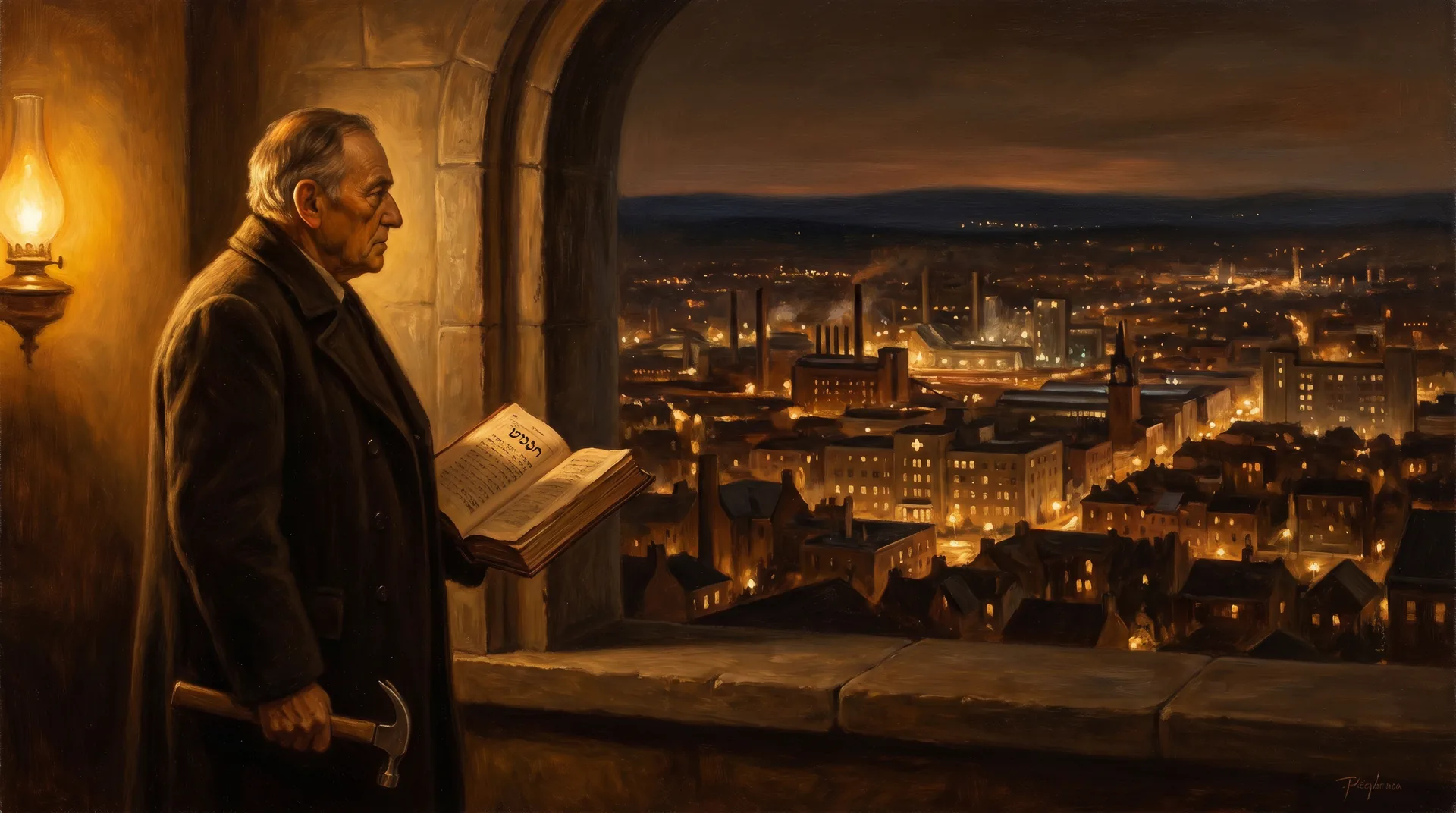
One hand holds the builder's rod. The other holds the open sefer. The hands belong to one person, performing one avodah.
The Jew getting dressed for work
An argument about work must eventually reach the ordinary morning. The alarm sounds. The person dresses. The train arrives, or the laptop opens, or the clinic lights come on. What changes?
First, work that contributes to the structural relief of human suffering is not merely a concession to parnasah. It can be high avodah. The Jew walking to the office may be walking toward one of the most religiously consequential things he can do with his hours. The sentence should not inflate his ego. It should burden his attention. If the work matters, then honesty, competence, and the effects on other people matter more, not less.
Kavanah gives the act a name. The same line of code, experiment, hiring decision, investment, patient encounter, lesson, or shipment is lived differently when the practitioner can say, even briefly: this hour strengthens a hand. This hour may prevent a widow. This hour lowers the distance between help and the person who needs it. Intention does not sanctify bad work and cannot replace evidence about results. It keeps good work answerable to its purpose.
The choice of work may therefore be among the largest moral and religious decisions a modern Jew makes. Work that heals, teaches, employs with dignity, builds trustworthy infrastructure, reduces danger, or lowers the cost of necessities carries a different weight from work that merely rearranges status among the comfortable or manufactures a hunger that did not previously exist. This is not a license to audit a neighbor's career from across the room. It is a question each person must ask at his own desk.
Halakhah is the daily ballast, and the more leverage a person holds, the more ballast he needs. Shabbat is the weekly oath that the project has an Owner. Tefillah is the daily oath that capacity is on loan. The laws of speech, business, labor, privacy, and the body are the hourly texture that keeps scale from coarsening the soul. A practitioner of Avodat HaTikkun is more obligated in these disciplines, not less.
Torah study is not displaced by the work. It is the navigation. Without sustained learning, the practitioner forgets the grammar. He forgets why the eighth rung is the eighth, why the widow and orphan recur, why Adam I needs Adam II, why Chizkiyahu both buried a book and accepted a remedy, why Be'er Sheva is not Bavel, why the hand must open on Shabbat. The work needs the Torah because power forgets quickly.
The village lever never retires. The meal to the mourner, the visit to the bedside, the call to the lonely, the patient presence beside a problem that cannot be scaled: these are the places where the heart learns what the institution is for. The person who runs the system and cannot sit with one sick person has betrayed the posture of the rachman. Rachmanut is practiced with persons, not dashboards.
Gratitude is the final discipline. Gratitude toward the generations of builders, believing and unbelieving, whose labor bent the curves before we arrived. Gratitude toward the people whose names never entered the history of the discovery because they manufactured the vial, maintained the road, cleaned the room, checked the shipment, translated the instruction, or carried the medicine through the last mile. And gratitude toward the One whose world made the work possible.
Avraham's gesture at the eshel is the gesture to practice: you ate from the God of the world. Say it over the cure, the harvest, the invoice paid, the bridge holding, the clean scan, the functioning sewer, the child who comes home from the hospital. The work is ours to do. The credit was never ours to keep.
The blessing before the knife
This argument entered my body on an ordinary afternoon. A doctor looked at a scan of my kidney and scheduled a surgery. A duct that should open had closed. The condition is as old as the species. The difference is the century.
In my great-grandfathers' world, what I have was a death sentence with a slow clock, one of the ten thousand unremarkable ways the old world made widows. In mine, it is an inconvenience with anesthesia. A surgeon I have met twice can put me to sleep and repair, with instruments that did not exist when my grandfather was born, the exact failure mode described in a blessing I have recited perhaps ten thousand times without once fully hearing it: asher yatzar et ha-adam b'chochmah, who formed the human being with wisdom and created within him openings and hollows; if one of them were to rupture or to seal, it would be impossible to stand before You for even an hour.
I know the fear from the inside now. I know that fear is not a failure of emunah. Vayira Yaakov me'od, and Yaakov had promises I do not. I know that the surgeon does not compete with God. The Gemara gave the physician permission to heal, and the Rambam described healing as the return of a lost object, the object being the body itself.
And I know what the second lever feels like from underneath.
It feels like being the orphan who was not.
Somewhere in the long ledger of the last two centuries, in the anonymous column where prevented griefs are never itemized, there is a line that would have read: a family, fatherless, mid-century, cause unremarkable. The line was never written. It was deleted in advance by generations of Adam I doing his commanded work: by anatomists, engineers of sterile steel, chemists of anesthesia, researchers, machinists, nurses, and unnamed thousands whose labor converges on one operating room in which one Jew will sleep, in the middle of a mercy, while strangers keep his ledger-line blank.
So I will go to the surgeon because lo ta'amod applies to one's own blood also. I will say the raw bakashah without embarrassment: refa'einu, in the plural, inside all the sick of Israel, because the tradition refuses to let a person be afraid alone. On the far side, please God, I will say Birkat HaGomel in public, as Berakhot prescribes, because rescue is information and the community is owed its disclosure.
Then I will get dressed on an ordinary Monday and return to the work: the building, the employing, the writing, the small unglamorous repair of a small corner of the world. I will return knowing with a knowledge that has passed through my own body that the lever is real, that the hands pulling it are capable of doing the oldest errand in the Torah, and that every Asher Yatzar I say for the rest of my life will be a citation of this essay, offered by its most grateful reader.
The mesorah's concern has not changed. The lever has. Halakhah is how the lever is wielded without destroying the wielder. And the person under the surgical drape, every man, every woman, every child whose stone will now be full-sized and late, is why the work is called what it is called.
Aleinu's phrase is not a slogan. It is a job description spoken before the King of kings. The lever exists. Halakhah binds it. Shabbat teaches the hand to open. On Monday, the work begins again.
הִנֵּנִי